
Ever wondered why your glassware looks cloudy even after a deep scrub, or why your stainless steel sink is plagued by stubborn white spots? The battle for a truly spotless kitchen often comes down to the chemistry of your tap. Hard water is packed with minerals like calcium and magnesium that leave behind unsightly "scale" deposits, forcing you to use more elbow grease and aggressive chemicals to maintain shine. Conversely, soft water rinsing eliminates these mineral intruders, allowing detergents to lather more effectively and surfaces to dry with a crystal-clear finish. Choosing soft water isn't just about aesthetics; it's a strategic move to reduce cleaning time, cut down on soap waste, and significantly extend the lifespan of your kitchen appliances.
| Feature | Hard Water Deposits | Soft Water Rinsing |
|---|---|---|
| Mineral Content | High (Calcium/Magnesium 120+ ppm) | Minimal (Sodium/Potassium <17 ppm) |
| Visual Results | Chalky white film and cloudy streaks | Streak-free, high-gloss brilliance |
| Detergent Power | Binds with soap; creates "scum" | 100% activation; rich lathering |
| Cleaning Effort | High; requires acidic descalers | Low; simple wipe-down required |
| Appliance Impact | Scale buildup reduces efficiency/life | Prevents clogs; optimizes performance |
| Chemical Usage | Requires 50% more soap/cleaners | Saves up to 50% on detergent costs |
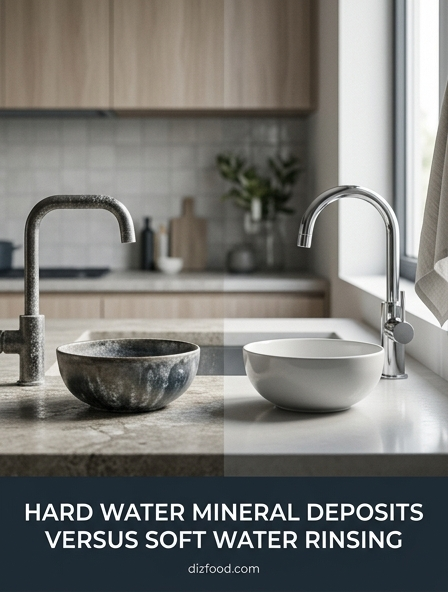
Hard Water Mineral Buildup Explained
Hard water mineral buildup, often referred to as lime scale, is a common occurrence in kitchens where the local water supply contains high concentrations of dissolved minerals, primarily calcium and magnesium. As water flows through the plumbing and exits through faucets or sprayers, it eventually evaporates on surfaces, leaving behind these solid mineral deposits. Over time, these microscopic particles bond together to form a hard, chalky white or grayish crust that is notoriously difficult to remove with standard liquid cleaners. This process is accelerated in areas of the kitchen that experience frequent wetting and drying cycles, such as the base of the sink, the dish rack, and the interior of the dishwasher.
In the kitchen environment, these minerals interact with other substances, creating complex residues. For instance, when calcium ions react with the fatty acids found in many dish soaps, they form an insoluble curd known as soap scum. This sticky substance acts as an adhesive, trapping food particles and bacteria against the surfaces of your cookware and fixtures. The resulting buildup is not merely an aesthetic issue; it can physically obstruct the flow of water and create a textured surface that harbors germs. Understanding this accumulation is the first step in managing the unique cleaning challenges that hard water presents to homeowners.
- Primary minerals: Calcium carbonate and magnesium sulfate.
- Visual indicators: White cloudy spots, chalky rings, and matte finishes on chrome.
- Common hotspots: Faucet aerators, kettle heating elements, and granite countertops.
- Interaction: Combines with soap to form insoluble precipitates.
Benefits of Soft Water Rinsing
Soft water rinsing offers a transformative experience for kitchen maintenance by eliminating the heavy metallic ions found in hard water. When water is softened, usually through an ion-exchange process, calcium and magnesium are replaced by sodium or potassium ions. These minerals are highly soluble and do not precipitate out of the water to form scale or spots. As a result, when you rinse your dishes or wipe down your countertops with soft water, the liquid evaporates cleanly without leaving behind the telltale white film that characterizes hard water usage. This leads to a significant reduction in the time and physical effort required to keep the kitchen looking pristine.
Beyond the visual appeal, soft water enhances the chemical efficiency of cleaning agents. Surfactants in dish detergents are designed to lather and break down grease; however, hard minerals typically interfere with this process. With soft water, you can achieve a superior level of cleanliness using up to fifty percent less soap or detergent. This not only saves money but also reduces the chemical load being flushed into the drainage system. Furthermore, the lack of abrasive mineral particles means that delicate surfaces, such as fine glassware and polished stone, are protected from the micro-scratching that can occur during heavy scrubbing sessions.
- Elimination of unsightly water spots on glassware and cutlery.
- Significant reduction in detergent and soap consumption.
- Prevention of scale buildup in high-heat appliances like espresso machines.
- Enhanced shine on stainless steel sinks and chrome fixtures.
- Faster drying times for hand-washed items due to reduced surface tension.
Comparing Mineral Deposits and Soft Water
The difference between the effects of hard water mineral deposits and soft water rinsing is most apparent when examining the longevity and cleanliness of kitchen surfaces. Hard water is essentially "heavy" with dissolved solids that are looking for a surface to latch onto. When this water is heated, as it often is in a kitchen, the minerals precipitate faster, creating a rock-hard layer of calcite. In contrast, soft water acts as a much more effective solvent. Because it lacks the saturating minerals of hard water, it has a higher capacity to dissolve and carry away soap and organic debris, leading to a truly clean surface rather than one covered in a thin layer of mineral film.
The following table outlines the key differences observed in a standard kitchen environment between these two water types. These distinctions affect everything from the clarity of your morning glass of water to the efficiency of your dishwasher's drying cycle.
| Feature | Hard Water Deposits | Soft Water Rinsing |
|---|---|---|
| Visual Result | Cloudy, spotted, and dull finishes. | Crystal clear and high-gloss shine. |
| Tactile Feel | Rough, "sticky," or chalky texture. | Smooth, slippery, and clean. |
| Soap Reaction | Creates sticky curd and low lather. | Rich lather and easy rinsing. |
| Long-term Effect | Clogs pipes and ruins appliances. | Extends life of plumbing and machines. |
Hard Water Scale and Residue Effects
The cumulative effects of hard water scale can be devastating to kitchen infrastructure. One of the most immediate impacts is seen in the reduction of water pressure. As calcium carbonate builds up inside the small holes of a faucet aerator or the spray arms of a dishwasher, the openings become constricted. This forces the pump to work harder and results in an uneven or weak flow of water, which ultimately compromises the appliance's ability to clean dishes effectively. In extreme cases, the internal piping of high-end refrigerators with built-in water dispensers can become so clogged that the entire unit requires professional servicing to restore functionality.
Moreover, hard water residue acts as an insulator on heating elements. In electric kettles, coffee makers, and dishwashers, the scale wraps around the heating coils. Because the mineral layer is not a good conductor of heat, the element must stay on longer and reach higher temperatures to heat the surrounding water. This leads to increased energy bills and premature mechanical failure. Additionally, the porous nature of lime scale makes it an ideal breeding ground for biofilm and bacteria. Once the scale takes hold, it can trap food particles and moisture, leading to unpleasant odors in the sink or dishwasher that are difficult to eradicate without aggressive chemical descaling agents.
- Increased energy consumption due to insulated heating elements.
- Frequent clogging of spray nozzles and faucet aerators.
- Shortened lifespan of expensive kitchen appliances.
- Unpleasant odors trapped within porous mineral layers.
- Etched glassware that appears permanently cloudy.
Soft Water Rinsing for Cleaner Surfaces
Soft water rinsing is the secret to achieving a "showroom" look in a modern kitchen. Many homeowners struggle with stainless steel appliances that look streaky even after a thorough cleaning. This is often because the water used to wipe the surface contains enough minerals to leave behind a residue once the moisture evaporates. Soft water, however, allows for a streak-free finish because it lacks the solids that cause spotting. When you use soft water to wipe down a granite countertop or a stainless steel fridge, the water evaporates into the air, leaving nothing behind on the material. This creates a deep, reflective shine that is impossible to achieve with hard water.
In addition to the aesthetic benefits, soft water rinsing ensures that surfaces are more hygienic. Because soft water does not form soap scum, there are fewer sticky residues for dust and bacteria to adhere to. When you rinse a cutting board or a dinner plate in soft water, the detergent is stripped away completely along with the grease and food waste. There is no microscopic "film" left behind that could potentially harbor pathogens. This makes the kitchen environment safer for food preparation. For those who take pride in their kitchen's appearance and cleanliness, the transition to soft water rinsing represents a significant upgrade in daily maintenance efficiency and overall sanitation standards.
The Science of Hard Water Deposits
The formation of hard water deposits is a chemical process rooted in the solubility of minerals under varying temperatures and pressures. Most hard water contains calcium bicarbonate, which is soluble in water. However, when this water is heated or exposed to the air, a chemical reaction occurs that converts the soluble bicarbonate into insoluble calcium carbonate. This is the "science" behind why your tea kettle develops scale so much faster than your cold-water pitcher. The heat acts as a catalyst, driving the carbon dioxide out of the water and forcing the minerals to crystallize into their solid, "calcite" form, which then bonds to the nearest surface through ionic attraction.
This process is further complicated by the pH levels of the water. Higher pH levels typically encourage the precipitation of these minerals, making the buildup more aggressive. At a molecular level, the calcium and magnesium ions have a strong positive charge, which allows them to easily bond with the negatively charged surfaces of ceramics, glass, and metals found in the kitchen. Once a single layer of crystals has formed, it provides a textured anchor point for more minerals to attach to, leading to an exponential growth of the deposit. This crystalline structure is incredibly dense, which is why physical scrubbing often fails to remove it, requiring instead an acidic solution to break the chemical bonds and return the minerals to a liquid state.
Why Soft Water Rinses More Effectively
The superior rinsing capability of soft water is a result of its low surface tension and high "solvent power." Because soft water is free of the heavy ions that saturate hard water, it has more "room" to pick up and carry away other substances. When water is softened, it becomes a more aggressive solvent for soaps and organic soils. In a kitchen setting, this means that when you rinse a soapy pan, the soft water molecules immediately surround the soap molecules, pulling them away from the surface of the pan and holding them in suspension until they are flushed down the drain. Hard water, conversely, is already "full" of minerals, making it less effective at absorbing the soap.
Furthermore, the absence of calcium and magnesium prevents the formation of "curd." In hard water, the minerals react with soap to create a waxy solid that is water-insoluble. This curd is what causes the "squeaky" feeling on skin or dishes, which is actually the sensation of friction against a layer of residue. Soft water allows the soap to remain in its liquid, slippery state, ensuring it is completely washed away. The result is a surface that is truly bare and clean. This effectiveness is particularly noticeable in dishwashers, where the lack of mineral interference allows the final rinse cycle to sheet off the dishes perfectly, facilitating faster air-drying and preventing the formation of water droplets that lead to spots.
- Higher solubility allows for better absorption of detergents.
- Lower surface tension promotes better "sheeting" action during drying.
- Prevents the chemical reaction that creates sticky soap scum.
- Ensures no microscopic particles remain after evaporation.
Removing Hard Water Mineral Stains
Removing established hard water stains requires a departure from standard alkaline soaps and a move toward acidic cleaners. Since mineral deposits like lime scale are alkaline in nature, they must be neutralized and dissolved by an acid. In the kitchen, the most effective and food-safe options are white vinegar (acetic acid) and lemon juice (citric acid). For light spotting on glassware, a simple soak in a solution of equal parts water and vinegar is often sufficient to break the mineral bonds. For more stubborn buildup on faucets or inside kettles, a more concentrated application or prolonged contact time is necessary to penetrate the dense crystalline layers of the scale.
When dealing with heavy accumulation around sink fixtures, a common technique involves soaking a cloth in vinegar and wrapping it tightly around the affected area, allowing it to sit for several hours. The acid slowly reacts with the calcium carbonate, turning it into a soluble salt that can then be wiped away with a sponge. For appliances like coffee makers or dishwashers, running a dedicated descaling cycle with a citric acid-based cleaner can clear out internal components that are otherwise inaccessible. It is important to avoid using highly abrasive pads during this process, as the mineral deposits can act like sandpaper, scratching the underlying finish before they are fully dissolved by the acid.
- Apply an acidic agent (vinegar or citric acid) to the mineral site.
- Allow sufficient dwell time for the chemical reaction to occur.
- Gently scrub with a non-abrasive brush to dislodge softened scale.
- Rinse the area thoroughly with fresh water to remove acidic residue.
- Dry the surface immediately to prevent new spots from forming.
Soft Water vs Hard Water Performance
The performance gap between soft and hard water in the kitchen is measurable in both time and resources. In a hard water environment, cleaning tasks are doubled; first, one must remove the organic grime, and second, one must battle the inorganic mineral film. This often leads to the use of harsher chemicals and more frequent deep-cleaning sessions. Conversely, soft water streamlines the process. Because it leaves no residue, the "cleaning" phase is finished the moment the rinse is complete. This efficiency extends to the mechanical performance of kitchen tools. For example, a dishwasher running on soft water will produce cleaner plates in a "light" cycle than a hard-water dishwasher can achieve on a "heavy" cycle with twice the detergent.
The following comparison highlights the operational efficiencies gained when transitioning from hard water to soft water systems. These factors contribute to a more sustainable and cost-effective kitchen management routine over the lifespan of a home.
| Metric | Hard Water Performance | Soft Water Performance |
|---|---|---|
| Detergent Use | High; required to overcome hardness. | Low; maximizes soap efficiency. |
| Cleaning Time | Extended; requires manual drying/buffing. | Minimal; surfaces air-dry cleanly. |
| Appliance Efficiency | Degrades over time as scale builds. | Maintains factory-standard efficiency. |
| Surface Integrity | Gradual etching and dulling. | Preserves original luster and finish. |
Protecting Surfaces from Mineral Accumulation
Protecting kitchen surfaces from mineral accumulation is a dual strategy involving water treatment and surface conditioning. The most comprehensive solution is the installation of a whole-house water softener, which addresses the problem at the source by removing the offending ions before they reach the tap. However, for those without such systems, protection can be achieved through regular maintenance and the use of protective barriers. For instance, applying a specialized stone sealer to granite or marble countertops can fill the microscopic pores of the stone, preventing mineral-laden water from soaking in and leaving permanent stains. Similarly, using a rinse aid in the dishwasher can help water sheet off glass more effectively, even if the water is relatively hard.
Proactive habits are also essential for protection. Wiping down the sink and fixtures with a dry microfiber cloth after each use prevents water from evaporating in place, which is the primary mechanism of scale formation. This "dry sink" method is highly effective at maintaining the shine of stainless steel and chrome. For small appliances like espresso machines, using filtered or distilled water can entirely bypass the issue of internal scaling. By combining these physical habits with chemical preventatives, homeowners can significantly slow the rate of mineral accumulation, ensuring that the kitchen remains a clean, functional, and aesthetically pleasing space without the constant need for aggressive descaling treatments.



Comments