
Achieving a showroom shine in your kitchen often comes down to selecting the right formula for the surface at hand, as using the wrong product can leave behind stubborn smudges or even damage delicate finishes. While glass cleaners are celebrated for their fast-evaporating, ammonia-based formulas that leave windows and mirrors crystal clear, they often lack the conditioning agents needed to protect metal. On the other hand, specialized stainless steel cleaners are engineered with oils or silicones that not only lift grime but also provide a protective barrier to repel fingerprints and mask minor abrasions. Choosing between them isn't just about cleaning-it's about deciding whether you need a residue-free finish for transparency or a deep, polished luster that preserves the longevity of your high-end appliances.
| Feature | Stainless Steel Cleaner | Glass Cleaner |
|---|---|---|
| Primary Base | Oil or Silicone-based | Water, Alcohol, or Ammonia |
| Best For | Refrigerators, Ovens, Sinks | Windows, Mirrors, Glass Hobs |
| Finish Type | Protective, lustrous coating | Zero-residue, transparent |
| Smudge Defense | High (Repels future prints) | Low (Removes but doesn't prevent) |
| Evaporation | Slow; requires buffing | Rapid; air-dries quickly |
| Effect on Metal | Conditions and hides scratches | Can cause streaking or "rainbowing" |
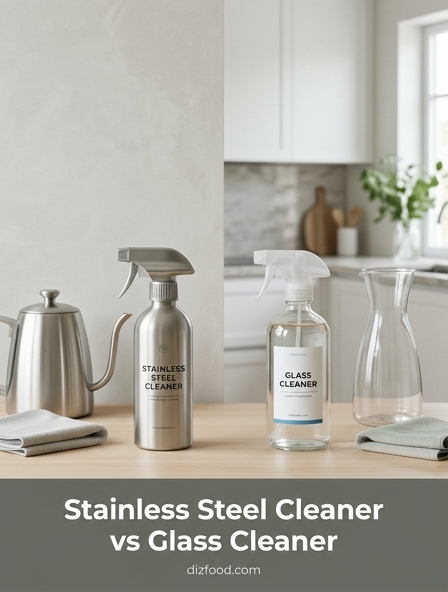
Core Differences Between Stainless Steel and Glass Cleaners
In the modern kitchen, maintaining the aesthetic appeal of appliances and surfaces requires an understanding of the distinct chemical roles played by different cleaning agents. Glass cleaners and stainless steel cleaners are formulated with diametrically opposed goals. A glass cleaner is primarily designed to be a "vanishing" agent. Its objective is to break down light grime and oils, then evaporate rapidly to leave behind a perfectly transparent finish. This is achieved through highly volatile solvents like isopropyl alcohol or ammonia, which ensure that no residue remains to distort the clarity of the glass.
Conversely, stainless steel cleaners are designed to leave something behind. Because metal is inherently porous at a microscopic level and prone to oxidation, these cleaners utilize protective oils or silicones to fill in those pores and create a sacrificial barrier. While a glass cleaner aims for total removal of substances, a stainless steel cleaner focuses on conditioning the metal. Understanding this fundamental difference is the first step in proper kitchen maintenance.
- Glass Cleaner Goal: Rapid evaporation and zero residue for transparency.
- Stainless Steel Cleaner Goal: Surface conditioning and protective barrier creation.
- Action on Grease: Glass cleaners dissolve and lift; stainless cleaners encapsulate and polish.
Using these products interchangeably often leads to frustration. A glass cleaner may sanitize a metal surface, but it leaves it "naked" and susceptible to immediate smudging. Meanwhile, applying a stainless steel cleaner to a window would result in a greasy, opaque mess that is difficult to remove. Each product serves a specific mechanical function tailored to the material's physical properties.
Why Glass Cleaner Leaves Streaks on Metal Surfaces
The phenomenon of streaking on stainless steel when using glass cleaner is a common grievance among homeowners. This occurs primarily due to the "drying time" and the lack of lubricating agents in glass cleaning formulas. When you spray an alcohol-based glass cleaner on a warm oven door or a refrigerator, the liquid begins to evaporate almost instantly. This rapid drying traps dissolved particulates and surfactants on the surface before they can be wiped away, resulting in visible white or blueish streaks.
- Surface Porosity: Stainless steel has a "grain" similar to wood. Glass cleaner cannot penetrate this grain effectively.
- Lack of Lubrication: Without the oils found in specialized cleaners, the cloth creates friction, dragging dirt across the metal rather than lifting it.
- Chemical Film: Many glass cleaners contain dyes and fragrances that, while invisible on glass, react with the metallic finish to create a hazy film.
Furthermore, because glass cleaners are aggressive degreasers, they strip away any existing protective oils that were previously applied to the metal. This leaves the stainless steel looking "dry" and uneven. Without the reflective uniformity provided by a polishing agent, the light hits the microscopic imperfections of the metal inconsistently, which the human eye perceives as unsightly streaks or shadows. To achieve a mirror-like finish on metal, one must provide a level of moisture that glass cleaners are simply not designed to offer.
Chemical Composition Comparison Ammonia vs Oil Bases
The chemical silhouettes of these two products reveal why they cannot be used for the same tasks. Glass cleaners often rely on ammonia, a powerful alkaline gas dissolved in water. Ammonia is excellent at cutting through the fatty acids found in fingerprints and kitchen grease, but it is a harsh desiccant. It works alongside glycol ethers to ensure that the liquid film breaks down and disappears into the atmosphere shortly after application. This makes it ideal for non-porous, inert surfaces like tempered glass.
| Feature | Glass Cleaner (Ammonia/Alcohol) | Stainless Steel Cleaner (Oil-Based) |
|---|---|---|
| Primary Ingredient | Ammonium Hydroxide or Isopropanol | Mineral Oil or Distillates |
| Evaporation Rate | Very High | Very Low |
| Residue Level | Near Zero | Functional Protective Layer |
| pH Level | Typically Alkaline (pH 10-11) | Neutral to Slightly Acidic |
In contrast, stainless steel cleaners are frequently oil-based, utilizing food-grade mineral oil or petroleum distillates. These ingredients do not evaporate. Instead, they bond to the chromium oxide layer of the steel. Some premium formulations also include "chelating agents," which help to lift metallic oxides (rust) and prevent further corrosion. While the ammonia in glass cleaners provides a "squeaky clean" feel, the oil base in metal cleaners provides the "slip" and luster necessary to keep stainless steel looking new and vibrant in a high-traffic kitchen environment.
Is Glass Cleaner Safe for Stainless Steel Appliances
A common question is whether glass cleaner is actually "safe" for stainless steel, or if it causes permanent damage. The short answer is that glass cleaner is generally safe for occasional use, but it is suboptimal for long-term maintenance. Most stainless steel appliances feature a brushed or polished finish that is protected by a thin layer of chromium oxide. Glass cleaners, especially those containing ammonia, are not corrosive enough to eat through this metal in a single application. However, they can be detrimental to the specialized coatings found on many modern "fingerprint-resistant" appliances.
Many contemporary refrigerators come with a thin polymer coating over the steel to help repel smudges. The harsh solvents and high pH levels found in traditional glass cleaners can gradually degrade this polymer, causing it to peel, yellow, or become cloudy over time. Once this factory coating is compromised, the appliance becomes much harder to clean and may lose its uniform appearance. Furthermore, because glass cleaner strips all oils, it leaves the metal vulnerable to "flash rusting" if it is exposed to high humidity or salt without a follow-up protective treatment.
If you must use glass cleaner to quickly sanitize a handle or a spill, it is vital to rinse the area with a damp cloth and buff it dry immediately. Using it as a primary daily cleaner will eventually lead to a dull, lifeless finish that lacks the characteristic depth of high-quality stainless steel. For those with luxury appliances, the cost of specialized cleaner is a small investment compared to the risk of altering the factory finish with aggressive glass cleaning chemicals.
The Role of Polishing Agents in Metal Maintenance
Polishing agents are the "secret sauce" in stainless steel maintenance, providing benefits that no glass cleaner can replicate. These agents serve two primary purposes: aesthetic enhancement and physical protection. On a microscopic level, even the smoothest-looking stainless steel is full of "peaks and valleys." Polishing agents, often consisting of fine silicones or waxes, fill these valleys. This creates a perfectly flat surface for light to reflect off of, which is what gives the metal its signature deep, lustrous glow.
- Micro-gap Filling: Smooths out scratches to prevent dirt buildup.
- Oxidation Barrier: Blocks oxygen from reaching the metal surface, preventing tea-staining and rust.
- Hydrophobic Properties: Causes water and liquid spills to bead up rather than soak in or streak.
Beyond looks, these agents act as a sacrificial layer. In a busy kitchen, appliances are constantly subjected to splatter from cooking oils, acids from citrus, and moisture from steam. A well-polished surface allows these contaminants to sit on top of the protective film rather than coming into direct contact with the metal. When you wipe the appliance down later, you are essentially cleaning the polish, not the steel itself. This preserves the integrity of the metal for decades, ensuring that the kitchen remains a showpiece of the home rather than a site of gradual degradation.
Eliminating Fingerprints Which Product Performs Better
Fingerprints are the primary enemy of kitchen aesthetics. Human skin secretes natural oils (sebum) that are highly visible on reflective surfaces. When comparing glass cleaner and stainless steel cleaner for fingerprint management, the performance difference is significant. Glass cleaner is excellent at removing the *current* fingerprint because its alcohol content dissolves the sebum instantly. However, because it leaves the surface "dry" and stripped, the very next touch will leave a fresh, highly visible mark. It offers zero preventative value.
| Performance Metric | Glass Cleaner Results | Stainless Steel Cleaner Results |
|---|---|---|
| Fingerprint Removal | Instant and thorough | Requires buffing to integrate oils |
| Future Resistance | Zero resistance; marks appear easily | High; oils repel further smudges |
| Ease of Spot Cleaning | High | Moderate (requires blending) |
Stainless steel cleaners, specifically the oil-based varieties, are much more effective at hiding and preventing fingerprints. By applying a thin, uniform layer of mineral oil, the surface already has a controlled "oil profile." When a finger touches the appliance, the natural oils from the skin blend into the existing film rather than standing out against a stripped surface. This makes the marks nearly invisible. For high-traffic households with children or pets, a dedicated stainless steel cleaner is the only way to avoid the constant cycle of wiping away every touch.
Surface Sensitivity and Preventing Long Term Damage
Maintaining the longevity of kitchen surfaces requires an appreciation for surface sensitivity. While glass is incredibly hard and chemically inert (making it resistant to most household cleaners), stainless steel is surprisingly delicate. It is a "living" surface in the sense that its protective oxide layer is constantly reacting with the environment. Using the wrong chemicals can lead to "pitting" or "clouding," which are forms of permanent damage that cannot be simply wiped away. Ammonia, found in many glass cleaners, can be particularly problematic if it seeps into the seams of appliances.
Long-term damage often manifests as a loss of the "blue-white" brilliance of the steel, replaced by a yellowish or greyish cast. This is usually the result of chemical buildup or the gradual etching of the surface by acidic or high-alkaline cleaners. To prevent this, it is essential to follow the "grain" of the metal during the cleaning process. Even with a dedicated metal cleaner, scrubbing against the grain can create micro-scratches that eventually dull the finish. Glass cleaners do not provide enough lubrication to safely glide over these surfaces without the risk of abrasion from trapped dust particles.
To ensure long-term health, one should always test a new cleaner on an inconspicuous area, such as the side of the fridge or the bottom of the dishwasher. If a product leaves the metal feeling tacky or looking noticeably different in color, it is likely reacting poorly with the specific alloy or coating of your appliance. Consistency with the right product is better than rotating through various "hacks" that may inadvertently shorten the lifespan of your kitchen's most expensive components.
Debunking the Universal Cleaner Myth for Modern Kitchens
The rise of "multi-surface" or "all-purpose" cleaners has led many to believe that a single bottle can handle everything from the window to the stovetop. While these products are convenient, they are often a compromise of chemistry that fails to excel at any one task. In a modern kitchen with high-end materials like quartz, tempered glass, and 304-grade stainless steel, the "universal" approach can actually increase your workload. A cleaner that is balanced enough to be safe on glass will almost always lack the conditioning agents needed for metal.
- The Dilution Problem: Universal cleaners are often diluted to ensure they don't damage sensitive surfaces, making them weak against heavy kitchen grease.
- The Residue Conflict: Glass needs no residue; metal needs a film. A single product cannot physically achieve both at the same time.
- Material Evolution: Modern stainless steel is often thinner and more specifically finished than vintage appliances, making it more sensitive to "average" chemical blends.
The myth of the universal cleaner persists because it appeals to our desire for simplicity. However, professional cleaners and kitchen designers suggest that specialized products actually save time in the long run. When you use a dedicated stainless steel cleaner, you only have to clean the surface once every week or two because the protective barrier repels dirt. Using a universal or glass cleaner often requires daily touch-ups because the surface is left unprotected. True efficiency in the kitchen comes from using the right tool for the specific material.
Water Based vs Solvent Based Cleaning Formulations
When selecting a stainless steel cleaner, you will often choose between water-based and solvent-based (oil-based) formulations. Glass cleaners are almost exclusively water-based, using water as the carrier for the cleaning agents. In the realm of metal care, water-based cleaners are usually emulsions-a mix of water and small amounts of oil. These are excellent for light cleaning and daily maintenance because they are less greasy and have a lower odor. They are the middle ground between a glass cleaner and a heavy-duty polish.
Solvent-based cleaners are the heavyweights of the industry. They do not contain water and are composed entirely of cleaning solvents and protective oils. These are the products that provide that "showroom shine." They are superior for removing heavy grease, adhesive residue, and deep-set smudges. However, they require more "elbow grease" to buff out, as applying too much can lead to a sticky residue that actually attracts dust. Solvent-based products are also more likely to contain VOCs (Volatile Organic Compounds), which can have a stronger chemical smell during use.
Choosing between them depends on your priorities. If you want a quick, streak-free wipe-down that leaves the metal looking "clean" but not necessarily "wet-look," a water-based emulsion is your best bet. If you are performing a deep seasonal clean and want the maximum possible protection and shine for your investment, a solvent-based polish is the gold standard. Glass cleaner, being water-based but lacking the emulsion oils, sits outside this spectrum as a purely subtractive cleaner that should be used sparingly on metal.
Choosing the Best Solution for Your Home Surfaces
The final decision on whether to reach for the blue glass cleaner or the specialized stainless steel polish should be based on the specific task at hand and the type of finish you are maintaining. For glass cooktops, windows, and decorative glass inserts in cabinet doors, a high-quality glass cleaner is indispensable. It ensures the clarity and sparkle that define a clean kitchen. For the vast expanses of metal on your refrigerator, oven, and dishwasher, a dedicated stainless steel product is a non-negotiable requirement for professional results.
- Daily Maintenance: Use a microfiber cloth with warm water or a mild water-based stainless steel spray.
- Heavy Grime: Reach for a solvent-based metal cleaner to dissolve baked-on grease.
- Quick Sanitization: Glass cleaner is acceptable for handles, but follow up with a protectant.
Ultimately, a "dual-product" strategy is the most effective way to care for a modern kitchen. Keep a bottle of glass cleaner for the transparent surfaces and a dedicated metal polish for the appliances. By respecting the chemical requirements of each material, you prevent the frustration of streaks, protect the longevity of your appliances, and ensure that your kitchen remains a clean, inviting space. Remember that the goal of cleaning is not just to remove dirt, but to preserve the beauty and function of the home's surfaces for years to come.




Comments