
Keeping your kitchen air fresh depends on a clear range hood filter, yet many homeowners struggle to choose between the simplicity of a hot water soak and the heavy-duty power of a specialized degreaser. While a boiling water bath is a cost-effective, chemical-free solution perfect for light weekly maintenance, it often falls short against the stubborn, polymerized "yellow gunk" that builds up over time. In contrast, dedicated degreasers use targeted surfactants to emulsify deep-seated oils in minutes, making them the superior choice for high-volume cooking or deep cleaning sessions. Understanding the balance between convenience and cleaning potency will help you extend the life of your ventilation system and maintain a fire-safe cooking environment.
| Feature | Hot Water Soak | Specialized Degreaser |
|---|---|---|
| Grease Cutting | Melts surface oils only | Chemically breaks molecular bonds |
| Time Required | 30-60 minutes + scrubbing | 5-15 minutes (fast-acting) |
| Cost Efficiency | Virtually free | $8-$20 per bottle |
| Material Safety | 100% safe for all metals | May tarnish aluminum if too acidic |
| Effort Level | High; requires manual agitation | Low; mostly "spray and rinse" |
| Best For | Daily/Weekly light upkeep | Deep cleans & heavy frying residue |
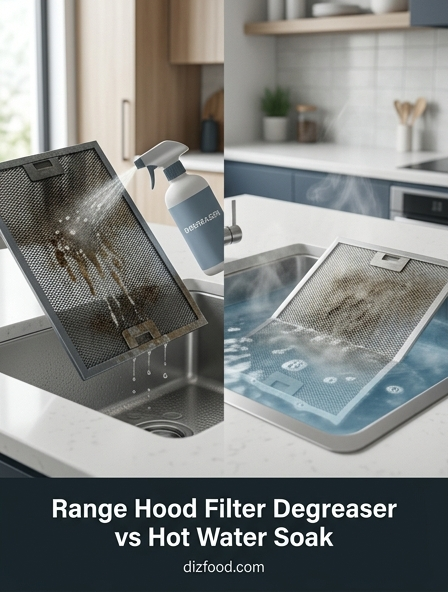
Degreaser vs Hot Water Soak Efficiency Comparison
Maintaining a clean kitchen environment requires a functional range hood, which relies entirely on the efficiency of its filters. When comparing a specialized chemical degreaser against a standard hot water soak, the difference in efficiency often comes down to the age and volume of the grease. Hot water works by using thermal energy to lower the viscosity of fats, making them easier to wipe away. However, water alone cannot emulsify the oils, often leaving a sticky residue behind that requires significant physical scrubbing.
On the other hand, chemical degreasers are engineered to break the molecular bonds of polymerized grease. This leads to a much higher efficiency rating in professional settings where filters are exposed to constant high-heat frying. While a hot water soak might suffice for a residential kitchen that sees light cooking once a day, it often fails to penetrate the multi-layered mesh found in high-end range hoods. The following table highlights the primary differences in efficiency markers between the two methods:
| Feature | Hot Water Soak | Chemical Degreaser |
|---|---|---|
| Emulsification Power | Low | High |
| Scrubbing Required | Significant | Minimal |
| Residue Removal | Partial | Complete |
| Time Investment | High (Long Soaks) | Low (Fast Action) |
Ultimately, efficiency is measured by the time spent versus the cleanliness achieved. For a deep clean that restores the airflow to the manufacturer's original specifications, the chemical approach typically outperforms the traditional thermal approach by a wide margin, especially in the removal of hardened, yellowed grease deposits.
Breaking Down Grease with Chemical Degreasers
The science behind chemical degreasers involves complex surfactants and alkaline builders that target the organic structure of kitchen oils. When grease is heated and cooled repeatedly on a range hood filter, it undergoes a process called polymerization, turning from a simple liquid oil into a tough, plastic-like varnish. Standard dish soap and hot water often slide right over this surface without penetrating the core of the buildup.
Degreasers function through a process of saponification and emulsification. The alkaline components in the cleaner react with the fatty acids in the grease to create a soap-like substance that is water-soluble. This allows the once-stubborn grime to be rinsed away effortlessly under a tap. The surfactants in these products further reduce the surface tension of the water, allowing the cleaning solution to seep into the tiny crevices of a stainless steel or aluminum mesh filter.
- Surfactants: These molecules have a hydrophilic head and a hydrophobic tail, physically lifting oil away from the metal surface.
- Alkaline Builders: These raise the pH level, which is essential for dissolving thick, carbonized grease layers.
- Solvents: Many professional degreasers contain solvents that specifically dissolve the resins found in vegetable oils and animal fats.
Using a degreaser ensures that the internal layers of the filter-the parts you cannot see or reach with a brush-are actually cleaned. Without this chemical intervention, the "clean" appearance of a filter may be deceptive, as the internal mesh remains clogged with old, rancid oils that can eventually become a fire hazard or cause the fan motor to burn out prematurely.
The Pros and Cons of Hot Water Soaking
Hot water soaking remains the most common method for cleaning range hood filters in residential households, primarily due to its accessibility and safety. The primary advantage is the lack of harsh chemicals, which eliminates concerns regarding skin irritation or the inhalation of toxic fumes. For those with aluminum filters, which can sometimes be sensitive to high-pH chemicals, hot water mixed with a mild, pH-neutral dish soap is often the safest route to prevent discoloration or corrosion of the metal.
However, the limitations of this method are significant when dealing with neglected filters. Hot water loses its effectiveness as soon as the temperature drops. If the water is not kept at a near-boiling point, the grease begins to solidify again, often redepositing itself onto the filter in a more concentrated form. This results in a cycle of repeated soaking and scrubbing that can take hours to complete.
- Pro: Cost-Effective. Aside from the cost of heating the water, this method is essentially free.
- Pro: Non-Toxic. No specialized disposal is required for the wastewater, and it is safe for all types of filter materials.
- Con: Ineffective on Old Grease. It cannot break down the "varnish" layer of aged grease.
- Con: Labor Intensive. Requires manual agitation and often multiple rounds of soaking to achieve a mediocre result.
While the hot water soak is an excellent maintenance tool for weekly cleaning, it is rarely sufficient for the monthly or quarterly deep cleans required to keep a kitchen safe and odor-free. It serves better as a supplementary step rather than a standalone solution for heavy-duty kitchen maintenance.
Which Method Best Removes Kitchen Filter Grease
When determining which method reigns supreme for the removal of kitchen filter grease, one must look at the specific state of the filter. If the filter is cleaned weekly, the hot water soak method might be "best" simply because it is less aggressive and more environmentally friendly. However, for the vast majority of users who clean their filters every few months, the chemical degreaser is the undisputed winner in terms of total soil removal and restoration of airflow.
The reason degreasers are more effective lies in their ability to handle the "triple threat" of kitchen buildup: sticky dust, hardened fats, and carbonized food particles. Hot water can soften the fats, but it does little to detach the dust and carbon that have become fused to the metal. A degreaser acts as a molecular wedge, prying these substances off the surface. This ensures that the fine holes in the mesh are completely cleared, allowing the range hood to pull steam and smoke out of the kitchen with maximum efficiency.
Furthermore, the best method must also account for the structural integrity of the filter. While degreasers are powerful, they must be used according to instructions to avoid "pitting" or darkening the metal. If the goal is a "like-new" finish with minimal physical effort, the degreaser wins. If the goal is a low-impact, chemical-free routine for a lightly used kitchen, the hot water soak is a viable alternative. Most professionals recommend a hybrid approach: using a degreaser for the heavy lifting and hot water for the final rinse and regular maintenance.
Degreaser Performance on Heavy Grease Buildup
Heavy grease buildup is a common sight in kitchens where frying and high-heat sautéing are frequent. In these scenarios, the grease doesn't just sit on the surface; it migrates deep into the aluminum or stainless steel baffles and solidifies. Standard cleaning methods usually fail here because the outer layer of grease acts as a waterproof shield, protecting the inner layers from heat. Professional-grade degreasers are formulated specifically to penetrate this barrier.
The performance of a high-quality degreaser on heavy buildup can be categorized into three stages: penetration, suspension, and removal. During the penetration stage, the chemicals seep through the pores of the hardened grease. In the suspension stage, the chemicals lift the grease away from the metal, holding it in a liquid state so it cannot re-attach. Finally, the removal stage allows the user to simply wash the filter under a stream of water, watching as the brown, sludge-like buildup melts away.
- Application: Spraying the degreaser directly onto the dry filter allows for maximum chemical concentration.
- Dwell Time: Allowing the product to sit for 5 to 10 minutes gives the surfactants time to break the polymer chains.
- Agitation: For extreme cases, a light brush can help the degreaser reach the innermost layers of the mesh.
- Rinsing: Using hot water to rinse after a degreaser treatment ensures any remaining chemical residue is flushed out.
This systematic breakdown is why degreasers are the standard in commercial kitchens. They eliminate the need for harsh abrasive tools like steel wool, which can scratch and damage the delicate fins or mesh of the range hood filters, thereby extending the lifespan of the hardware itself.
Is Hot Water Enough for Mesh Filter Cleaning
The question of whether hot water is "enough" depends entirely on the definition of clean. If the goal is to remove the surface oils that are still in a liquid or semi-liquid state, then yes, boiling water can be effective. However, range hood filters are designed with multiple layers of fine mesh to catch microscopic grease droplets. These droplets cool down and solidify inside the layers where hot water often cannot reach with enough pressure or heat to make a difference.
Over time, using only hot water leads to a "creeping clog." While the outside of the filter looks clean, the inner layers become progressively more restricted. This restriction increases the load on the range hood motor, making it louder and less effective at removing smoke. In some cases, the internal buildup can become so dense that it starts to drip back down onto the cooking surface, creating a hygiene and safety risk. Therefore, while hot water is a great starting point, it is rarely "enough" for a truly comprehensive clean.
For those who prefer a natural approach but find hot water insufficient, adding baking soda to the boiling water can create a mild alkaline solution that assists in the breakdown of fats. This is a middle-ground solution that is more effective than plain water but still lacks the rapid-acting power of a commercial degreaser. Ultimately, most homeowners find that after a year of only using hot water, they eventually need to resort to a chemical cleaner to restore the filter's performance.
Chemical Degreaser vs Natural Hot Water Methods
The debate between chemical degreasers and natural hot water methods often centers on the trade-off between power and environmental impact. Chemical degreasers are the "heavy hitters" of the cleaning world, but they come with warnings about ventilation, skin protection, and potential damage to certain finishes. Many contain butyls or hydroxides that can be harsh if not handled correctly. However, their ability to dissolve grease in minutes is unmatched by any natural alternative.
Natural methods, such as a boiling water bath with vinegar or baking soda, are much gentler. They are ideal for households with small children, pets, or individuals with chemical sensitivities. These methods rely on thermal energy and mild pH changes to move grease. While they are significantly slower and require more manual effort, they provide peace of mind regarding the safety of the household environment and the disposal of the cleaning liquid down the drain.
- Chemical Pros: Instant results, no scrubbing, handles the toughest "baked-on" grease.
- Chemical Cons: Fumes, requires gloves, potential for metal corrosion if left too long.
- Natural Pros: Safe, eco-friendly, zero cost, no risk of damaging filter metal.
- Natural Cons: Requires a large pot for boiling, time-consuming, ineffective on heavy buildup.
Choosing between these two depends on your cleaning philosophy. If you are a "set it and forget it" cleaner, the chemical route is the only way to achieve results. If you prefer a more holistic, hands-on approach and clean frequently enough that grease never truly hardens, the natural hot water method is perfectly adequate for maintaining a hygienic kitchen.
Time Saving Benefits of Professional Degreasers
Time is perhaps the most significant factor in the argument for professional degreasers. A standard hot water soak can take anywhere from 30 minutes to two hours, often requiring the user to refresh the water several times to maintain the necessary temperature. Even after this long period, the user must still spend time scrubbing the mesh with a brush to dislodge the softened but still-attached grease particles. For a busy household, this is often an unattractive chore that gets postponed indefinitely.
Professional degreasers transform this ordeal into a five-minute task. Most modern degreasers are "spray-on, rinse-off" formulas. You simply spray the filter, wait for the chemical reaction to take place, and rinse. The chemical does the work that your muscles would otherwise have to do. This dramatic reduction in labor time makes it much more likely that the filters will be cleaned on a regular schedule, which in turn prevents the buildup from ever reaching a critical level.
Furthermore, because degreasers are so effective at dissolving grease on contact, they eliminate the need for the "double-soak." In many hot water scenarios, the first soak only removes the top layer, requiring a second round of boiling water for the bottom layers. A professional degreaser penetrates all layers simultaneously. When you calculate the time spent boiling water, monitor the soak, and perform the manual scrubbing, a chemical cleaner can save over 90 minutes per cleaning session, making it a valuable tool for time-management in kitchen maintenance.
Cost Analysis of Water Soaking vs Degreaser Products
When evaluating the cost of cleaning range hood filters, it is easy to assume that the hot water soak is the cheaper option because it does not require a "product" purchase. However, a deeper analysis reveals a more complex picture. A bottle of high-quality kitchen degreaser typically costs between $10 and $20 and can last for several dozen cleanings. The cost per use is often less than one dollar. When compared to the utility costs and the value of the user's time, the "free" method might actually be more expensive.
Heating several gallons of water to a boil requires significant energy, whether using gas or electricity. Furthermore, the potential damage to the range hood itself must be considered. A filter that is not cleaned effectively forces the fan motor to work harder, consuming more electricity and shortening the lifespan of an expensive kitchen appliance. Replacing a burnt-out range hood motor can cost hundreds of dollars, a cost that can be entirely avoided with a five-dollar bottle of degreaser.
| Factor | Water Soak Cost | Degreaser Cost |
|---|---|---|
| Product Price | $0.00 | $0.50 - $1.00 per use |
| Energy/Utilities | Moderate (Boiling) | Low (Warm Rinse) |
| Labor (Time Value) | High ($20+ in time) | Negligible |
| Equipment Longevity | Risk of motor strain | Protects motor efficiency |
In summary, while the out-of-pocket cost of a degreaser is higher, the long-term savings in energy, appliance maintenance, and personal time make it the more economically sound choice for most homeowners.
Choosing the Right Cleaning Method for Your Range Hood
Deciding between a degreaser and a hot water soak ultimately depends on your filter type, the frequency of your cleaning, and your tolerance for chemicals. If you own a high-end range hood with stainless steel baffle filters, these are built to withstand professional-strength degreasers and should be cleaned as such to maintain their sleek appearance and high airflow. Conversely, if you have an older aluminum mesh filter that is prone to tarnishing, you should start with the gentlest method possible before moving to stronger solutions.
A good rule of thumb is to assess the "tackiness" of the filter. If the grease feels like wet oil, hot water and dish soap will likely suffice. If the grease feels like tape or hard plastic, you need a degreaser. To help you choose the right path, consider the following checklist for your next kitchen maintenance day:
- Check the Material: Aluminum is sensitive to high pH; Stainless steel is virtually indestructible.
- Evaluate the Buildup: Clear mesh requires maintenance (water); opaque or blocked mesh requires a deep clean (degreaser).
- Consider Ventilation: If you cannot open a window, stick to natural methods or low-odor degreasers.
- Time Availability: If you have 5 minutes, use a degreaser; if you have 2 hours, a hot soak is fine.
Regardless of the method you choose, consistency is the most important factor. A range hood that is cleaned regularly will operate more quietly, remove odors more effectively, and significantly reduce the risk of a kitchen fire. By matching the cleaning method to your specific cooking habits, you ensure a cleaner, safer, and more pleasant cooking environment for years to come.


Comments