
Industrial Nylon Durability and Resilience
Industrial nylon stands as the gold standard for brush filaments in commercial kitchen environments due to its exceptional toughness and resilience. Unlike natural fibers or lower-grade plastics, industrial nylon is engineered to withstand the rigorous demands of daily sanitation routines without fraying or snapping. Its molecular structure allows it to absorb high-impact energy, ensuring that cleaning tools remain functional even after thousands of cycles against abrasive surfaces like cast iron or industrial grills. This durability is essential for maintaining a consistent cleaning standard in high-volume settings where equipment is subjected to constant physical stress. Furthermore, the resilience of nylon ensures that the tools do not shed bristles, a critical factor in preventing physical contamination in food preparation areas. Operators rely on this material to bridge the gap between heavy-duty performance and long-term reliability.
- High tensile strength preventing bristle breakage
- Exceptional fatigue resistance under constant load
- Reduced risk of filament shedding in food zones
- Maintains structural integrity across varying humidity levels
Optimal Bristle Stiffness for Grease Removal
The removal of polymerized oils and carbonized grease requires a specific level of mechanical agitation that industrial nylon provides through its inherent stiffness. In a kitchen setting, grease acts as a powerful adhesive, trapping food particles and pathogens against surfaces. Nylon filaments are manufactured with precise diameters to achieve the exact flexural modulus needed to break the surface tension of thick grease layers. This optimal stiffness ensures that the brush penetrates the lipid barrier rather than merely sliding over it. Because the material does not soften significantly when exposed to hot water, it maintains its "scrubbing power" throughout the entire cleaning process. This characteristic is particularly beneficial for cleaning hoods, filters, and backsplashes where grease accumulation is most dense. By providing a consistent level of resistance, industrial nylon allows staff to clean more efficiently with less physical exertion, optimizing labor costs and improving overall kitchen hygiene standards.
High Shape Retention and Elastic Memory
One of the most technically impressive features of industrial nylon is its elastic memory, which allows bristles to return to their original vertical orientation after being compressed. In the context of kitchen cleaning, tools are often pushed into tight corners or used with significant downward force. Lower-quality materials often suffer from "bristle set," where the fibers remain bent and lose their effectiveness. Industrial nylon resists this deformation, ensuring that the tool provides the same surface contact area every time it is used. This shape retention is vital for tools like glass washers and dish brushes that undergo repetitive circular motions. When bristles remain upright, they can effectively channel water and detergents to the cleaning surface, whereas flattened bristles simply trap debris. This mechanical consistency translates to predictable results in every shift.
- Initial Compression: Bristles flex to accommodate surface contours.
- Stress Distribution: Internal molecular chains distribute the load.
- Elastic Recovery: Material returns to original alignment once pressure is released.
- Long-term Alignment: Consistency is maintained over thousands of uses.
Superior Chemical Resistance for Sanitizing
Commercial kitchens utilize a wide array of aggressive chemicals, from alkaline degreasers to acidic descalers and chlorine-based sanitizers. Industrial nylon is specifically formulated to resist the corrosive effects of these substances, preventing the material from becoming brittle or dissolving. This chemical stability is crucial for ensuring that the cleaning tool itself does not become a source of contamination. While other plastics might swell or lose their tensile strength when soaked in sanitizing solutions, nylon maintains its physical properties. This makes it an ideal material for brushes that must be submerged in "quat" or bleach buckets between uses. The following table illustrates the compatibility of industrial nylon with common kitchen agents:
| Chemical Agent | Resistance Level | Effect on Nylon |
|---|---|---|
| Sodium Hypochlorite (Bleach) | High | Minimal degradation |
| Alkaline Degreasers | Excellent | No structural change |
| Phosphoric Acid | Moderate | Stable for short exposure |
| Citric Acid (Descalers) | High | Excellent compatibility |
Thermal Stability in Commercial Kitchen Environments
The thermal stability of industrial nylon is a critical attribute for tools used near active cooking lines. Kitchen surfaces often remain at elevated temperatures during the cleaning process to facilitate the removal of baked-on carbon. Nylon can typically withstand continuous operating temperatures up to 250 degrees Fahrenheit, and even higher for short bursts. This heat resistance prevents the bristles from melting or fusing together when scrubbing hot sauté pans, griddles, or oven interiors. Unlike polyester or polypropylene, which may deform at lower heat thresholds, nylon retains its mechanical stiffness even as the temperature climbs. This allows for "hot-cleaning" protocols, which are more effective at breaking down organic residues. By maintaining its physical properties at high temperatures, industrial nylon ensures that the cleaning process does not have to be delayed for equipment to cool down completely, thereby increasing the speed of turnover in busy commercial environments.
Mechanical Efficiency on Textured Surfaces
Industrial nylon is uniquely suited for cleaning the complex, textured surfaces found in modern kitchens, such as non-slip safety flooring and diamond-plate stainless steel. These surfaces feature microscopic peaks and valleys designed to provide traction or aesthetic value, but they also serve as reservoirs for bacteria and soil. The high recovery rate and tip-end stiffness of nylon allow the filaments to reach into these low-relief areas and flick out debris. This mechanical "flicking" action is much more effective than the wiping action provided by sponges or cloths. Because the filaments are individual units, they can act independently to contour to uneven surfaces, ensuring that no spots are missed. This makes nylon the preferred material for deck brushes and handheld detail brushes used on equipment housings.
- Penetrates non-slip floor textures to remove trapped soils.
- Effectively scrubs embossed metal surfaces on refrigeration units.
- Cleans non-slip handles and grip surfaces on kitchen machinery.
- Ideal for cleaning expanded metal grates and cooling racks.
Non Porous Fibers for Improved Hygiene
The hygienic profile of industrial nylon is bolstered by its non-porous nature, which significantly reduces its capacity to harbor moisture and microorganisms. In a kitchen, a porous tool is a liability, as it can become a breeding ground for mold, mildew, and foodborne pathogens like Salmonella or Listeria. Industrial nylon filaments are extruded with a smooth surface finish that prevents liquid absorption into the core of the fiber. This lack of porosity means that the brushes dry quickly after use, creating an inhospitable environment for bacterial growth. Furthermore, the smooth surface of each filament allows for easier rinsing; food particles and oils are washed away more readily than they would be from a natural fiber brush. This ensures that the tool is truly clean before its next use. Investing in non-porous nylon tools is a proactive step in a Hazard Analysis and Critical Control Points (HACCP) plan, as it minimizes the risk of cross-contamination during the cleaning cycle.
Deep Penetration into Grout and Crevices
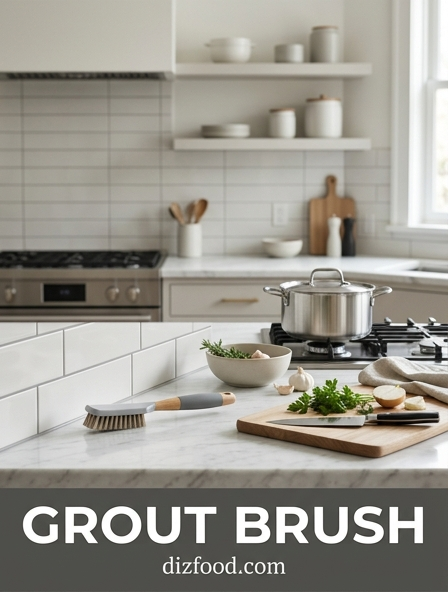
Kitchen environments are characterized by countless seams, grout lines, and tight crevices where organic matter tends to accumulate. Industrial nylon brushes are engineered with a specific "taper" and "trim" that allow them to penetrate these difficult-to-reach areas. The high modulus of elasticity ensures that even when the bristles are pushed into a narrow gap, they maintain enough force to dislodge compacted debris. This is particularly important for floor grout, which can quickly become a source of odors and pest attraction if not properly agitated. The thin profile of individual nylon filaments allows them to enter spaces that thicker, less flexible materials cannot reach.
- Bristles align with the narrow channel of the grout line.
- Mechanical energy is concentrated at the filament tips.
- Agitation breaks the bond between the soil and the porous grout.
- Debris is lifted to the surface for extraction and rinsing.
Balanced Abrasion for Surface Protection
One of the primary challenges in kitchen maintenance is removing stubborn soils without damaging the underlying substrate. Industrial nylon offers a "balanced abrasion" that is aggressive enough to remove carbon and grease but soft enough to avoid scratching most stainless steel and food-grade plastic surfaces. This is a critical distinction from wire or metal brushes, which can create microscopic scratches that harbor bacteria and eventually lead to corrosion. Nylon's ability to clean without marring preserves the "passive layer" of stainless steel, ensuring the equipment remains rust-resistant. This makes it suitable for a wide range of surfaces as shown below:
| Surface Material | Cleaning Action | Potential for Damage |
|---|---|---|
| 304 Stainless Steel | Excellent Scouring | Negligible |
| Polyethylene Boards | Deep Cleaning | None |
| Anodized Aluminum | Gentle Agitation | Low |
| Ceramic Tile | Aggressive Scrubbing | None |
Extended Lifespan for Heavy Duty Cleaning
The total cost of ownership for kitchen cleaning supplies is heavily dependent on the lifespan of the tools. Industrial nylon brushes consistently outperform alternative materials in longevity tests, often lasting three to five times longer than polypropylene or natural fiber equivalents. This longevity is rooted in the material's resistance to "flagging" or splitting at the ends. When bristles split, they lose their ability to agitate effectively and start to trap dirt within the brush itself. Because industrial nylon remains intact for much longer, the brush maintains its peak performance levels throughout its life cycle. For commercial operations, this means fewer replacements, less waste in the landfill, and a more predictable budget for sanitation supplies. While the initial investment in nylon may be higher, the extended service life provides a much better return on investment. Professionals choose nylon because it ensures that the "heavy duty" in their cleaning routine doesn't result in a "short life" for their equipment.

Comments