
Choosing between a dish drying rack and an absorbent drying mat often comes down to a balancing act between heavy-duty utility and kitchen aesthetics. If you're regularly tackling stacks of family-sized pots and pans, the vertical structure of a traditional rack is a lifesaver for maximizing airflow and organization. However, for those living in compact apartments or prioritizing a minimalist countertop, a sleek, microfiber, or silicone mat provides a discreet solution that can be tucked away the moment the dishes are dry. Both tools aim to keep your surfaces moisture-free, but your final decision should hinge on your daily dish volume, available counter "real estate," and how much you value a clutter-free visual landscape.
| Feature | Dish Drying Rack | Absorbent Drying Mat |
|---|---|---|
| Drying Capacity | High; supports vertical stacking of plates/bowls. | Low; items must be spread out in a single layer. |
| Airflow Efficiency | Excellent 360° ventilation; prevents "musty" smells. | Moderate; trapped moisture under rims requires flipping. |
| Space Requirement | Bulky; occupies a permanent counter footprint. | Minimal; foldable and easy to store in drawers. |
| Maintenance | Requires occasional scrubbing of hard water spots. | Machine washable; quick-dry fabric or silicone. |
| Fragile Items | Higher risk of chips if items are overcrowded. | Soft surface; ideal for delicate stemware and glass. |
| Best Used For | Large families and heavy daily cookware loads. | Small households, hand-wash only items, or "dry-and-hide." |
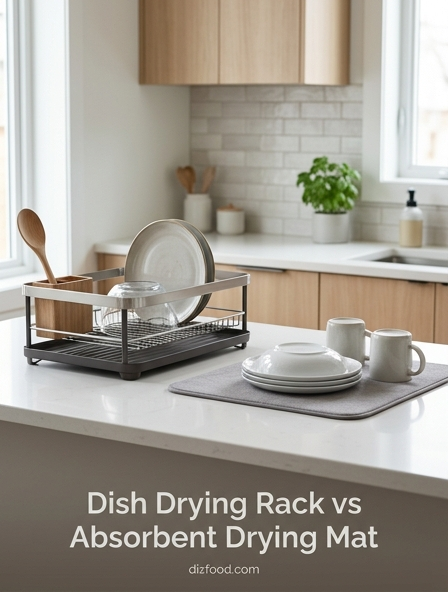
Dish Drying Rack vs Absorbent Drying Mat Comparison
Choosing between a traditional dish drying rack and a modern absorbent drying mat is a decision that impacts the daily workflow of any home cook. At their core, these two tools serve the same primary purpose-providing a designated space for wet dishes to dry-but they achieve this goal through vastly different mechanisms. A dish drying rack is a structured, often multi-tiered framework made from metal, plastic, or bamboo. It relies on verticality to maximize space and uses slots or tines to hold plates upright. Conversely, an absorbent drying mat is a flat, soft surface, typically constructed from microfiber, silicone, or stone, designed to soak up moisture while dishes rest directly on top of it.
| Feature | Dish Drying Rack | Absorbent Drying Mat |
|---|---|---|
| Space Usage | Vertical and fixed | Horizontal and flexible |
| Drying Method | Gravity and 360-degree air | Absorption and surface evaporation |
| Visual Profile | High; can look cluttered | Low; minimalist aesthetic |
The primary conflict between these two options lies in the trade-off between capacity and visual clutter. A rack can hold a significant volume of dishes, including heavy pots and pans, by utilizing the air space above the counter. However, it remains a permanent fixture that can dominate the kitchen's visual landscape. A drying mat offers a low-profile alternative that blends into the countertop, making the kitchen look cleaner when not in use. While the mat is excellent for a handful of items or delicate stemware, it lacks the structural integrity to support the heavy loads that a sturdy rack can handle with ease.
Best Kitchen Drying Solution for Small Spaces
In compact kitchens where every square inch of counter space is a premium commodity, the choice of drying equipment becomes critical. Small apartment dwellers often struggle with the "permanent footprint" of a dish rack. Traditional racks, even those labeled as "compact," tend to occupy a fixed location near the sink. However, recent innovations have introduced over-the-sink racks, which utilize the vertical air space above the basin, leaving the surrounding counters entirely clear for food preparation. This vertical orientation is a game-changer for studio apartments or tiny homes where counter surface is non-existent.
- Collapsible Racks: These can be folded flat and tucked into a cabinet when guests arrive or when the dishes are dry.
- Rolling Slat Racks: Silicone-coated steel rods that unroll over the sink and can be stored in a drawer like a scroll.
- Microfiber Mats: The ultimate space-saver that can be folded, hung by a loop, or stowed in a narrow gap between the fridge and the wall.
Despite the spatial efficiency of racks, the absorbent drying mat often wins the small-space battle for those who prioritize a "clear-counter" look. Because a mat can be whisked away in seconds, it allows a small kitchen to transition from a cleaning zone to a serving zone instantly. For those who cook for one or two people, a small 12x18 inch mat provides sufficient real estate for a few plates and glasses without the bulky architectural presence of a wire frame. The best solution for a small space ultimately depends on whether you prefer the utility of a permanent rack or the flexibility of a disappearing mat.
Airflow Efficiency and Drying Speed Differences
The speed at which your dishes dry is directly proportional to the amount of airflow reaching the surfaces of the items. This is where the dish drying rack holds a significant scientific advantage. Because the rack suspends plates, bowls, and cutlery in the air, oxygen can circulate 360 degrees around each object. This "all-around" exposure facilitates rapid evaporation and prevents water from pooling inside cups or under the rims of plates. Gravity pulls the water downward into a drainage tray or back into the sink, ensuring that the item is not sitting in its own runoff.
In contrast, absorbent drying mats rely on contact-based moisture removal. When a glass is placed upside down on a microfiber mat, the rim is in direct contact with the fabric. This creates a seal that traps humid air inside the glass, often resulting in "fogging" or condensation that takes hours to clear. To mitigate this, many users must prop items up at an angle, which can be unstable. Silicone mats with raised ridges attempt to solve this by elevating the dishes slightly, allowing some air to flow underneath, but they still cannot compete with the open-air design of a wire rack.
For items like deep pots or narrow-necked bottles, the difference in drying speed is even more pronounced. A rack allows these items to be tilted or inverted with plenty of space for steam and moisture to escape. On a mat, these items often remain damp overnight. If you frequently wash large batches of dishes and need them bone-dry in a short window of time, the high-airflow environment of a rack is the superior engineering choice.
Hygiene and Cleaning Maintenance for Each Method
Maintaining a hygienic drying environment is essential to prevent the spread of bacteria in the kitchen. Both racks and mats have unique maintenance requirements and potential pitfalls. Dish drying racks, particularly those made of plastic or coated wire, are prone to accumulating "biofilm" or slime in the drainage tray. Hard water deposits, or limescale, can also build up on the metal tines, making the rack look dingy and white over time. Cleaning a rack can be a tedious chore, requiring a small brush to reach into corners and scrub between narrow wires.
- Rack Cleaning: Requires manual scrubbing or a cycle in the dishwasher if the unit is detachable and heat-safe.
- Mat Cleaning: Microfiber mats are typically machine-washable and can be thrown in with the laundry, though they may take time to dry.
- Silicone Maintenance: These can be wiped down or placed in the top rack of the dishwasher for high-heat sanitization.
Drying mats face a different hygiene challenge: trapped moisture. Because they absorb water, they can remain damp for hours after the dishes are put away. If not dried properly between uses, microfiber mats can develop a musty odor or become a breeding ground for mold and mildew. This is especially true if the mat is left on a non-porous countertop like granite or quartz, where moisture can become trapped between the mat and the stone. To maintain hygiene, mats must be laundered frequently-at least once a week-whereas a rack might only require a deep clean once a month, provided the drainage is working correctly.
Durability and Long Term Value Analysis
When analyzing the long-term value of kitchen accessories, one must weigh the initial purchase price against the expected lifespan of the product. A high-quality stainless steel dish drying rack is often a one-time purchase. Grade 304 stainless steel is resistant to rust and corrosion, meaning a well-built rack can easily last a decade or more. While the upfront cost of a premium rack can be significantly higher than a mat-sometimes ranging from $50 to over $100-the cost per use over ten years is negligible. Bamboo racks are also durable but may require more care to prevent cracking or mold in very humid environments.
Absorbent drying mats are generally much more affordable, with prices typically falling between $10 and $25. However, they are essentially "consumable" goods. Microfiber is a synthetic textile that eventually breaks down with repeated washing. Over time, the fibers can lose their absorbency, become stained, or develop permanent odors that cannot be washed out. Silicone mats fare better in terms of durability as they do not fray or stain easily, but they can still tear or develop permanent water spots that affect their appearance. On average, a fabric drying mat might need replacement every one to two years to maintain peak performance and hygiene.
From a sustainability perspective, the long-lasting nature of a metal rack often outweighs the low cost of a mat. A single stainless steel rack prevents the waste associated with disposing of several worn-out fabric mats over a decade. However, for those on a strict budget or in temporary living situations like dorms, the low entry price and portability of the mat offer immediate value that a bulky, expensive rack cannot match.
Aesthetics and Kitchen Countertop Organization
The visual impact of a dish drying solution is often the deciding factor for many homeowners. Modern kitchen design frequently leans toward minimalism, emphasizing clean lines and uncluttered surfaces. In this context, the dish drying rack is often seen as an "eyesore." No matter how sleek the design, a rack filled with a chaotic assortment of plates and bowls creates visual noise. For those who have invested in beautiful stone countertops or custom cabinetry, a large metal structure can feel like an intrusion into the room's aesthetic harmony.
Absorbent mats are the darling of the minimalist movement. They come in a wide variety of colors-from charcoal grey and navy to neutral beige-allowing them to blend seamlessly with the countertop material. When the dishes are put away, the mat can be stored, leaving the kitchen looking pristine and "staged." This flexibility is particularly valuable for open-concept homes where the kitchen sink is visible from the living or dining area. A mat ensures that the utilitarian aspects of the kitchen can be hidden from guests.
However, organization is a different story. A rack provides a dedicated place for everything: a cup for silverware, hooks for mugs, and slots for plates. This structure keeps the "work-in-progress" area organized. On a mat, dishes are often piled in a precarious heap, which can look just as cluttered as a rack while being less functional. For those who value the "everything in its place" philosophy, the architectural organization of a rack provides a sense of order that a flat mat simply cannot replicate.
Handling Heavy Cookware vs Delicate Glassware
The "cargo" you wash most frequently should dictate your choice of drying surface. If your cooking style involves heavy cast iron skillets, large stockpots, and Dutch ovens, a drying mat is often inadequate. These heavy items can compress the fibers of a mat, leading to puddling, and they take up so much surface area that there is no room left for anything else. Furthermore, heavy cookware requires significant airflow to dry thoroughly and prevent rust on seasoning. A heavy-duty rack with thick wire gauges can support the weight of a 10-pound skillet without buckling, allowing it to dry safely in a vertical or slanted position.
On the other end of the spectrum is delicate glassware, such as wine glasses, champagne flutes, or crystal. Placing these items in a wire rack can be nerve-wracking; one slip can lead to a chipped rim or a shattered stem against the hard metal. For these items, an absorbent drying mat is the superior choice. The soft, cushioned surface of microfiber provides a gentle landing spot. If a glass tips over on a mat, it is far less likely to break than if it tips over on a hard plastic or metal rack.
Many professional chefs and home enthusiasts use a hybrid approach. They keep a sturdy rack for the "heavy lifting" of pots and plates but lay out a small mat specifically for their high-end glassware and knives. This ensures that the structural needs of heavy cookware are met while the fragility of delicate items is respected. If you must choose only one, consider the "worst-case scenario" of your typical dish load to see which tool provides the most safety and stability.
Storage Convenience and Portability Features
The ability to reclaim your kitchen space is a major selling point for portable drying solutions. Absorbent mats are the gold standard for portability. They are lightweight, flexible, and can be moved with a single hand. This makes them ideal for multi-use spaces. For example, if you need extra room for rolling out dough or preparing a large meal, you can simply slide the mat (even if it has a few dry items on it) to another part of the house or stack it in a drawer. They are also the perfect companion for camping trips or RV living, where space is extremely limited and items must be packed away securely for travel.
Dish drying racks have historically been the opposite of portable. However, the market has adapted with "collapsible" designs. Some modern racks use accordion-style folding mechanisms or removable components that allow them to shrink down to a few inches in height. While this improves their storage potential, they still require more cabinet real estate than a mat. A folded rack is still a rigid object that won't fit into shallow drawers where a mat might easily slide.
Portability also extends to the "drainage" aspect. A rack with a fixed drain spout must be positioned exactly next to the sink to function. If you move it, you risk water leaking onto the counter. A mat, because it holds the water within its fibers or ridges, can technically be placed anywhere on the counter or even on a kitchen island without immediate drainage concerns. This "place-anywhere" capability provides a level of convenience that rigid, sink-dependent racks cannot match, making the mat the more versatile tool for dynamic kitchen environments.
Mold Prevention and Material Safety Concerns
Water and warmth are the primary ingredients for mold growth, and the kitchen sink area provides both in abundance. When using a dish drying rack, mold usually appears in the "drip tray" or the cutlery caddy, where water can sit stagnant. To prevent this, many racks now feature sloped trays with drainage spouts that direct water into the sink. Material safety is also a concern; cheap plastic racks can contain BPA, while low-quality metal racks may flake off bits of chrome or paint. Choosing food-safe, BPA-free plastics and high-grade stainless steel is crucial for long-term health safety.
For absorbent mats, the safety concerns are centered on the growth of bacteria within the fabric. Microfiber is effective at trapping moisture, but it can also trap food particles or soap residue, which feed microbial growth. If a mat stays damp for more than a few hours, it can develop a biofilm that is invisible to the eye but carries a distinct odor. Diatomaceous earth mats are a newer, safer alternative; they are made from natural fossilized algae that "instantly" dries by wicking moisture into millions of tiny pores, making it nearly impossible for mold to survive.
- Microfiber: High risk of mold if not laundered and dried completely between uses.
- Silicone: Non-porous and naturally resistant to mold, but can trap water underneath.
- Stainless Steel: No mold risk on the rack itself, but the drainage tray requires frequent wiping.
Users should be wary of leaving any drying solution "wet" for extended periods. The best practice for mold prevention is to ensure the item is allowed to dry out completely once a day. For a rack, this means wiping the tray; for a mat, this means hanging it up or putting it in the dryer. Ignoring these steps can lead to a kitchen environment that is less sanitary than the dishes you just finished washing.
Final Verdict on the Best Dish Drying Option
Ultimately, the "best" choice between a dish drying rack and an absorbent drying mat depends on your volume of cooking, the size of your kitchen, and your personal tolerance for visual clutter. Neither tool is strictly superior; they simply cater to different lifestyle needs. If you are a dedicated home cook who prepares multi-course meals and uses heavy cookware, a high-capacity, stainless steel drying rack is an essential investment. Its superior airflow and structural integrity ensure that your kitchen stays functional and your dishes dry quickly and safely without the risk of mildew.
On the other hand, the absorbent drying mat is the perfect solution for the modern minimalist, the apartment dweller, or the "light" cook who primarily washes a few plates and wine glasses. Its ability to disappear into a drawer keeps the kitchen looking sharp and organized, and its soft surface protects delicate items from damage. For many, the most effective system is actually a combination: a small, high-quality rack for everyday essentials and a stowaway mat that can be brought out for overflow during dinner parties or for drying fragile stemware.
Before making a purchase, evaluate your sink-side habits. If you find yourself constantly frustrated by a lack of counter space, go for a foldable mat or an over-the-sink rack. If you hate the smell of damp fabric and want the fastest drying time possible, stick with the traditional wire rack. By matching the tool to your specific kitchen dynamics, you can turn the chore of dishwashing into a more efficient and aesthetically pleasing experience.

Comments