
When it comes to moving fluids efficiently, choosing between gravity transfer and siphoning can be the difference between a messy spill and a professional-grade workflow. Gravity transfer is the most straightforward approach, utilizing direct hydrostatic pressure to move liquid from a higher vessel to a lower one through a vertical path. However, siphoning is often considered the superior method for precision tasks because it uses atmospheric pressure to pull liquid "up and over" an obstacle, allowing for greater control and the ability to leave sediment behind. Whether you are managing high-volume industrial drainage or delicate homebrewing transfers, understanding the mechanical advantages of flow velocity versus suction-based control ensures seamless, air-free liquid handling every time.
| Feature | Gravity Transfer | Siphon Transfer |
|---|---|---|
| Driving Force | Linear hydrostatic pressure | Atmospheric pressure + Gravity |
| Setup Path | Direct vertical discharge | "Up-and-over" barrier elevation |
| Priming Needs | None (Instant start) | Required (Manual or pump) |
| Sediment Control | Poor (Pulls from the bottom) | Excellent (Adjustable intake depth) |
| Flow Precision | High volume, low control | High precision, easily throttled |
| Primary Use | Rapid tank/vat drainage | Fuel, brewing, and decanting |
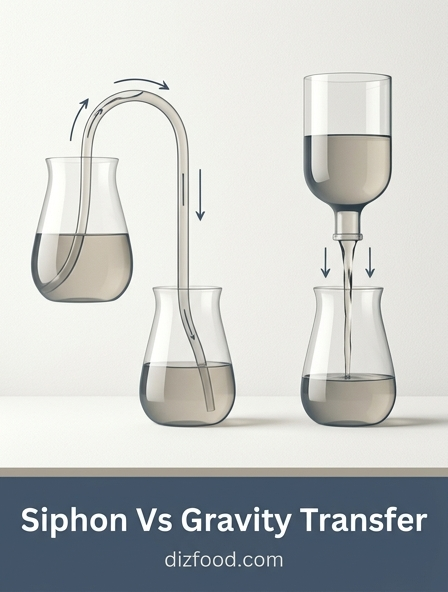
Understanding Siphon vs Gravity Transfer
In the culinary and home-processing world, the movement of liquids is a fundamental task that can be achieved through two primary passive methods: siphon and gravity transfer. While both techniques rely on the natural pull of the Earth to relocate fluids, they utilize different physical configurations and atmospheric principles. Understanding these methods is essential for tasks ranging from homebrewing and winemaking to draining deep fryers or transferring large quantities of bulk cooking oils. Gravity transfer is the most intuitive method, involving a direct downward path from a higher vessel to a lower one, often utilizing a simple spout or drain valve. In contrast, a siphon is a more complex arrangement where liquid is forced upward over the edge of a container before descending to a lower level through a tube.
The choice between these two methods often depends on the equipment available and the level of precision required. For instance, a chef might use gravity to strain stock through a chinois, whereas a brewer uses a siphon to move beer while leaving sediment undisturbed at the bottom. Both systems eliminate the need for mechanical pumps, making them cost-effective and easy to maintain. However, they are not interchangeable in every scenario. To master kitchen fluid management, one must recognize how pressure differentials and vessel placement dictate the success of the transfer. The following list highlights common kitchen scenarios where these methods are frequently employed:
- Decanting wine to separate it from bitter sediment.
- Racking beer from a primary fermenter to a keg.
- Draining spent oil from a tabletop deep fryer into a disposal container.
- Transferring large batches of cold-brew coffee from steeping vessels.
- Moving filtered water from a high-capacity reservoir to smaller pitchers.
Mechanics of Fluid Displacement and Pressure
The science of moving liquids in the kitchen is rooted in the interplay between gravity and atmospheric pressure. In a gravity-fed system, the weight of the liquid itself provides the necessary force to push the fluid through an opening. The higher the column of liquid, the greater the pressure at the exit point. This is why a full beverage dispenser pours much faster than one that is nearly empty. The fluid simply follows the path of least resistance toward the center of the Earth, requiring only an unobstructed downward trajectory to maintain flow.
Siphoning adds a layer of complexity by introducing atmospheric pressure as the driving force. For a siphon to work, the tube must first be primed, meaning it must be completely filled with liquid to remove all air. Once primed, the weight of the liquid in the longer discharge end of the tube pulls the remaining liquid upward through the shorter intake end. This creates a partial vacuum at the highest point of the tube. Because the atmosphere is pushing down on the surface of the liquid in the source container, it forces the fluid up into that vacuum to fill the void. This continuous "tug-of-war" between gravity and pressure allows the liquid to seemingly defy gravity for a brief moment as it peaks over the rim of the vessel.
| Feature | Gravity Transfer | Siphon Transfer |
|---|---|---|
| Driving Force | Weight of liquid column | Atmospheric pressure and gravity |
| Path Requirement | Direct downward opening | Continuous tube over an elevation |
| Starting Action | Opening a valve or tilting | Priming the tube (suction/pump) |
| Vessel Integrity | Requires a hole or spout | Works with sealed-bottom vessels |
Key Differences in Liquid Transfer Methods
The most significant difference between siphon and gravity transfer lies in the physical requirements of the containers involved. Gravity transfer requires a vessel with a bottom or side-mounted outlet, such as a spigot or a valve. This makes it ideal for permanent installations like commercial coffee urns or water filtration systems. If a container does not have an opening at the bottom, gravity transfer can only be achieved by tilting the vessel, which often leads to spills and agitation of the liquid. For delicate processes where clarity is vital, such as moving clear broth or fermented spirits, tilting is counterproductive as it stirs up particulates settled at the bottom.
Siphoning offers a non-invasive alternative because the intake tube can be placed into the liquid from the top. This allows the user to precisely control the depth of the intake, avoiding the "trub" or sediment layer at the bottom of the container. Additionally, siphons are portable and adaptable; a single length of food-grade tubing can serve multiple different pots and carboys. However, siphons are more prone to failure if air enters the line. A single bubble can break the vacuum and stall the entire process, a problem rarely encountered in gravity systems where the weight of the fluid provides a constant, reliable push. Gravity systems are generally faster for bulk movement, while siphons are preferred for selective, clean transfers.
- Portability: Siphons require only a tube; gravity needs specific vessel hardware.
- Cleanliness: Siphons allow for top-down entry to avoid bottom solids.
- Consistency: Gravity flow is steady until empty; siphons can "lose prime."
- Setup: Gravity is "set and forget"; siphons require manual initiation.
How Siphoning Works Without Mechanical Pumps
A siphon functions as a liquid chain, where the cohesive forces of the fluid molecules allow them to pull one another along the path of the tube. This phenomenon is often compared to a "liquid rope." Once the flow is established, the weight of the water in the exit arm-which must be lower than the surface of the liquid in the source container-creates a persistent downward pull. This pull generates a low-pressure zone at the apex of the siphon. Because nature abhors a vacuum, the higher atmospheric pressure acting on the surface of the liquid in the upper pot pushes the liquid up the tube to equalize the pressure. This creates a self-sustaining cycle that continues until the liquid level in the source drops below the intake or the discharge end is raised.
In the kitchen, "priming" the siphon is the most critical step. This can be done using a small hand-operated "auto-siphon" pump, which is a common tool in homebrewing. Alternatively, it can be done by filling the tube with water beforehand or using manual suction, though the latter is discouraged for hot liquids or those containing alcohol for safety and hygiene reasons. Once the air is purged, the siphon becomes an incredibly efficient tool. It requires no electricity and can move gallons of liquid with minimal supervision. It is an elegant solution for transferring liquids from heavy, immobile containers that cannot be easily lifted or tilted for a standard gravity pour.
The Role of Gravity in Fluid Dynamics
Gravity is the ultimate engine behind both transfer methods, acting as a constant force that pulls all matter toward the Earth's center. In fluid dynamics, this is expressed as potential energy being converted into kinetic energy. A liquid held in a vessel at a certain height possesses gravitational potential energy. When a path is opened-whether through a spigot at the bottom or a primed siphon tube reaching over the top-that energy is released, and the liquid begins to move. The speed of the flow is directly proportional to the vertical distance between the surface of the liquid and the exit point. This vertical distance is known as the "head height."
In a kitchen environment, gravity flow is seen in everything from the way a drip coffee maker functions to the drainage of a sink. It is a predictable force; as long as the destination is lower than the source, the liquid will move. However, gravity is also responsible for the friction loss that occurs within the system. As liquid flows through tubes or over the edges of a pot, it encounters resistance from the walls of the container. This "skin friction" can slow down the transfer. Therefore, even in a gravity-dependent system, the diameter and smoothness of the tubing or channel play a significant role in how efficiently the fluid moves. By maximizing the height difference and minimizing the length of the tubing, a cook can significantly speed up the transfer process without using any mechanical assistance.
Practical Applications for Siphon Systems
Siphon systems are indispensable in specialized kitchen tasks where the quality of the liquid is just as important as the quantity. One of the most common applications is in the production of homemade vinegar, kombucha, or beer. These liquids undergo a fermentation process that leaves a layer of dead yeast and organic debris at the bottom of the vessel. Using a gravity spigot at the bottom would pull all that sediment directly into the final bottle. A siphon allows the user to gently lower the tube just above the sediment line, drawing out only the clear, finished product. This process, known as "racking," is essential for achieving a professional-grade appearance and taste.
Beyond fermentation, siphons are used for safety when handling hot liquids. Rather than attempting to lift a massive pot of boiling stock to pour it through a strainer-a move that risks severe burns-a heat-resistant siphon can be used to move the liquid into smaller, more manageable containers. It is also a preferred method for cleaning large, built-in kitchen features like sous-vide water baths or specialized prep tanks that lack a built-in drain. By using a siphon, a chef can easily empty these basins into a nearby floor drain or bucket. The following steps outline a typical siphon procedure in a kitchen setting:
- Place the full container on a counter and the empty container on the floor.
- Sanitize a food-grade PVC or silicone tube.
- Submerge the intake end of the tube into the upper vessel.
- Prime the tube using an auto-siphon pump or by filling it with liquid.
- Ensure the discharge end remains lower than the source at all times.
- Monitor the flow to prevent the intake from sucking in air or sediment.
Efficiency Comparison of Gravity Flow vs Siphons
When evaluating efficiency, one must consider both the speed of the transfer and the effort required for setup. Gravity flow is the undisputed champion of speed and simplicity for bulk transfers. Because gravity-fed systems typically use larger apertures, such as 1-inch spigots or wide-mouth drains, they can move a high volume of liquid in a very short time. There is no risk of losing prime, and the flow starts instantly. For a high-volume restaurant needing to drain a large stockpot or move filtered water into a prep station, gravity is the most efficient choice because it minimizes labor and time.
Siphons, however, offer a different kind of efficiency: the efficiency of precision. While a siphon may be slower due to the narrower diameter of the tubing used, it reduces the need for secondary filtration. If a gravity-fed system is used to drain a container with sediment, the user must often filter the liquid afterward, adding an extra step to the workflow. A siphon combines the transfer and "filtering" (via selective intake) into one step. Furthermore, siphons are more efficient in terms of equipment costs; you don't need to buy expensive pots with welded spigots. You only need a simple, inexpensive tube. In terms of energy efficiency, both methods are equal, as they utilize zero electricity, relying entirely on the physical environment.
| Metric | Gravity (Spigot) | Siphon (Tube) |
|---|---|---|
| Flow Rate | High | Moderate to Low |
| Setup Time | Instant | 1-3 Minutes |
| Sediment Control | Poor | Excellent |
| Equipment Cost | Higher (Modified Pots) | Lower (Simple Tubing) |
Height and Pressure Requirements for Success
For both siphon and gravity systems, the "vertical drop" is the most important variable. In a gravity system, the pressure is determined by the height of the liquid inside the container above the outlet. However, in a siphon, the pressure is determined by the difference in height between the surface of the liquid in the upper container and the end of the discharge tube. This is a critical distinction. If the discharge end of a siphon tube is only one inch lower than the source liquid level, the flow will be agonizingly slow. For a vigorous and reliable flow, a height difference of at least 18 to 24 inches is recommended for most kitchen applications.
There are also physical limits to how high a siphon can lift liquid. At sea level, atmospheric pressure can theoretically support a column of water about 33 feet high. In a kitchen, you will never reach this limit, but the "lift"-the height the liquid must travel up and over the rim of the pot-should be kept as low as possible. The higher the lift, the lower the pressure at the apex, which increases the likelihood of dissolved gases (like CO2 in beer) coming out of the solution and creating bubbles. These bubbles can expand and break the siphon's vacuum. To ensure success, always place the receiving vessel as low as possible and keep the "hump" of the siphon tube close to the rim of the source container to minimize the vertical climb.
Common Challenges in Fluid Transfer Projects
The most frequent challenge in any fluid transfer project is the introduction of air into the system. In gravity systems, this usually manifests as "glugging," where air rushes into the container to replace the exiting liquid, causing an uneven flow and splashing. This can be solved by ensuring the container is properly vented at the top. In siphon systems, air is a much more serious problem. Even a tiny leak at the point where the tube connects to a pump or a small crack in the tubing will allow air to enter. Once an air pocket forms at the highest point of the siphon, the vacuum is lost, and the flow stops immediately. This is known as an "air lock."
Another common issue is clogging. Kitchen liquids often contain fats, fibers, or small particles like peppercorns or hops. In a gravity system, these can easily jam a spigot, which is difficult to clear while the pot is full. Siphons are also prone to clogging, but they have the advantage of being easier to clear; you can often simply "flick" the tube or briefly reverse the flow. Temperature also plays a role; very hot liquids can soften certain types of plastic tubing, causing it to kink and restrict flow. Furthermore, the viscosity of the liquid matters; thick syrups or cold oils move much slower than water, requiring a greater height difference to maintain a steady stream. To avoid these issues, consider the following:
- Use a "sediment tip" on the end of your siphon to prevent clogs.
- Ensure all tube connections are airtight with hose clamps.
- Vent the source container to prevent vacuum-related flow slowing.
- Choose high-temperature-rated silicone for moving hot stocks or oils.
Choosing the Right Method for Your Needs
Selecting between siphon and gravity transfer ultimately comes down to the specific requirements of your kitchen project. If your primary goal is speed and you are working with clean liquids like water, tea, or filtered juice, a gravity-fed system with a spigot is the superior choice. It is simple to operate, easy for anyone to use without training, and provides a fast, reliable flow. Gravity systems are best for "service" environments where you need to dispense liquid frequently throughout the day, such as at a beverage station or a buffet.
However, if you are a craftsman-a brewer, a vintner, or a chef making clarified consommé-the siphon is your best friend. It provides a level of control over the purity of the liquid that a bottom-drain gravity system cannot match. It is also the correct choice for one-off tasks where you don't want to modify your existing pots by drilling holes for valves. Before deciding, ask yourself: Does this liquid have sediment? Is the container too heavy to move? Do I need to control the flow rate precisely? By answering these questions, you can choose the method that ensures a clean, efficient, and safe transfer every time. For most home kitchens, having a length of versatile, food-grade siphon tubing on hand is a low-cost way to handle a wide variety of liquid management challenges that a standard gravity pour simply cannot manage without mess or waste.



Comments