

Understanding Coffee Micro-fines
Micro-fines are the microscopic dust-like particles produced during the coffee grinding process, typically measuring less than 100 microns in diameter. Regardless of the quality of the grinder, the brittle cellular structure of roasted coffee beans ensures that some degree of shattering occurs, creating these tiny fragments. In the kitchen, understanding these particles is essential because they possess a disproportionately high surface area compared to their volume. This physical characteristic means they interact with water almost instantly, leading to a much faster chemical exchange than larger "boulders" or standard grinds.
- Fragment Origin: Micro-fines originate from the breaking of the bean's cellulose walls.
- Surface Area: Their small size increases the contact points for solvent extraction.
- Migration: Fines tend to migrate toward the bottom of a filter bed during brewing.
- Solubility: They reach full extraction significantly faster than the rest of the dose.
While often viewed as a nuisance, a controlled amount of fines can contribute to the body and complexity of certain brew methods. However, the primary challenge for the home barista is managing their quantity to prevent an imbalanced cup that masks the nuanced notes of the coffee.
Impact on Flavor Profile
The presence of micro-fines in a brew directly dictates the balance between sweetness, acidity, and bitterness. Because these particles extract so rapidly, they often reach a state of over-extraction while the larger particles are still reaching their peak. This leads to the introduction of heavy, astringent, and bitter compounds into the cup, which can obscure the delicate floral or fruity notes of high-quality beans. When fines are excessive, the coffee often tastes "muddy" or "flat," lacking the crisp definition found in professionally prepared beverages.
- Astringency: Excessive fines contribute a drying sensation on the tongue.
- Bitterness: Over-extracted cellular material releases harsh tannins.
- Muddled Notes: Fine particles can cloud the specific origin characteristics.
- Inconsistency: An uneven distribution of fines makes it difficult to repeat successful brews.
Managing the "tail" of the grind size distribution is the most effective way to brighten a flavor profile. By reducing the volume of these tiny particles, the extraction becomes more uniform, allowing the user to push the overall extraction higher without the risk of bitterness. This results in a cleaner, sweeter, and more transparent cup that highlights the roaster's intent.
Precision Filter Technology
To combat the issues caused by micro-fines, modern kitchen equipment has evolved to include precision-engineered filtration systems. Unlike traditional mesh or stamped metal filters, precision filters utilize laser-cutting technology to ensure that every aperture is identical in size and shape. This uniformity is crucial for preventing "channeling," where water finds the path of least resistance through gaps in the coffee bed. High-end espresso baskets and pour-over drippers now feature specific hole counts and geometries designed to regulate the flow of micro-fines and oils.
| Filter Type | Hole Uniformity | Fine Retention |
|---|---|---|
| Standard Mesh | Low | Low |
| Laser-Cut Steel | High | Moderate |
| Double-Walled | Moderate | High |
| Sintered Disk | Extreme | Very High |
These technological advancements allow for a more predictable flow rate. When the holes are consistent, the micro-fines are less likely to clog specific areas of the filter, which ensures that water passes through the entire coffee bed evenly. This leads to a higher extraction yield without the localized over-extraction typically caused by "fines migration" or filter blinding.
Optimizing Particle Distribution
The most effective way to handle micro-fines is to limit their production at the source: the grinder. Precision burr sets are designed to produce a "unimodal" distribution, where as many particles as possible fall within a narrow size range. Cheaper blade grinders or low-quality burrs produce a "bimodal" or scattered distribution, resulting in a high percentage of both massive chunks and microscopic fines. For the kitchen enthusiast, investing in high-alignment burrs can drastically reduce the volume of dust produced during the grinding cycle.
- Burr Alignment: Ensures that the crushing surfaces meet evenly to prevent shattering.
- RPM Control: Lower speeds can sometimes reduce the heat and static that cause clumping.
- Material Quality: Hardened steel or ceramic burrs maintain sharpness longer.
- Static Reduction: Using a droplet of water (RDT) prevents fines from sticking to the grinder walls.
By optimizing the distribution, the brewer gains more control over the contact time. A uniform grind allows for a finer setting overall, which increases sweetness, without the micro-fines causing the brew to stall or turn bitter. This balance is the hallmark of advanced brewing technique and equipment maintenance.
Enhancing Extraction Clarity
Extraction clarity refers to the ability to perceive individual flavor notes in a cup of coffee. Micro-fines are the primary enemy of clarity because they introduce suspended solids that physically block the palate from sensing lighter compounds. When a brew is "clean," it has a transparency that allows subtle acidity and aromatics to shine. To enhance this clarity, techniques must be employed to either remove fines or prevent them from entering the final vessel. This is particularly important for light-roasted specialty coffees where the complexity is easily lost.
- Rinsing: Pre-wetting paper filters helps seal the fibers to trap more dust.
- Agitation Control: Excessive stirring can force fines to the bottom, causing a clog.
- Vertical Filtering: Using the sides of a conical filter to bypass the silt at the bottom.
Achieving high clarity often involves a trade-off with body or "mouthfeel." However, for many aficionados, the trade-off is worth it to experience the tea-like qualities and vibrant acidity of high-elevation beans. Reducing micro-fines ensures that the "noise" of the extraction is minimized, allowing the "signal" of the bean's terroir to be clearly communicated to the drinker.
Sieving for Consistency
Sieving is a mechanical process used in the kitchen to physically remove micro-fines and boulders from ground coffee before brewing. By using specialized tiered sieves, a barista can isolate only the particles within a specific micron range, such as 400 to 800 microns. This creates a perfectly uniform dose that extracts at a predictable rate. While this process can be labor-intensive and results in some wasted coffee, it is the most reliable method for achieving professional-level consistency in a home setting.
- Removal of Dust: Eliminates particles that cause bitterness and silt.
- Boulder Exclusion: Removes large chunks that cause under-extraction and sourness.
- Recipe Calibration: Allows for precise testing of how different sizes impact taste.
- Uniform Saturation: Ensures every grain of coffee is wetted and extracted at the same speed.
Sieving effectively "cleans up" the output of even a mediocre grinder. By removing the microscopic tails of the distribution curve, the brewer can experiment with longer brew times and higher temperatures, unlocking flavors that would otherwise be hidden by the harshness of over-extracted micro-fines. It is a transformative step for those seeking perfection.
Advanced Filtration Methods
Beyond traditional paper and metal, advanced filtration methods have emerged to specifically target micro-fines. These include specialized fabric weaves, multi-layered synthetic membranes, and even the use of paper filters inside espresso portafilters. Placing a small paper disc at the bottom of an espresso basket can trap fines that would otherwise pass through the metal holes, leading to a higher clarity shot with less sediment. Similarly, "zero-bypass" brewing systems force all water through the coffee bed, requiring meticulous management of fines to prevent the filter from stalling.
| Method | Mechanism | Flavor Impact |
|---|---|---|
| Paper Sandwich | Dual-layer trapping | High Clarity |
| Cloth Siphon | Dense fiber weave | High Body/Clean |
| Vacuum Filter | Pressure-assisted | Bright/Crisp |
| Ceramic Stone | Porous tortuosity | Soft/Mellow |
These methods offer a different tactile experience. For example, cloth filters allow oils to pass through while catching almost all micro-fines, providing a unique combination of heavy body and high clarity. Exploring these advanced tools allows the user to manipulate the final texture of the beverage to suit their specific palate preferences.
Achieving Clean Mouthfeel
Mouthfeel is the physical sensation of the liquid in the mouth, and micro-fines play a decisive role in this experience. A "clean" mouthfeel is characterized by the absence of grit, silt, or a lingering "chalky" texture. When micro-fines are successfully managed, the coffee feels smooth and refined. Conversely, a high concentration of fines creates a "heavy" or "sandy" feel that can be unpleasant and may leave a coating on the tongue. This is often the result of using immersion methods like the French Press without proper sediment control.
- Decanting: Allowing the brewed coffee to sit for a minute so fines settle before pouring.
- Slow Pouring: Reducing turbulence to keep sediment at the bottom of the brewer.
- Paper Upgrading: Using thicker, high-density paper filters to catch more particulates.
In the kitchen, achieving a clean mouthfeel is as much about technique as it is about equipment. By understanding how gravity and flow affect the movement of these tiny particles, one can produce a cup that feels light and elegant. This tactile cleanliness is often what distinguishes a "hobbyist" brew from a "connoisseur" experience, emphasizing the importance of particle management.
Comparing Filter Materials
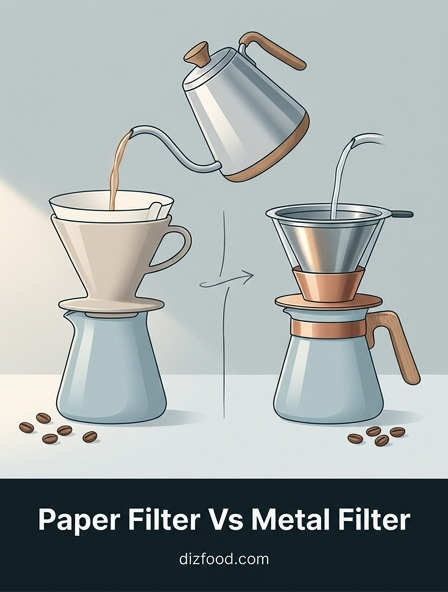
The choice of filter material is the final gateway that determines how many micro-fines reach the cup. Different materials have varying levels of "tortuosity," which is the complexity of the path the liquid must take. A simple metal mesh has low tortuosity, allowing many fines to pass through, whereas a thick paper filter has high tortuosity, trapping particles deep within its fibers. For those who enjoy a sediment-free cup, paper is the gold standard, though it can also absorb some of the coffee's aromatic oils, slightly altering the flavor.
| Material | Fine Retention | Oil Retention | Typical Usage |
|---|---|---|---|
| Bleached Paper | Highest | High | V60, Chemex |
| Stainless Steel | Lowest | Lowest | French Press |
| Organic Cotton | Medium-High | Low | Nel Drip |
| Nylon Mesh | Low | Low | Auto-Drip |
Understanding these differences allows for intentional brewing. If a user wants a rich, buttery cup and doesn't mind a bit of silt, metal is ideal. If they want a sparkling, tea-like brew, paper is necessary. The interplay between micro-fines and filter material is perhaps the most significant variable in determining the final texture and visual clarity of the coffee.
Brewing Without Sediment
To conclude, brewing without sediment requires a holistic approach that addresses micro-fines at every stage of the process. Starting with a high-quality burr grinder, employing RDT to reduce static clumping, and choosing the right filtration method are the foundational steps. However, technique also matters. In immersion brewing, for example, avoiding the "plunge" in a French Press and instead skimming the top can result in a much cleaner cup. In percolation, avoiding excessive agitation keeps the fines from migrating to the filter and causing a "stall" that ruins the extraction.
- Skimming: Remove floating fines and foam before finishing a brew.
- Two-Stage Pour: A gentle bloom followed by a steady pour to keep the bed stable.
- Equipment Care: Regularly cleaning burrs to ensure they cut rather than crush.
- Final Pour: Stop pouring before the very last drops, where the most sediment resides.
By mastering these kitchen variables, any brewer can eliminate the frustration of muddy coffee. The result is a consistent, professional-grade beverage that celebrates the true flavor of the beans without the interference of unwanted particulates. Managing micro-fines is the ultimate path to coffee clarity.




Comments