
The Chemistry of Dissolved Carbon Dioxide
At the heart of every sparkling beverage lies a fundamental chemical reaction between water and carbon dioxide gas. When CO2 is introduced into a liquid under pressure, it does not merely occupy the space between water molecules; a small portion of it chemically reacts with the water to form carbonic acid (H2CO3). This weak acid is responsible for the characteristic tangy zip associated with plain carbonated water. The process is governed by chemical equilibrium, where the rate of gas dissolving into the liquid matches the rate of gas escaping back into the atmosphere.
- Solubility: Carbon dioxide is highly soluble in water compared to oxygen or nitrogen.
- Hydration: The formation of carbonic acid provides the "bite" that defines the beverage's profile.
- Equilibrium: Maintaining pressure is essential to prevent the CO2 from reverting to its gaseous state.
The stability of this dissolved gas is highly sensitive to the surrounding environment. As soon as the pressure is released, such as when opening a bottle, the equilibrium is disrupted. This triggers the transition of dissolved molecules back into gas bubbles, a process that continues until the liquid reaches a new state of atmospheric balance, eventually resulting in a "flat" drink.
Natural Versus Forced Carbonation Methods
In the culinary world, carbonation is achieved through two primary pathways: biological fermentation and mechanical injection. Natural carbonation relies on living yeast organisms to consume sugars, producing carbon dioxide and ethanol as byproducts. This method is traditional in bottle-conditioned beers and sparkling wines, often resulting in complex flavors and finer, more persistent bubbles. Forced carbonation, conversely, involves injecting pure CO2 gas directly into a liquid under high pressure, a method favored for its speed and consistency.
| Method | Primary Mechanism | Common Application |
|---|---|---|
| Natural | Yeast Fermentation | Champagne, Kombucha |
| Forced | Direct CO2 Injection | Seltzers, Fountain Soda |
While forced carbonation allows for precise control over the exact volumes of gas, natural carbonation creates a unique sediment and a nuanced mouthfeel. Forced carbonation is the standard for the modern soda industry because it allows for a clean flavor profile that is not influenced by yeast metabolism. However, many artisanal producers prefer the traditional method for the depth of character it imparts to the final product over several weeks of aging.
How Bubbles Influence Flavor Perception
Carbonation does far more than provide a physical sensation; it fundamentally alters how we perceive the flavor of a drink. As bubbles rise to the surface and burst, they create a fine mist of aromatic compounds. This process, known as "aromatic lift," delivers scent molecules directly to the olfactory receptors, enhancing the perceived intensity of the beverage's ingredients. Without these bubbles, many drinks would taste dull or overly sweet, as the effervescence provides a necessary structural contrast.
- Volatility: Bubbles carry volatile organic compounds to the nose.
- Palate Cleansing: The physical action of bubbles helps scrub the tongue of fats and heavy flavors.
- Taste Modification: Carbonic acid suppresses the perception of sweetness while enhancing saltiness and acidity.
The "scrubbing" effect of carbonation is particularly important when pairing drinks with food. The mechanical agitation of the bubbles helps break down the film left by rich or oily foods, refreshing the palate for the next bite. This is why sparkling water is a preferred accompaniment for multi-course meals. Furthermore, the slight bitterness of carbonic acid can balance out high sugar content, providing a more sophisticated and less cloying taste experience.
The Role of Temperature in Gas Retention
Temperature is the most critical external factor in determining how much carbon dioxide a liquid can hold. According to Henry's Law, the solubility of a gas in a liquid is inversely proportional to the temperature. In simpler terms, colder liquids can hold significantly more dissolved CO2 than warmer ones. When a liquid is cold, the water molecules have less kinetic energy, making it easier for the gas molecules to remain trapped within the liquid's structure rather than escaping into the air.
In a kitchen or bar setting, this means that chilling a beverage before carbonating it is essential for achieving high levels of effervescence. If you attempt to carbonate a room-temperature liquid, the gas will struggle to dissolve, and the resulting drink will likely lose its fizz almost immediately upon pouring. Conversely, a near-freezing liquid will accept the gas readily and hold onto it much longer, ensuring a persistent sparkle. This relationship is why sodas and beers are served cold; warmth not only changes the flavor but physically forces the gas out of the solution, leading to rapid flattening.
The Trigeminal Nerve and the Carbonation Bite
The sensation of drinking something carbonated is not actually a "taste" in the traditional sense, like sweet or salty. Instead, it is a form of somatosensation mediated by the trigeminal nerve. This nerve is responsible for detecting touch, temperature, and pain in the face and mouth. When you feel the "bite" or "sting" of a highly carbonated beverage, you are experiencing a mild chemical irritation. This occurs because the enzyme carbonic anhydrase, located on the tongue, converts the CO2 into acid, which then triggers the nerve endings.
- Carbon dioxide enters the oral cavity and contacts the tongue.
- Carbonic anhydrase converts CO2 into protons and bicarbonate ions.
- The resulting change in local pH stimulates the trigeminal nerve fibers.
- The brain interprets these signals as a refreshing, tingling, or "biting" sensation.
Interestingly, studies have shown that if the trigeminal response is inhibited, carbonated drinks are often perceived as less satisfying or even "off." This physical sensation provides a textural dimension to the drink that complements the flavor, making the experience of drinking seltzer fundamentally different from drinking still water, even if the flavorings are identical.
The Mechanics of Nucleation Sites
A glass of carbonated liquid may appear still until a bubble suddenly forms on the side and rises to the top. This occurs at "nucleation sites," which are tiny imperfections, scratches, or dust particles on the surface of the container. These sites provide the necessary surface area for dissolved carbon dioxide molecules to gather and form a gas bubble. Once the bubble reaches a critical size, its buoyancy overcomes the surface tension holding it to the glass, and it detaches to float upward.
In the beverage industry, glassware is often intentionally etched at the bottom with specific patterns to create controlled nucleation. This ensures a steady stream of bubbles, maintaining the drink's "head" or foam and continuously releasing aromas. Without these sites, a liquid could theoretically remain supersaturated with gas, appearing flat despite containing high levels of CO2. However, too many nucleation sites-such as those found in a dirty or scratched glass-will cause the gas to release too rapidly, leading to a drink that goes flat prematurely. Achieving the perfect pour requires a balance between a clean vessel and just enough surface irregularity to stimulate the desired effervescence.
Pressure and Solubility in Brewing
For homebrewers and professional zymologists alike, managing pressure is the key to achieving the perfect level of carbonation. The amount of CO2 dissolved in a liquid is measured in "volumes." One volume of carbonation means that at a specific temperature and pressure, the liquid has absorbed an amount of gas equal to its own volume. Most beers are carbonated to between 2.2 and 2.7 volumes, while sparkling wines can reach up to 6.0 volumes, requiring much sturdier bottles to prevent explosions.
- Regulators: These devices control the PSI (pounds per square inch) from a gas tank to the keg.
- Headspace: The air gap at the top of a bottle allows for pressure stabilization.
- Seal Integrity: Any leak in the system will result in a loss of pressure and flat liquid.
The relationship between pressure and solubility is linear; doubling the pressure will roughly double the amount of gas that can be dissolved. However, this must be balanced against the temperature. Brewers use carbonation charts to determine the exact PSI needed at a specific temperature to reach their target volumes. This precision ensures that every pour has the correct mouthfeel and that the beverage does not foam uncontrollably when dispensed.
Optimizing Mouthfeel Through Effervescence
Mouthfeel is a critical component of the drinking experience, and the size and density of bubbles play a primary role in defining it. Fine, "creamy" bubbles are often associated with high-end sparkling wines and nitrogenated beers. These smaller bubbles create a soft, velvety texture on the tongue. In contrast, the large, aggressive bubbles found in many commercial sodas provide a sharp, crisp sensation that is highly refreshing but less subtle. The difference is often a result of how the gas was introduced and the presence of proteins or surfactants in the liquid.
In beverages like stout beer, nitrogen is used alongside carbon dioxide to produce even smaller bubbles that do not dissolve as easily. This results in a thick, stable foam and a silky mouthfeel. For the home enthusiast, mouthfeel can be manipulated by adjusting the carbonation speed and the mineral content of the water. Soft water tends to produce a different bubble sensation than hard water, which contains minerals like calcium and magnesium that can influence how bubbles interact with the palate. By fine-tuning these variables, one can transform a simple sparkling drink into a complex textural experience.
The Impact of Acidity on Refreshment
The relationship between carbonation and acidity is a cornerstone of beverage design. Because dissolved CO2 naturally creates carbonic acid, carbonated drinks are inherently acidic, usually falling between a pH of 3 and 4. This acidity is what creates the "clean" finish on the palate. When combined with other acids, such as the citric acid in lemons or the tartaric acid in grapes, the carbonation amplifies the perception of freshness and brightness in the drink.
- pH Balance: Carbonation lowers the pH, making the beverage taste "sharper."
- Sugar Counterpoint: Acidity cuts through the sweetness of syrups and fruit juices.
- Salivation: High-acid drinks stimulate saliva production, which aids in tasting.
This synergetic effect is why sparkling lemonade or a dry Prosecco feels more refreshing than their still counterparts. The acidity serves as a palate cleanser, removing lingering flavors and preparing the mouth for more food or another sip. Culinary professionals often use this knowledge to balance heavy, fatty dishes with highly carbonated, acidic beverages, ensuring that the richness of the food does not overwhelm the diner's senses over time.
Essential Equipment for Home Carbonation
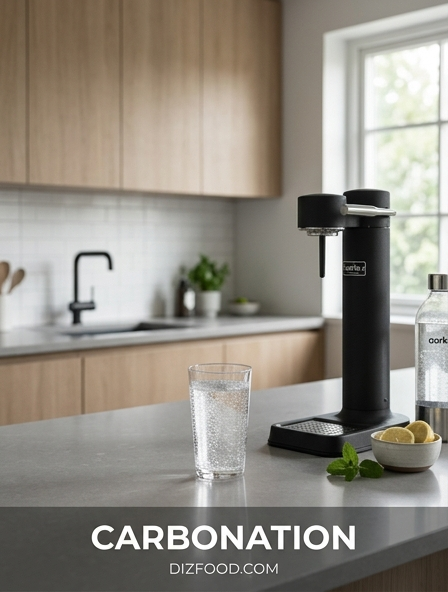
Creating professional-quality carbonated beverages at home requires specific tools designed to handle high pressures and maintain gas seals. The most common entry point is the countertop soda maker, which uses small, pre-filled CO2 canisters. However, for those looking for more control or higher volume, a dedicated carbonation rig is often the better choice. These systems allow the user to adjust the pressure precisely, enabling the carbonation of everything from plain water to cocktails and clarified juices.
| Equipment | Function |
|---|---|
| CO2 Tank | Stores pressurized liquid carbon dioxide. |
| Pressure Regulator | Controls the flow and PSI of the gas. |
| Carbonation Cap | Connects the gas line to standard PET bottles. |
| Swing-top Bottles | Reinforced glass for holding natural carbonation. |
Safety is paramount when working with pressurized gas. It is essential to use containers that are rated for the pressures involved, such as PET plastic bottles or heavy-walled glass. Regular inspection of seals and gaskets prevents leaks and ensures that the gas is efficiently dissolved into the liquid. With the right equipment, the home cook can experiment with custom infusions, varying the levels of effervescence to match the specific needs of any recipe or occasion.





Comments