
Achieving peak boiling efficiency in your kitchen often depends on the specific mineral composition of your local water supply. In hard water systems, high concentrations of calcium and magnesium can lead to scale buildup on heating elements, creating a thermal barrier that slows down heat transfer and increases energy consumption. On the other hand, soft water lacks these insulating minerals, typically allowing for a faster and more direct heating process. Beyond mineral content, factors like atmospheric pressure and cookware material also play roles, yet water chemistry remains a fundamental influence on your cooking speed. To learn more about how these variations affect your daily culinary routine, check out our comprehensive comparison of Hard Water Boiling vs Soft Water Boiling.
Mineral Concentration and Energy
Mineral concentration significantly influences the thermodynamics of kitchen operations. When water contains a high level of dissolved solids, primarily calcium and magnesium ions, the energy required to facilitate a phase change from liquid to vapor increases. This phenomenon is rooted in the increased density and altered specific heat capacity of the fluid. In a standard kitchen kettle, these minerals absorb a portion of the thermal energy that would otherwise be used to agitate water molecules toward their boiling threshold.
Consequently, the appliance must draw more electricity or gas to achieve the same result as purified water. Furthermore, the presence of these minerals can lead to early precipitation, where heat is diverted into chemical separation rather than temperature elevation. Understanding the relationship between mineral concentration and energy consumption is vital for high-volume kitchens looking to optimize their utility costs. By monitoring the parts per million (PPM) of the water supply, chefs can predict the thermal behavior of their boiling tasks and adjust their equipment settings accordingly to maintain consistent preparation times and energy usage patterns.
Limescale Thermal Insulation
Limescale acts as a potent thermal insulator, creating a physical barrier between the heat source and the water. In the context of a boiling pot or an electric kettle, this white, chalky deposit forms a crust that possesses very low thermal conductivity. As the heating element warms up, the heat must first penetrate this thick layer of mineral buildup before it can reach the liquid. This results in significant energy loss, as the heating element is forced to reach much higher internal temperatures to overcome the resistance provided by the scale.
Not only does this delay the boiling process, but it also creates a thermal gradient that can damage the appliance. For every millimeter of scale thickness, energy efficiency can drop by as much as ten to fifteen percent. In a busy kitchen, this inefficiency compounds over several boiling cycles, leading to noticeably higher energy bills and a slower workflow. Removing this insulation through regular maintenance is essential for restoring the rapid heat transfer rates required for efficient food preparation and water sterilization processes in any professional or home environment.
Soft Water Heat Conductivity
Soft water is characterized by a low concentration of dissolved minerals, which directly enhances its heat conductivity within kitchen vessels. Without the interference of heavy metal ions, the water molecules can circulate more freely, facilitating faster convection currents when heat is applied from below. This rapid movement ensures that thermal energy is distributed uniformly throughout the liquid, preventing "hot spots" at the base of the pot and promoting an even rise in temperature.
Furthermore, soft water maintains a cleaner contact interface with the metal or glass surfaces of the cookware. Because there is no microscopic layer of debris, the transfer of energy from the burner or element to the fluid is nearly instantaneous. Professional kitchens often utilize water softeners to ensure that their boiling processes remain as lean and fast as possible. The lack of resistance in soft water allows for a more predictable boiling curve, which is essential for precision cooking techniques that require strict temperature control and timing. By optimizing conductivity, kitchens can reduce their carbon footprint and increase their overall output.
Nucleation Site Density
Nucleation site density plays a critical role in how quickly water appears to reach a rolling boil. These sites are small imperfections, scratches, or mineral particles where steam bubbles first begin to form. In a perfectly smooth container with purified water, nucleation sites are scarce, which can sometimes lead to superheating-a state where water exceeds its boiling point without boiling. Conversely, hard water creates a high density of nucleation sites due to mineral deposits.
- Surface Roughness: Increased scale provides more points for bubble formation.
- Bubble Size: Higher mineral content can lead to smaller, more frequent bubbles.
- Energy Distribution: Excessive nucleation sites can cause uneven heat release.
- Visual Indicators: More sites cause water to look like it is boiling before it hits 100°C.
Managing the cleanliness of the interior surfaces helps regulate these sites for a predictable boil. While some nucleation is necessary for a steady transition from liquid to gas, an overabundance caused by scale can lead to violent, inefficient boiling that spatters and loses heat rapidly to the surrounding air.
Hardness and Boiling Point
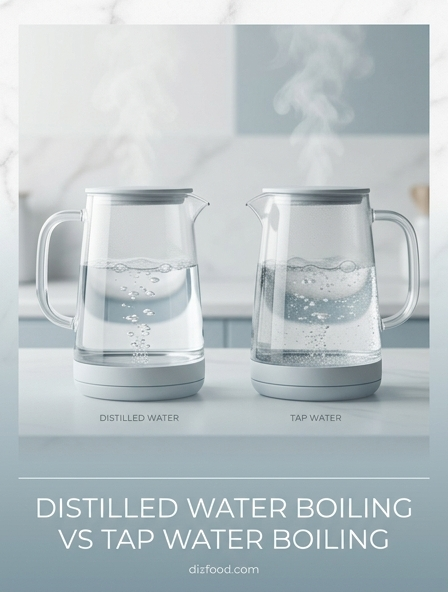
The hardness of water is a primary factor in determining the actual boiling point of the liquid in a kitchen setting. Due to the principle of boiling point elevation, the presence of dissolved solutes like calcium carbonate and magnesium sulfate raises the temperature at which water turns to steam. While the shift is often only a fraction of a degree in typical tap water, it nonetheless requires a higher total energy input to reach the necessary threshold. This means that a pot of hard water will technically need to be hotter than a pot of distilled water before it reaches a steady boil.
| Water Type | Mineral Level | Boiling Speed |
|---|---|---|
| Distilled | Very Low | Fastest |
| Softened | Low | Moderate-Fast |
| Hard Water | High | Slower |
| Very Hard | Extremely High | Slowest |
This difference, though subtle, affects the cooking times of delicate items like pasta or blanched vegetables. For culinary consistency, chefs must account for these variations in boiling points caused by local water hardness to ensure repeatable results across different geographical locations.
Surface Scale Accumulation
Surface scale accumulation is the gradual buildup of solid minerals on the interior walls and base of cookware. This accumulation is particularly aggressive in high-heat environments like boiling pots. As water evaporates, the minerals are left behind, bonding to the stainless steel or aluminum surfaces. This layer increases the mass of the vessel that must be heated, essentially adding "dead weight" to the thermal equation. The rough texture of the scale also increases the surface area, but not in a way that aids heat transfer.
Instead, it creates stagnant pockets of water that heat at different rates. This can lead to localized boiling while the rest of the liquid remains below the target temperature. Over time, this accumulation becomes a permanent fixture if not treated, permanently degrading the performance of expensive kitchenware. The visual presence of scale is a clear indicator that the thermal efficiency of the tool is compromised, requiring the chef to use more fuel to achieve the same culinary results. Regular inspection of pot interiors is a simple yet effective way to monitor boiling efficiency.
Heating Element Efficiency
Heating element efficiency is heavily impacted in modern electric kitchens. In kettles and electric boilers, the heating element is often submerged directly in the water. When minerals precipitate, they gravitate toward the hottest point, which is the surface of the element itself. This encases the element in a "stone" sleeve. Because the heat cannot escape into the water efficiently, the internal temperature of the element's resistance wire skyrockets.
- Initial Phase: Light scaling reduces efficiency by approximately 5%.
- Intermediate Phase: Thickening scale increases boil time by several minutes.
- Terminal Phase: Element overheats and the safety fuse trips or the coil breaks.
- Maintenance Phase: Descaling restores original energy draw and heating speed.
Maintaining the integrity of the heating element is essential for long-term kitchen cost management and ensuring that water-based tasks are completed within standard operational windows. A protected element ensures that the maximum amount of wattage is converted directly into water temperature rather than being wasted as ambient heat within the appliance housing.
Calcium Carbonate Impact
Calcium carbonate is the primary culprit behind reduced boiling efficiency in most kitchens. This compound is less soluble in hot water than in cold water, a trait known as retrograde solubility. As the temperature rises toward the boiling point, the calcium carbonate is forced out of solution and crystallizes onto the nearest surface. This chemical reaction consumes a small amount of energy itself, but its primary impact is the creation of an insulating barrier.
Furthermore, the presence of calcium carbonate increases the surface tension of the water, making it slightly harder for steam bubbles to break through the surface and escape. This can lead to a "simmer" state that lasts longer than necessary before transitioning into a full rolling boil. By understanding the chemistry of calcium carbonate, kitchen managers can better appreciate why water filtration and softening systems are not just about taste, but are fundamental tools for operational and thermal efficiency. Addressing calcium levels directly correlates with faster prep times and lower utility expenses over the fiscal year.
Boiling Time Comparison
A boiling time comparison reveals the tangible impact of water quality on kitchen productivity. When testing identical volumes of water in the same kettle, the discrepancy between purified water and hard water becomes evident. In controlled experiments, hard water consistently takes thirty to sixty seconds longer to reach a 100-degree Celsius threshold compared to soft water. While one minute might seem negligible, in a high-volume restaurant setting where water is boiled fifty times a day, this results in nearly an hour of lost productivity.
- Energy Waste: Longer boiling times directly correlate to higher kilowatt usage.
- Labor Costs: Staff wait times for boiling water add up over multiple shifts.
- Consistency: Soft water provides a repeatable timeframe for recipe execution.
- Equipment Wear: Extra time under heat stresses the metal components of cookware.
This comparison highlights the importance of using treated water for boiling tasks. The cumulative effect of these delays can significantly alter the workflow of a fast-paced kitchen, making water quality a key metric for overall operational efficiency and time management.
Equipment Descaling Benefits
The benefits of equipment descaling are both immediate and long-lasting. Descaling involves using an acidic solution, such as vinegar or citric acid, to dissolve the accumulated mineral deposits. Once the scale is removed, the heating surfaces are restored to their original state, allowing for maximum heat flux. This restoration drastically reduces the time required to reach a boil and lowers the energy consumption of the appliance. Beyond efficiency, descaling extends the lifespan of kitchen equipment by preventing the overheating of elements.
Common descaling agents include:
- Citric Acid: Non-toxic and highly effective for light to moderate buildup.
- White Vinegar: A common kitchen staple for regular, low-cost maintenance.
- Commercial Descalers: Formulated for heavy-duty industrial boilers and rapid action.
A regular descaling schedule ensures that every boiling cycle is as efficient as the first day the equipment was used. This proactive maintenance strategy is the most cost-effective way to manage boiling efficiency, reduce utility waste, and preserve the long-term value of professional kitchen assets.


Comments