
While boiling water is a fundamental kitchen task, mastering the delicate science of boiling milk requires a shift from "set-it-and-forget-it" to active heat management. Water is a simple substance that transitions predictably to steam, but milk is a complex emulsion of fats, proteins, and sugars that reacts volatilely to high temperatures. Understanding the distinction-specifically how milk forms a protein film that traps steam and leads to rapid boil-overs-is essential for any cook looking to avoid scorched pans and messy stovetops. By mastering heat control and recognizing the unique thermal properties of these liquids, you can ensure smoother textures in your sauces and more consistent results in your daily culinary ventures.
| Feature | Boiling Water | Boiling Milk |
|---|---|---|
| Boiling Point | 100°C (212°F) | ~100.2°C (Slightly higher) |
| Composition | Pure H2O (Inorganic) | Water, fats, proteins, lactose |
| Surface Behavior | Vapor escapes freely | Protein film traps rising steam |
| Scorching Risk | Zero (Evaporates cleanly) | High (Solids sink and burn) |
| Visual Cues | Large, rolling bubbles | Foaming and rapid volume rise |
| Management | Passive (Self-regulating) | Active (Constant stirring/low heat) |
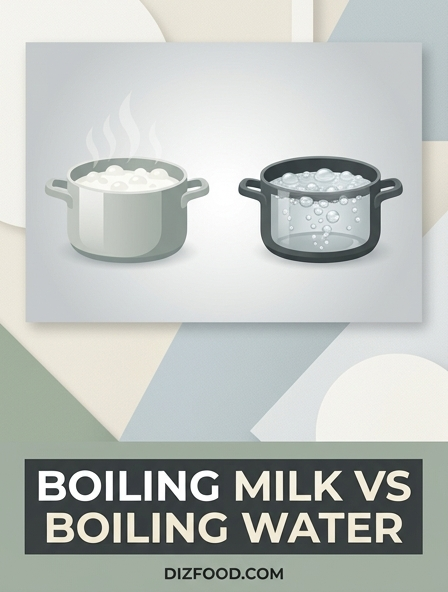
Boiling Point Differences Explained
In the culinary world, the transition of a liquid into a gas is a fundamental process, yet the temperature at which this occurs varies significantly between water and milk. Pure water has a predictable boiling point of 100°C (212°F) at standard sea-level atmospheric pressure. This consistency is due to the uniform nature of water molecules, which require a specific amount of kinetic energy to overcome atmospheric pressure and escape as vapor. Because water is a pure substance, its boiling point remains constant until the entire volume has undergone a phase change.
Milk, however, is a complex biological fluid containing dissolved sugars, minerals, and suspended fats and proteins. According to the principle of boiling point elevation, the presence of these solutes increases the temperature required for the liquid to boil. While the difference is relatively small-usually less than one degree Celsius-it is a critical distinction in food science. The solutes interfere with the vapor pressure of the solvent, requiring more thermal energy to reach the point where the internal pressure of the liquid equals the external pressure. The following table summarizes these primary differences:
| Liquid Type | Boiling Point (Sea Level) | Primary Factor |
|---|---|---|
| Pure Water | 100°C / 212°F | Standard Vapor Pressure |
| Whole Milk | ~100.2°C / 212.4°F | Boiling Point Elevation |
This elevation means that while a pot of water will reliably bubble at a specific threshold, milk requires slightly more heat. Furthermore, as water evaporates from the milk during the heating process, the concentration of solutes increases, which can cause the boiling point to shift even further as the liquid thickens.
Molecular Composition of Milk vs Water
To understand why these two liquids behave differently on a stovetop, one must examine their molecular architecture. Water is a simple polar molecule consisting of two hydrogen atoms covalently bonded to one oxygen atom. This simplicity allows for rapid movement and efficient heat distribution through hydrogen bonding. In its liquid state, water acts as a universal solvent, but it remains a single-phase substance until it reaches its boiling point, where it transitions into a gas.
Milk is not a single substance but a complex emulsion and colloidal suspension. It is composed of approximately 87% water, with the remaining 13% consisting of a diverse array of molecules that significantly alter its physical properties. These components include:
- Lipids: Fat globules suspended in the liquid that provide richness and influence heat transfer.
- Proteins: Primarily caseins and whey proteins which are sensitive to temperature changes.
- Carbohydrates: Lactose, a milk-specific sugar that can undergo chemical changes when heated.
- Minerals and Vitamins: Calcium, phosphorus, and B-vitamins that are dissolved within the aqueous phase.
Because of this heterogeneity, milk does not heat as uniformly as water. The proteins and fats create a structural complexity that water lacks. When heat is applied, these molecules interact with one another, leading to physical changes such as the denaturation of proteins and the coalescence of fat. While water molecules simply move faster as they get hotter, the components in milk undergo structural transformations that can lead to the formation of films or sediments at the bottom of the pan.
Why Milk Foams and Overflows
One of the most frustrating experiences in the kitchen is watching a pot of milk suddenly surge over the sides of the vessel. This phenomenon rarely happens with pure water because water bubbles burst easily once they reach the surface, releasing steam into the air. In a pot of boiling water, the steam can escape freely, maintaining a relatively stable liquid level even at a rolling boil. Milk behaves differently due to the "skin" or film that forms on its surface as it approaches its boiling point.
As milk heats up, water evaporates from the surface, concentrating the proteins and fats at the top. This creates a thin, viscous layer known as a protein-fat coagulum. When the liquid beneath this layer begins to boil, the resulting steam becomes trapped under the film. Instead of the bubbles popping, they push the film upward. Because milk contains surfactants in the form of proteins, the bubbles created are much more stable than water bubbles. This creates a rapidly expanding foam that rises quickly.
To prevent this overflow, the cook must utilize specific techniques to disrupt the film formation or the bubble stability:
- Constant stirring to prevent the protein skin from solidifying.
- Using a larger pot to provide more headspace for the foam.
- Lowering the heat immediately as the first bubbles appear.
- Placing a wooden spoon across the pot to break the surface tension of the rising foam.
Once the film is broken, the steam can escape, and the foam will subside, but the precarious nature of milk's surface tension makes it a much more volatile liquid to boil than water.
Heat Conductivity and Temperature Rise
The rate at which a liquid increases in temperature is determined by its specific heat capacity and its thermal conductivity. Water has an exceptionally high specific heat capacity, meaning it requires a significant amount of energy to raise its temperature. However, because it is a low-viscosity, single-phase liquid, it undergoes vigorous convection. The hot water at the bottom of the pot rises quickly, and the cooler water sinks, creating an efficient cycle that distributes heat evenly throughout the container.
Milk has a slightly lower specific heat capacity than pure water because of its solid content, which theoretically means it should heat up faster. However, its thermal conductivity is hampered by its viscosity and the presence of suspended particles. The fats and proteins in milk act as insulators, and the liquid's thickness slows down the natural convection currents. This leads to uneven heating, where the milk in contact with the bottom of the pot can become much hotter than the milk at the surface.
This uneven distribution often results in "scorching" or "scalding." When the milk at the bottom reaches high temperatures without being circulated, the proteins and sugars undergo a Maillard reaction and eventually carbonize, sticking to the pan. This not only ruins the flavor of the milk but also creates a barrier that further reduces heat efficiency. In contrast, water will never scorch; it simply turns into steam. Therefore, heating milk requires a gentler touch and lower flame settings compared to the high-heat approach typically used for boiling water for pasta or tea.
The Role of Surface Tension
Surface tension is a measurement of the cohesive forces between molecules at the interface of a liquid and the air. In pure water, surface tension is relatively high due to strong hydrogen bonding. When water boils, the vapor pressure inside the bubbles must overcome this surface tension to expand. Once the bubbles reach the surface, the high surface tension actually helps them burst quickly because the water molecules want to pull back together, effectively "squeezing" the steam out into the atmosphere.
In milk, the surface tension is lower than that of pure water, but the bubbles formed are far more durable. This is because milk contains proteins and lipids that act as stabilizers. When a bubble forms in milk, these molecules migrate to the bubble's surface, forming a protective elastic layer. This reduces the energy required to maintain the bubble's shape, preventing it from bursting easily. The result is a stable foam rather than a clean release of vapor.
The following points illustrate how surface tension affects the boiling experience:
- Water: High surface tension leads to large, unstable bubbles that collapse instantly upon reaching the surface.
- Milk: Low surface tension coupled with protein stabilization leads to small, resilient bubbles that accumulate into a thick foam.
- Evaporation: In water, evaporation occurs freely across the surface. In milk, the surface tension and the resulting film create a physical barrier to evaporation.
This stability is why milk is used to create lattes and cappuccinos; the proteins allow the air to be trapped in a structure that lasts. However, when boiling on a stove, this same property becomes a liability, as the stable bubbles do not release heat energy quickly enough to prevent the liquid from rising and spilling over.
Nutritional Impact of High Heat
Boiling water has no impact on its nutritional value, as water contains no macronutrients or heat-sensitive vitamins. The primary concern when boiling water is the concentration of minerals (such as calcium or magnesium) if the water is boiled for a long duration, leading to "hard water" deposits. Otherwise, water remains chemically stable throughout the heating process. Milk, being a nutrient-dense food, undergoes significant chemical and nutritional changes when subjected to high heat.
When milk is brought to a boil, several reactions occur simultaneously. First, the heat-sensitive vitamins, particularly Vitamin B12, Thiamine (B1), and Vitamin C, begin to degrade. While the loss is not total, prolonged boiling can reduce these levels by 10% to 20%. Second, the proteins in milk, specifically the whey proteins like beta-lactoglobulin, begin to denature. These proteins unfold and can bind with other molecules, which changes the texture and digestibility of the milk. The casein proteins are more heat-stable, but they can still be affected if the milk becomes too acidic or is heated for too long.
Furthermore, the high heat facilitates the Maillard reaction between the lactose (milk sugar) and the proteins. This reaction creates new flavor compounds and can give the milk a slightly toasted or "cooked" flavor, along with a subtle tan color. While this makes some foods more delicious, it can slightly reduce the bioavailability of certain amino acids like lysine. For maximum nutritional retention, milk is often "scalded" (heated to just below boiling) rather than held at a rolling boil for an extended period.
Vapor Pressure and Evaporation Rates
Vapor pressure is the pressure exerted by a vapor in thermodynamic equilibrium with its condensed phases. For a liquid to boil, its vapor pressure must equal the surrounding atmospheric pressure. Pure water has a high vapor pressure relative to its temperature, allowing it to evaporate readily. When heat is added, the vapor pressure rises until it reaches the boiling point. Because there are no impurities, the evaporation rate is constant and depends solely on the heat input and the surface area of the pot.
Milk has a lower vapor pressure than pure water at any given temperature. This is explained by Raoult's Law, which states that the vapor pressure of a solvent is lowered when a non-volatile solute is added. In milk, the lactose, minerals, and proteins occupy space at the surface of the liquid, effectively blocking water molecules from escaping into the air. This reduces the number of water molecules that can transition to the gas phase at a specific temperature.
Because the evaporation rate is lower in milk, it holds onto its heat differently than water. In water, the cooling effect of evaporation is significant; as the fastest-moving molecules leave the liquid, they carry away energy. In milk, the restricted evaporation-partially caused by the lower vapor pressure and partially by the surface film-means that heat is trapped within the liquid more effectively. This contributes to the rapid temperature spikes seen right before milk boils over, as the energy that would normally be lost to evaporation is instead used to increase the kinetic energy of the liquid.
Protein and Fat Behavior in Milk
The behavior of proteins and fats during heating is what truly differentiates milk from water in a culinary context. Water is chemically inert during boiling, but milk is a site of active biochemistry. Milk contains two primary types of protein: casein and whey. Casein molecules exist in clusters called micelles, which are held together by calcium phosphate. These micelles are remarkably heat-stable and do not easily coagulate even at boiling temperatures. However, whey proteins are highly sensitive and begin to denature at around 70°C (158°F).
When whey proteins denature, they lose their folded structure and expose reactive groups that can form bonds with other proteins or with the fat globule membranes. This process contributes to the following changes:
- Skin Formation: Denatured whey proteins cross-link with fat globules to form the solid film on the surface.
- Sedimentation: Some proteins may precipitate out of the solution and settle on the bottom of the pot, leading to burning.
- Flavor Alteration: Sulfur-containing amino acids in the proteins release volatile compounds that produce the characteristic "cooked milk" aroma.
The fat in milk also plays a role. As the milk heats, the protective membranes around the fat globules can weaken. If the milk is boiled vigorously, these globules can break and coalesce, occasionally creating a greasy layer on the surface. This is why "low-fat" or "skim" milk behaves slightly differently than whole milk; the lower fat content changes the strength of the surface film and the overall viscosity of the liquid during the boiling process.
Comparing Boiling Times and Energy
While it may seem that milk boils faster than water, the reality depends on the specific conditions of the stovetop and the composition of the milk. Water has a specific heat capacity of approximately 4.18 J/g°C. Whole milk has a specific heat capacity of about 3.93 J/g°C. Because milk's specific heat is lower, it actually requires less energy than water to raise the temperature of a given mass by one degree. If you put identical masses of water and milk on identical burners, the milk would reach the boiling point slightly sooner.
However, "boiling time" in a kitchen setting is often perceived differently due to the following factors:
| Factor | Water Impact | Milk Impact |
|---|---|---|
| Specific Heat | Higher (Heats slower) | Lower (Heats faster) |
| Convection | Efficient (Even heating) | Slower (Uneven heating) |
| Stirring Necessity | Optional | Mandatory for speed |
In practice, milk often feels like it takes longer because we typically heat it over medium or low heat to prevent scorching, whereas water is usually heated on the highest possible setting. Additionally, because milk is denser than water, a "cup" of milk weighs more than a "cup" of water, which can offset the lower specific heat capacity. From an energy efficiency standpoint, water is a more predictable medium, while milk requires constant monitoring and manual intervention (stirring) to ensure that heat is distributed effectively and that the energy is used to boil the liquid rather than burning the solids at the base.
Safety Tips for Heating Liquids
Heating liquids in a kitchen environment carries inherent risks, from thermal burns to kitchen fires. Whether boiling milk or water, safety should be the primary concern. Water is generally safer because it is predictable, but it can suffer from a dangerous phenomenon known as superheating. This occurs when water is heated in a very smooth container (like a glass measuring cup in a microwave) and reaches a temperature above its boiling point without bubbling. When disturbed, it can "explode" into steam instantly.
Milk presents a different set of safety challenges, primarily related to its tendency to overflow and create a mess that can extinguish a gas flame or cause an electrical short on a glass-top stove. To ensure safety when heating these liquids, follow these guidelines:
- Use Appropriate Vessels: Always use a pot that is at least twice the volume of the liquid you are heating, especially for milk.
- Prevent Superheating: When microwaving water, place a non-metallic object like a wooden stirrer in the cup to provide nucleation sites for bubbles.
- Monitor Closely: Never leave a pot of milk unattended. The transition from simmering to overflowing happens in seconds.
- Temperature Control: Use a thermometer to reach specific temperatures (like 82°C for scalding milk) rather than relying on visual cues.
- Handle with Care: Always turn pot handles inward toward the center of the stove to prevent accidental tipping.
By understanding the physical differences between how water and milk react to heat, cooks can better manage their kitchen tasks, avoiding the frustration of burnt pans and the danger of sudden boils.




Comments