
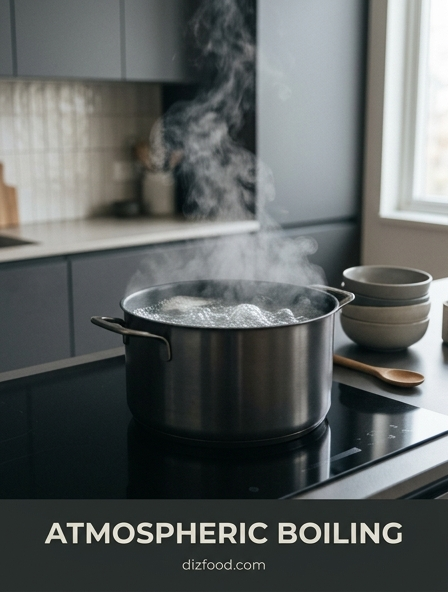
Defining the Maximum Temperature Threshold
In the context of a standard kitchen, the maximum temperature of liquid water is strictly governed by the local atmospheric conditions. Once water reaches its boiling point, typically 100°C (212°F) at sea level, it undergoes a phase transition that prevents further temperature increases regardless of the intensity of the heat source. This thermal plateau occurs because the energy being introduced into the system is no longer used to increase the kinetic energy of the molecules, but is instead consumed to break the intermolecular forces holding the liquid together. This phenomenon ensures that food cooked in boiling water is subjected to a constant, predictable temperature, which is essential for culinary consistency.
- Temperature remains fixed at the boiling point until all liquid has evaporated.
- Adding more flame or electricity increases the rate of evaporation, not the temperature.
- This threshold is the fundamental reason why boiling is a reliable cooking method.
- Excess heat is dissipated through steam, protecting the food from scorching.
Understanding this limit allows cooks to manage heat efficiently. While a "hard boil" creates more agitation, it does not cook food faster than a gentle boil, as the temperature of the medium remains identical in both states.
The Role of Atmospheric Pressure
Atmospheric pressure acts as a physical weight pressing down on the surface of a liquid, effectively "holding" the water molecules in their liquid state. For a liquid to boil, its internal vapor pressure must equal the external pressure exerted by the surrounding air. In a typical kitchen, this pressure is roughly 101.3 kPa at sea level. When the pressure is high, water molecules require more kinetic energy to overcome the downward force and escape into the air as gas. Conversely, if the atmospheric pressure drops, the energy required for this transition decreases, resulting in a lower boiling point.
| Pressure Level | Effect on Boiling Point | Kitchen Outcome |
|---|---|---|
| Standard (1 atm) | 100°C (212°F) | Standard cooking times. |
| High (Pressure Cooker) | Increases (>120°C) | Drastically reduced cooking times. |
| Low (High Altitude) | Decreases (<95°C) | Extended cooking times for proteins. |
This relationship explains why weather patterns or geographic location can subtly alter the efficiency of boiling-based culinary techniques, necessitating adjustments in timing or temperature settings.
Molecular Mechanics of Phase Transition
At the molecular level, water is held together by strong hydrogen bonds. In a liquid state, these molecules are in constant motion, sliding past one another while remaining in close proximity. As heat is applied, the kinetic energy of these molecules increases, causing them to vibrate and move more violently. The phase transition from liquid to gas occurs when individual molecules gain enough energy to completely overcome the attractive forces of their neighbors. This process is not instantaneous for the entire volume; it begins at the boundary layers where heat is most intense.
- Heat energy is absorbed by the water molecules, increasing their velocity.
- Molecules near the heat source reach a critical energy state.
- Hydrogen bonds are severed, allowing molecules to break free into a gaseous state.
- The resulting water vapor forms pockets of gas, which we perceive as bubbles.
This transition is a high-energy event. Because the molecules must "fight" to escape the liquid matrix, the boiling process is an effective way to transfer massive amounts of energy to food items, such as pasta or vegetables, through direct molecular collision and convection.
Latent Heat and Energy Absorption
Latent heat of vaporization is a critical concept in kitchen physics, referring to the specific amount of energy required to convert a liquid into a gas without changing its temperature. Even when water has reached 100°C, it requires a significant "burst" of extra energy-approximately 2,260 kilojoules per kilogram-to actually turn into steam. This energy is stored within the vapor and is released when the steam condenses back into a liquid. This explains why steam burns are often more severe than hot water burns; the steam carries the latent heat which is released upon contact with the skin.
- Energy input during boiling is redirected from heating to state-changing.
- Latent heat explains why a pot doesn't instantly vanish into steam at 100°C.
- It provides a thermal buffer that stabilizes the cooking environment.
- Steam-based cooking utilizes this stored energy for rapid heat transfer.
In the kitchen, recognizing that steam contains more energy than boiling water at the same temperature allows for more advanced techniques, such as steaming delicate seafood or vegetables to preserve texture while ensuring thorough cooking.
Vapor Pressure Dynamics in the Kitchen
Vapor pressure is the pressure exerted by a vapor in thermodynamic equilibrium with its condensed phases. In a pot of water, molecules are constantly evaporating from the surface and condensing back into the liquid. As the temperature rises, the rate of evaporation increases, and consequently, the vapor pressure rises. Atmospheric boiling occurs at the exact moment when the vapor pressure of the water equals the surrounding atmospheric pressure. This allows bubbles to form not just at the surface, but within the bulk of the liquid itself.
- Sub-boiling: Vapor pressure is lower than atmospheric pressure; bubbles cannot form.
- The Boiling Point: Vapor pressure matches atmospheric pressure; bubbles expand and rise.
- Saturation: The air above the pot becomes saturated with moisture, affecting evaporation rates.
The dynamics of vapor pressure also influence how flavors are carried through the air. Many aromatic compounds in food are volatile, meaning they have high vapor pressures and escape into the kitchen as the water boils, creating the characteristic scents of a simmering soup or stew.
The Physics of Bubble Formation
Bubbles are the most visible sign of boiling, representing pockets of water vapor that have achieved enough internal pressure to withstand the weight of the surrounding liquid and the atmosphere. The life cycle of a bubble begins at the bottom of the pot, where the heat is most intense. For a bubble to exist, the pressure of the steam inside it must slightly exceed the sum of the atmospheric pressure and the hydrostatic pressure of the water above it. If the internal pressure is too low, the bubble will simply collapse before reaching the surface.
- Nucleation: Small vapor pockets form at microscopic irregularities on the pot surface.
- Growth: Heat transfer from the surrounding water causes the vapor pocket to expand.
- Detachment: Buoyancy overcomes the surface tension holding the bubble to the pot.
- Ascent: The bubble rises, often growing larger as the surrounding hydrostatic pressure decreases.
The size and frequency of these bubbles provide a visual indicator of the heat flux. Smaller, frequent bubbles characterize a simmer, while large, chaotic bubbles indicate a rolling boil, which provides the mechanical agitation needed to keep starchy foods like pasta from sticking together.
Altitude and Variable Boiling Points
As one moves to higher elevations, the column of air above becomes shorter and less dense, leading to lower atmospheric pressure. This has a direct impact on kitchen operations. At sea level, water boils at 100°C, but in a city like Denver, it might boil at approximately 95°C (203°F). This lower temperature means that chemical reactions, such as the breakdown of cellulose in vegetables or the coagulation of proteins in meat, occur more slowly. Consequently, recipes must be adjusted to account for longer cooking times or modified ingredient ratios.
| Altitude (Feet) | Boiling Point (°F) | Cooking Adjustment |
|---|---|---|
| 0 (Sea Level) | 212°F | None |
| 2,000 | 208°F | Slightly longer simmering | 203°F | Increase liquid; extend time |
| 10,000 | 193°F | Pressure cooker recommended |
Baking is particularly sensitive to these changes. Lower pressure allows leavening gases to expand more quickly, which can cause cakes to rise and then collapse before their structure has set, necessitating higher oven temperatures or less leavening agent.
Thermal Equilibrium in Boiling Water
Boiling water is a highly dynamic but thermally stable system. Once a pot reaches a full boil, the water enters a state of thermal equilibrium where the heat being added is perfectly balanced by the heat lost through evaporation. This creates a uniform temperature throughout the vessel. Unlike roasting or frying, where the exterior of the food is subjected to much higher temperatures than the interior, boiling provides a gentle and even heat distribution. This is facilitated by convection currents-circular movements of water where hot, less dense water rises and cooler water sinks.
- Convection ensures that there are no "cold spots" in the water.
- The constant temperature prevents the outside of food from overcooking while the inside remains raw.
- Equilibrium is maintained as long as there is sufficient liquid to absorb the heat.
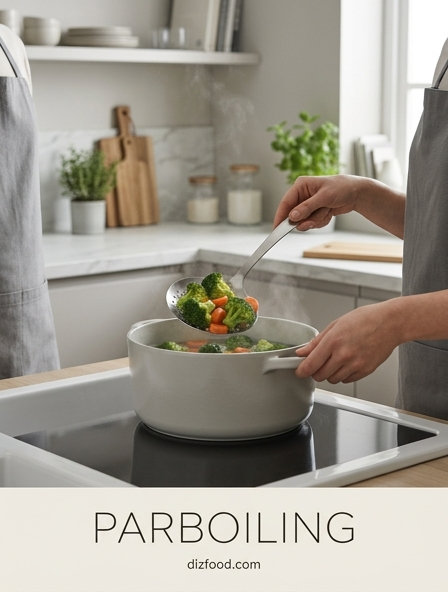
In culinary practice, this equilibrium is why boiling is the preferred method for blanching vegetables. The uniform heat quickly deactivates enzymes that cause spoilage without the risk of scorching the delicate plant tissues, ensuring a consistent color and crunch across the entire batch.
Nucleation Sites and Surface Interaction
The transition from liquid to gas does not happen randomly; it typically occurs at specific points called nucleation sites. These are microscopic scratches, pits, or dust particles on the surface of the cookware. These irregularities provide a "foothold" for water molecules to gather and form the initial vapor embryos. Without these sites, water can actually be superheated above its boiling point without turning into gas, which is a dangerous state that can lead to sudden, explosive boiling. High-quality stainless steel or seasoned cast iron provides a wealth of these sites, ensuring a steady stream of bubbles.
- Water molecules trap air in the microscopic crevices of the pot.
- The trapped air acts as a seed for vapor formation.
- Heat causes the vapor to expand into a bubble.
- The bubble breaks away, leaving a small amount of vapor behind to seed the next bubble.
This explains why a new, perfectly smooth glass container might lead to "bumping" or uneven boiling in a microwave, whereas a standard kitchen pot with minor surface wear produces a consistent and predictable boil. The interaction between the liquid and the vessel's surface is fundamental to the stability of the boiling process.
The Science of Simmering Versus Rolling Boils
In the kitchen, the distinction between a simmer and a rolling boil is defined by the rate of heat flux and the resulting bubble activity. A simmer occurs just below the full boiling point, typically between 85°C and 95°C, where small bubbles form but mostly collapse before reaching the surface. A rolling boil is characterized by vigorous bubble formation that cannot be stopped by stirring. The difference is not just about temperature, but about the mechanical energy delivered to the food. The high-velocity bubbles in a rolling boil provide significant agitation, which is necessary for certain tasks but detrimental to others.
- Simmering: Ideal for delicate proteins and long-term extraction of flavors in stocks.
- Rolling Boil: Necessary for cooking pasta to prevent sticking and for reducing sauces quickly.
- Mechanical Agitation: The movement of water helps distribute heat but can break apart fragile ingredients.
Choosing the correct intensity of boiling allows a cook to control both the rate of evaporation and the physical integrity of the ingredients. While the temperature difference between a simmer and a boil is small, the culinary outcomes are vastly different due to the physics of vapor movement and kinetic energy.

Comments