
Have you ever wondered why your pasta stays crunchy longer when you're vacationing in the mountains? The secret lies in atmospheric pressure: as you gain elevation, the air becomes "thinner," exertng less pressure on the surface of your liquids. At sea level, water needs to reach 212°F (100°C) to overcome atmospheric weight and turn into steam, but at higher altitudes, that barrier drops significantly. Because your water is boiling at a much lower temperature, it carries less thermal energy, meaning those "boiling" potatoes are actually sitting in cooler water than they would be at the beach. To compensate for this physics-driven drop in heat, high-altitude chefs must extend their simmering times, increase liquid ratios to account for faster evaporation, or reach for a pressure cooker to artificially restore the heat needed for a perfect meal.
| Altitude (Feet) | Boiling Pt (°F) | Boiling Pt (°C) | Pressure (PSI) | Cook Time Change | Pro Adjustment |
|---|---|---|---|---|---|
| 0 (Sea Level) | 212°F | 100°C | 14.7 | Standard | None (Baseline) |
| 2,000 | 208.1°F | 97.8°C | 13.7 | +5-10% | Minor time increase |
| 5,000 (Denver) | 202.4°F | 94.7°C | 12.2 | +20-25% | Increase liquid/lids |
| 7,500 | 197.6°F | 92.0°C | 11.1 | +35-40% | High-altitude baking rules |
| 10,000 | 192.9°F | 89.4°C | 10.1 | +50-60% | Pressure cooker recommended |
| 15,000 | 184.2°F | 84.6°C | 8.3 | +100% | Double time/Low temp prep |
Understanding Atmospheric Pressure and Boiling Points
In the culinary world, the behavior of water is often taken for granted as a constant, yet it is deeply influenced by the invisible weight of the atmosphere. Atmospheric pressure is the force exerted by the weight of air molecules in the column of atmosphere above a specific point. At lower elevations, such as sea level, this pressure is at its peak because there is a massive volume of air pressing down. This pressure acts like a lid on a pot, holding liquid molecules in place and preventing them from escaping into the air as gas. For boiling to occur, the energy within the liquid must be sufficient to overcome this downward environmental force.
The boiling point is specifically defined as the temperature at which the vapor pressure of the liquid equals the surrounding atmospheric pressure. Because the pressure is higher at sea level, water requires more heat energy to reach a state where its internal pressure can break through the atmospheric barrier. In the kitchen, this means that the standard benchmarks for cooking depend entirely on the weight of the air outside your window. If you change your location, you change the physical constraints of your cooking environment.
- Pressure creates a physical resistance against molecular escape.
- Sea level provides the maximum natural resistance for standard cooking.
- Heat energy must counteract environmental pressure to induce a phase change.
The Science of Altitude Versus Sea Level Boiling
When comparing the science of boiling at varying elevations, we are essentially looking at a gradient of molecular density. At sea level, the air is thick and dense, providing a consistent 14.7 pounds per square inch of pressure. As a cook ascends to higher altitudes, such as mountainous regions or high plateaus, the atmosphere becomes increasingly thin. This reduction in density means there are fewer air molecules per cubic inch, resulting in a significant drop in the force being applied to the surface of a pot of water. The fundamental science dictates that as pressure decreases, the energy required for molecules to transition from liquid to gas also decreases.
This relationship is not linear in a simple sense but follows specific physical laws that govern thermodynamics. In a sea-level kitchen, water molecules must be agitated by heat until they reach a high kinetic energy level. At high altitudes, the "lid" of atmospheric pressure is much lighter. Consequently, water molecules can break free into a gaseous state with much less agitation. This means that while the water appears to be boiling just as vigorously in a mountain cabin as it does on a coastal beach, the actual thermal energy contained within that boiling water is drastically different between the two locations.
How Elevation Lowers the Boiling Point of Water
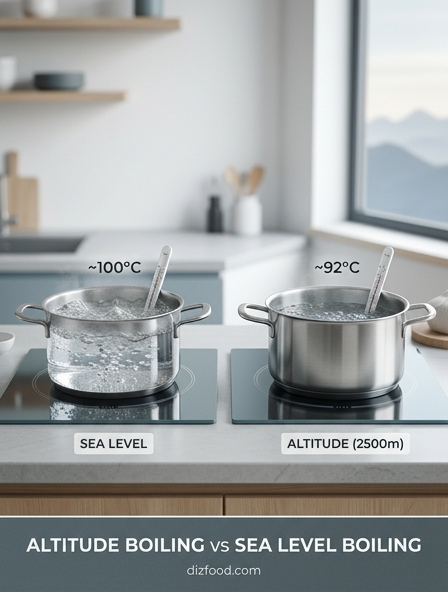
The lowering of the boiling point at high elevations is a direct result of the reduced resistance against vaporization. For every 500-foot increase in elevation, the boiling point of water drops by approximately 0.9 degrees Fahrenheit. This physical shift occurs because the equilibrium between the liquid phase and the vapor phase is reached sooner when there is less external pressure. In a kitchen located 5,000 feet above sea level, water will reach its boiling state at roughly 202 degrees Fahrenheit rather than the standard 212 degrees. This is because the molecules find it easier to push outward against a thinner atmosphere.
This phenomenon impacts nearly every liquid-based cooking process. When water boils at a lower temperature, it cannot get any hotter unless it is placed under artificial pressure, such as in a pressure cooker. Once a liquid reaches its boiling point, the temperature remains constant until all the liquid has evaporated, regardless of how high the burner is turned up. Therefore, in high-altitude environments, your "maximum temperature" for boiling water is physically capped at a lower threshold, which alters the speed of chemical reactions and the breakdown of food tissues during the cooking process.
Comparing Water Temperature at Sea Level and Peaks
Comparing the thermal capacity of boiling water at various heights reveals why geography is a critical ingredient in recipes. A cook in Miami is working with water that is 212 degrees Fahrenheit when it bubbles, while a cook in Denver is working with water that is nearly 10 degrees cooler. By the time you reach the peak of a high mountain, the boiling point may drop so low that it is barely hot enough to steep tea properly or cook an egg. This temperature disparity is the primary reason why "standard" recipes often fail when moved from the coast to the mountains without modification.
The following table illustrates the approximate boiling points of water as elevation increases, highlighting the steady decline in temperature that occurs as the atmosphere thins:
| Elevation (Feet) | Boiling Point (°F) | Boiling Point (°C) |
|---|---|---|
| 0 (Sea Level) | 212°F | 100°C |
| 2,000 | 208°F | 98°C |
| 5,000 | 202°F | 94°C |
| 7,500 | 198°F | 92°C |
| 10,000 | 193°F | 89°C |
Why Cooking Takes Longer at High Altitudes
The most frustrating aspect of high-altitude cooking is the significant increase in time required to achieve the same results as sea level. Many people mistakenly believe that because water boils faster at high altitudes, the food will cook faster. In reality, the opposite is true. Since the water is boiling at a lower temperature, it carries less heat energy to the food. Heat is what triggers the physical and chemical changes in ingredients, such as the softening of cellulose in vegetables or the coagulation of proteins in meats. If the water can only reach 200 degrees Fahrenheit, it will take much longer to break down these structures than water at 212 degrees.
This time extension is particularly noticeable in "low and slow" techniques like simmering beans or tough cuts of meat. In some cases, the temperature at very high altitudes may be so low that certain chemical transitions, like the softening of hard legumes, may never fully occur regardless of how long they are boiled. Additionally, the dry air often found at high elevations increases the rate of evaporation, meaning liquids in the pot disappear faster even though they are at a lower temperature. This creates a double challenge: you need more time to cook the food, but you have less time before the water boils away entirely.
The Relationship Between Vapor Pressure and Elevation
Vapor pressure is a measure of the tendency of molecules to escape from a liquid. At any given temperature, a liquid has a specific vapor pressure. As the temperature of the liquid increases, its vapor pressure also increases because the molecules are moving faster and with more force. Boiling occurs exactly when this internal vapor pressure rises to meet the external atmospheric pressure. At sea level, where atmospheric pressure is high, the vapor pressure must be quite high (which requires more heat) before it can match the environment. At high elevations, the bar is lower; the liquid does not need to generate as much vapor pressure to match the thin air around it.
This relationship explains why liquids other than water also behave differently at altitude. Alcohol, for instance, has a much higher vapor pressure than water, meaning it evaporates even more readily in mountain environments. This can affect the flavor profiles of reduced sauces and the alcohol content of flambéed dishes. Understanding this balance between internal molecular push and external atmospheric pull is the key to mastering high-altitude kitchen physics, as it governs the rate of evaporation and the maximum heat potential of any open-air cooking vessel.
Why 212 Degrees Fahrenheit Only Applies at Sea Level
The figure of 212 degrees Fahrenheit (or 100 degrees Celsius) is often taught as an absolute constant in science and cooking. However, this number is actually a conditional value based on "Standard Temperature and Pressure." Standard pressure is defined as one atmosphere, which is the average pressure at mean sea level. This benchmark was chosen for convenience and consistency in scientific communication, but it rarely applies to kitchens located even a few hundred feet above the shore. Most of the world's population lives at elevations where the boiling point is technically below 212 degrees.
When cookbooks or food safety guidelines mention 212 degrees, they are using a shorthand for the maximum heat of boiling water. For those in high-altitude regions, following these instructions literally can be dangerous or lead to culinary failure. For example, sterilization of equipment or the destruction of certain bacteria may require reaching a specific temperature. If a mountain cook assumes their boiling water is 212 degrees when it is actually 195 degrees, they may not be achieving the necessary thermal threshold for safety. Recognizing 212 degrees as a sea-level variable rather than a universal constant is essential for accurate high-altitude food preparation.
Adjusting Boiling Times for Mountainous Regions
Adjusting to high-altitude cooking requires a shift in timing and liquid management. Because you cannot increase the temperature of the boiling water, you must increase the duration of the cook time. As a general rule, for every 1,000 feet of elevation above sea level, you may need to increase the cooking time for boiled foods by approximately 10 percent. This adjustment ensures that the total heat energy absorbed by the food reaches the necessary levels to complete the cooking process. It is also helpful to keep lids on pots to trap as much heat and moisture as possible, counteracting both the lower temperature and the rapid evaporation rates.
- Determine your local elevation to find your specific boiling point.
- Increase the cooking time for pasta, grains, and vegetables by 10-20%.
- Add extra water to the pot to account for increased evaporation.
- Use a thermometer to check internal temperatures rather than relying on time.
- Consider using a pressure cooker to artificially raise the boiling point.
The Physics of Liquid Phase Changes at Altitude
A phase change occurs when a substance moves from one state of matter to another, such as from liquid to gas. This process involves latent heat-the energy absorbed or released during a change in state without a change in temperature. At high altitudes, the physics of this transition are altered because the intermolecular forces holding the liquid together are more easily overcome by the kinetic energy of the molecules. Since there is less atmospheric "work" for the molecules to do to push their way into the air, the transition happens at a lower energetic threshold. This shift changes the efficiency of heat transfer between the pot and the food.
Furthermore, because the boiling point is lower, the water reaches the phase change stage faster, but it carries less "sensible heat" (the heat we can measure with a thermometer) into the food. This means that while the water is technically boiling and undergoing a phase change, it is a less effective medium for cooking. The physics at altitude also means that the bubbles in boiling water form at lower temperatures and can be larger or more erratic, which can affect the texture of delicate foods like poached eggs or certain types of seafood that are sensitive to the mechanical agitation of boiling.
Key Differences in High Altitude Boiling Mechanics
The mechanics of boiling at high altitude versus sea level can be summarized by three primary factors: pressure, temperature, and time. At sea level, high pressure leads to a high boiling temperature, which results in standard cooking times. At high altitudes, low pressure leads to a lower boiling temperature, which necessitates longer cooking times. This inverse relationship between elevation and temperature creates a unique set of challenges for bakers and chefs who must reformulate recipes to account for the lack of heat. These differences are not just theoretical; they are tangible shifts that affect the texture, safety, and flavor of food.
- Pressure: Higher at sea level, lower at altitude.
- Temperature: Caps at 212°F at sea level; drops significantly as you rise.
- Evaporation: Occurs more rapidly at high altitudes due to lower pressure.
- Energy Transfer: Less efficient at altitude, requiring time compensations.
By understanding these mechanics, cooks can adapt their techniques. Whether it is using a pressure cooker to mimic sea-level conditions or simply being patient while a pot of beans simmers for an extra hour, the mastery of altitude boiling is a blend of physics and culinary intuition. Knowing that your stove is not the problem, but rather the very air around you, allows for more precise and successful cooking regardless of your home's elevation.

Comments