
Tritan Vs Polycarbonate Pitchers: The Safest Durable Choice For Your Kitchen
When upgrading your kitchenware, choosing between Tritan and Polycarbonate pitchers is a decision that balances rugged durability with long-term health safety. While both materials offer the crystal-clear aesthetics of glass without the fragility, Tritan has revolutionized the market as the premier "safety-first" alternative. Unlike traditional Polycarbonate, which contains Bisphenol A (BPA) that can leach into drinks during heating or wear, Tritan is a specialized co-polyester that is entirely BPA-free and estrogenic-activity-free. This makes Tritan the superior choice for families seeking impact-resistant pitchers that can handle the high temperatures of a dishwasher and the acidity of citrus juices without clouding, cracking, or compromising your wellness.
| Feature | Tritan Copolyester | Polycarbonate (PC) |
|---|---|---|
| Chemical Safety | 100% BPA/BPS-Free; No EA activity. | Contains BPA; potential chemical leaching. |
| Impact Strength | Shatter-proof; high drop resistance. | Virtually unbreakable; high-velocity resistance. |
| Heat Resistance | High; sustains clarity after 100+ cycles. | Moderate; prone to "crazing" (fine cracks). |
| Aesthetics | Glass-like clarity; resists yellowing. | High initial clarity; yellows over time. |
| Maintenance | Stain and odor resistant; dishwasher safe. | Can absorb odors and oils over heavy use. |
| Best Use Case | Home kitchens, infants, and health-focus. | High-volume commercial/industrial use. |
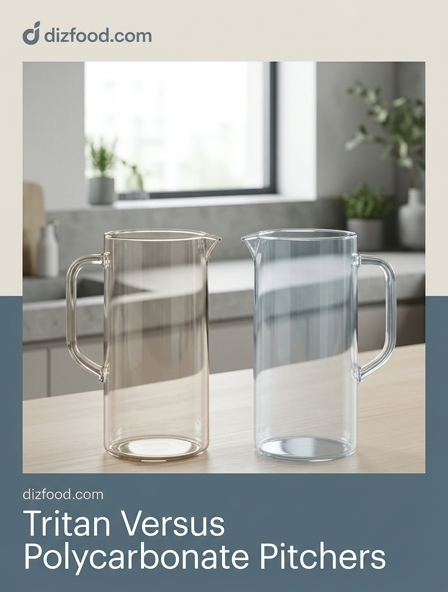
Tritan vs Polycarbonate Material Comparison
Understanding the fundamental differences between Tritan and polycarbonate begins with their chemical composition. Polycarbonate is a high-performance thermoplastic polymer that contains bisphenol A (BPA) as a primary building block. For decades, it was the gold standard for kitchenware due to its glass-like transparency and extreme toughness. However, as health concerns regarding BPA increased, chemical manufacturers sought alternatives that could match these physical properties without the associated health risks. Tritan, a copolyester developed by Eastman Chemical Company, emerged as the primary successor.
While both materials are classified as plastics, their molecular structures dictate their performance in a kitchen environment. Polycarbonate relies on its rigid aromatic rings to provide strength, but these same structures can become brittle over time when exposed to certain stressors. Tritan is engineered to be a "tough" polymer, meaning it can absorb significant energy before failing. Unlike traditional plastics that may feel flimsy, Tritan pitchers possess a density and "hand-feel" that closely mimics heavy glass. This comparison is essential for commercial buyers who require the aesthetic appeal of glass with the unbreakable nature of high-grade polymers.
- Polycarbonate: Contains BPA, high impact resistance, prone to chemical stress cracking.
- Tritan: BPA-free, BPS-free, superior chemical resistance, maintains clarity after hundreds of wash cycles.
- Visual Identity: Both offer 90% light transmission, rivaling the optical quality of soda-lime glass.
BPA Safety and Health Impacts
The primary driver for the shift from polycarbonate to Tritan in kitchenware is the concern over endocrine-disrupting chemicals. Polycarbonate is synthesized using Bisphenol A, a compound that can leach into food and beverages, especially when the plastic is heated or aged. Research has suggested that BPA can mimic estrogen in the human body, leading to potential developmental and reproductive issues. Because pitchers are often used for hot tea or run through high-temperature commercial dishwashers, the risk of chemical migration from polycarbonate is a significant consideration for health-conscious consumers and food service providers.
Tritan was specifically marketed as the solution to this safety crisis. It is not only BPA-free but also free from Bisphenol S (BPS) and other estrogenic and androgenic active compounds. Rigorous third-party testing has confirmed that Tritan does not leach chemicals that interfere with hormonal systems, even under extreme conditions such as microwave heating or prolonged UV exposure. This makes Tritan the preferred choice for environments serving vulnerable populations, such as schools and hospitals. While polycarbonate remains legal for food contact in many regions, the consumer preference for "BPA-free" labeling has rendered it less desirable in the modern kitchenware market.
When selecting a pitcher, the health impact extends beyond the material itself to its degradation products. Polycarbonate, as it breaks down, releases more of its constituent monomers. Tritan's polymer chain is more stable, ensuring that even as the pitcher wears down over years of use, it does not release harmful particulate matter into the water or juice contained within.
Durability and Shatter Resistance Testing
In a high-volume kitchen, durability is measured by a material's ability to survive drops on hard tile floors and the mechanical stress of constant handling. Polycarbonate is famously "bulletproof," often used in safety goggles and riot shields. It possesses incredible impact strength, meaning it rarely shatters into dangerous shards. Instead, a polycarbonate pitcher might crack or dent under extreme force. This has long made it a favorite for poolside service and busy bars where broken glass represents a major safety hazard and liability.
Tritan matches this shatter resistance while offering improved "toughness" against notched failure. In laboratory drop tests, Tritan pitchers have demonstrated the ability to withstand repeated impacts without showing signs of structural fatigue. One of the specific advantages of Tritan over polycarbonate is its resistance to "crazing"-the development of tiny internal cracks that occur when a material is stressed. While a polycarbonate pitcher might lose its structural integrity after being dropped a few times, Tritan maintains its molecular bonds more effectively.
| Feature | Polycarbonate | Tritan Copolyester |
|---|---|---|
| Impact Strength | Excellent | Excellent |
| Shatter Resistance | High | High |
| Crazing Resistance | Moderate | Superior |
| Flexibility | Rigid | Slightly Flexible |
This durability ensures that if a server drops a full two-quart pitcher, the vessel remains intact. This not only prevents injury but also reduces the "shrinkage" costs associated with replacing broken inventory in a commercial setting.
Long Term Clarity and Clouding
The aesthetic longevity of a pitcher is often the deciding factor for high-end dining establishments. Polycarbonate pitchers are known for a phenomenon called "clouding" or "yellowing." Over time, exposure to ultraviolet light and the harsh alkaline environment of dishwashers causes the polymer chains in polycarbonate to degrade. This results in a dull, milky appearance that makes the pitcher look dirty even when it is chemically clean. Once a polycarbonate pitcher has clouded, there is no way to restore its original transparency, often forcing businesses to discard otherwise functional equipment.
Tritan is engineered to be UV-resistant and chemically inert, allowing it to maintain its "crystal clear" look for a significantly longer duration. It does not possess the natural yellow tint that can develop in other plastics. Even after 500 cycles in a residential or commercial dishwasher, Tritan retains its high gloss and clarity. This is particularly important when serving colorful beverages like infused waters, sangrias, or fresh juices, where the visual presentation is part of the product's appeal.
Clouding is also exacerbated by mineral deposits and surface scratches. Because Tritan has a higher surface hardness than many traditional plastics, it resists the fine micro-scratches caused by abrasive sponges. These micro-scratches are where minerals from hard water typically lodge, leading to the "scum" look seen on older polycarbonate models. By resisting these surface imperfections, Tritan ensures that the pitcher remains a centerpiece of the table setting rather than a hidden utility item.
Dishwasher Safety and Heat Resistance
Thermal management is a critical aspect of kitchenware performance. Pitchers are frequently subjected to "thermal shock," such as being filled with ice immediately after a hot sanitizing rinse in a dishwasher. Polycarbonate has a high heat deflection temperature, typically around 270 degrees Fahrenheit, which makes it technically dishwasher safe. However, the combination of high heat and the high-pH detergents used in commercial machines causes polycarbonate to undergo hydrolysis. This chemical reaction breaks down the plastic, leading to the aforementioned clouding and eventual brittleness.
Tritan was designed to withstand the rigors of the modern dishwashing cycle without compromising its structural integrity. It can handle the high temperatures of the "sanitize" setting (usually around 180 to 190 degrees Fahrenheit) without warping or losing its shape. More importantly, Tritan is resistant to the chemical attack of detergents. While polycarbonate may begin to show stress cracks after 50 to 100 cycles, Tritan has been tested to survive over 500 cycles while remaining indistinguishable from a new product.
- Temperature Range: Both materials handle freezing temperatures well, making them suitable for refrigerator storage.
- Hydrolytic Stability: Tritan is significantly more stable in hot, moist environments.
- Dryer Cycles: Tritan resists the "melting" or warping risks associated with the high-heat drying elements of residential dishwashers.
For the average user, this means a Tritan pitcher can be tossed into the bottom rack of a dishwasher without a second thought, whereas polycarbonate often requires top-rack placement or hand-washing to extend its usable life.
Chemical Stability and Odor Retention
In the kitchen, pitchers are used for a variety of liquids, ranging from acidic lemonades to oily milk-based drinks and pungent iced teas. The porosity of the material determines whether flavors and odors from one beverage will "ghost" into the next. Polycarbonate is relatively non-porous, but as it develops micro-cracks and crazing from use, these tiny crevices become traps for organic molecules and bacteria. This can lead to a lingering smell of old coffee or tea that is difficult to remove, even with thorough scrubbing.
Tritan exhibits exceptional chemical stability. It is resistant to a wide array of substances that typically damage plastics, including oils, fats, and citrus acids. This resistance prevents the plastic from "pitting" or becoming etched by acidic juices. Because the surface remains smooth and non-reactive, odors do not cling to the material. A Tritan pitcher can be used for a strong garlic-infused water one day and, after a simple wash, be used for plain water the next without any flavor transfer.
This stability also prevents staining. Many plastics turn orange or red when they come into contact with tomato-based products or certain food dyes. Tritan's molecular structure is less likely to bond with these pigments. For commercial kitchens that rotate through various seasonal drinks, this versatility is a major operational advantage. It reduces the need for "dedicated" pitchers for specific beverages, thereby simplifying inventory and storage requirements.
Weight and Ergonomic Handling
The physical experience of using a pitcher involves more than just its capacity; weight and balance play a vital role in ergonomics. Both Tritan and polycarbonate are significantly lighter than glass. A standard 64-ounce glass pitcher can weigh several pounds when empty, making it heavy and potentially dangerous when full. In contrast, polymer pitchers are lightweight, reducing the strain on the wrists and arms of servers who must carry multiple vessels at once.
Between the two plastics, the weight difference is negligible, but the "perceived quality" differs. Tritan is often manufactured with thicker walls than cheap polycarbonate alternatives, giving it a reassuring heft that feels more premium. Ergonomic handling also involves the design of the handle and the pour spout. Because Tritan is a copolyester that flows well during the injection molding process, manufacturers can create more complex, comfortable handle shapes and precision "dripless" spouts that might be harder to achieve with the more rigid polycarbonate.
- Grip: Polymer surfaces are generally less slippery than glass when wet.
- Balance: Lightweight materials allow for a lower center of gravity, reducing tips and spills.
- Temperature Transfer: Both materials act as better insulators than glass, meaning a handle stays comfortable even when the contents are boiling hot or ice cold.
For home users, the light weight makes these pitchers ideal for children and the elderly. In a professional setting, it increases efficiency and reduces the physical fatigue of staff during long shifts.
Cost Analysis and Product Lifespan
When comparing cost, it is necessary to look beyond the initial purchase price. Polycarbonate pitchers are generally the more affordable option upfront. Because polycarbonate is a mature commodity plastic produced by numerous manufacturers globally, the competition keeps prices low. For a budget-conscious startup or a high-volume cafeteria where items are frequently lost or stolen, the lower unit cost of polycarbonate is an attractive feature.
Tritan pitchers usually carry a price premium, often costing 20% to 50% more than their polycarbonate counterparts. However, the "total cost of ownership" frequently favors Tritan. Because Tritan lasts significantly longer before clouding, cracking, or retaining odors, it needs to be replaced much less frequently. If a polycarbonate pitcher lasts six months in a commercial environment before becoming unsightly, and a Tritan pitcher lasts two years, the Tritan option is the more economical choice in the long run.
Product lifespan is also a sustainability factor. While both materials are technically recyclable (check local facilities for #7 plastics), the most eco-friendly approach is to reduce consumption. A pitcher that stays in service for several years represents a smaller environmental footprint than a series of cheaper pitchers that end up in a landfill every few months. For businesses, this longevity also means less time spent on procurement and fewer disruptions to service due to inventory shortages.
Commercial Grade Performance Standards
In the professional food service industry, equipment must meet specific regulatory standards, most notably those set by the National Sanitation Foundation (NSF). Both Tritan and polycarbonate pitchers are available in NSF-certified versions. This certification ensures that the pitcher is designed for easy cleaning, has no sharp internal corners where bacteria can grow, and is made from materials that are safe for food contact. However, the evolution of health codes is increasingly favoring BPA-free materials, making Tritan the safer bet for future-proofing a kitchen against changing regulations.
Commercial performance also relates to "stackability" and storage. Many Tritan pitchers are designed with tapered bodies and "lugs" that prevent them from jamming together when stacked. This is a crucial feature in a busy kitchen where space is at a premium and speed is essential. Furthermore, the ability of Tritan to withstand the "boosted" heat of a commercial dishwasher-which uses higher temperatures than residential models to ensure rapid sanitation-gives it a distinct edge in high-turnover environments like hotels and banquet halls.
Professional chefs and managers also value consistency. Tritan's ability to remain clear and odor-free means the presentation of the beverage remains consistent over the life of the product. In a brand-conscious environment, a cloudy, scratched polycarbonate pitcher can signal a lack of attention to detail or cleanliness to the customer, even if the vessel is technically sanitized. Tritan helps maintain the "like-new" appearance that aligns with high-quality service standards.
Choosing the Best Pitcher Material
The decision between Tritan and polycarbonate ultimately depends on the specific priorities of the user. For those who prioritize the lowest possible initial investment and are less concerned about long-term aesthetics or the presence of BPA, polycarbonate remains a functional and durable choice. It is particularly suited for high-loss environments where pitchers are likely to be misplaced before they have a chance to degrade. It provides the necessary shatter resistance for safety-sensitive areas at a fraction of the cost of other materials.
However, for the vast majority of modern kitchen applications, Tritan is the superior choice. It addresses the health concerns regarding BPA, offers better resistance to the harsh chemicals of modern detergents, and maintains its clarity for years. For the home user, the safety and dishwasher-friendliness of Tritan make it the clear winner. For the commercial operator, the reduced replacement frequency and better presentation of Tritan justify the higher initial cost. When choosing a pitcher, consider the following checklist:
- Health: Choose Tritan if you want a guaranteed BPA-free and BPS-free product.
- Environment: Choose Tritan if the pitcher will be cleaned in a dishwasher daily.
- Aesthetics: Choose Tritan if you want the pitcher to stay clear and glass-like for its entire life.
- Budget: Choose Polycarbonate only if the immediate capital outlay is the primary constraint.
As the industry continues to move away from older plastic formulations, Tritan has established itself as the modern standard for high-performance, safe, and beautiful kitchenware.

Comments