
When it comes to mastering your culinary craft, the tools you choose define the quality of your results, and the debate between stainless steel and plastic blades is a masterclass in performance versus convenience. While plastic blades offer niche benefits for safety or preventing enzymatic browning in delicate greens, they simply cannot match the surgical precision, structural integrity, and long-term value of high-carbon stainless steel. Stainless steel is the gold standard for kitchen efficiency, providing a razor-sharp edge that glides through tough proteins and dense vegetables with minimal effort, whereas plastic alternatives often struggle with friction and dulling. Investing in steel isn't just about a sharper cut; it's about choosing a non-porous, heat-resistant material that ensures superior food safety and survives the rigors of a high-performance kitchen for decades.
| Feature | Stainless Steel Blades | Plastic Blades |
|---|---|---|
| Cutting Precision | Micro-honed edge; clean, surgical slices. | Thick edge; tends to tear or crush fibers. |
| Durability | High Rockwell Hardness (HRC 54-60+). | Low; prone to snapping and chipping. |
| Longevity | Multi-decade lifespan; easily resharpened. | Short lifespan; disposable/non-repairable. |
| Hygiene & Safety | Non-porous; naturally bacteria-resistant. | Porous; scratches trap food and pathogens. |
| Heat Resistance | Excellent; maintains shape in high heat. | Poor; warps or melts near stove/dishwasher. |
| Best Use Case | Heavy prep, meats, and hard root vegetables. | Lettuce, soft dough, and child-safe tasks. |
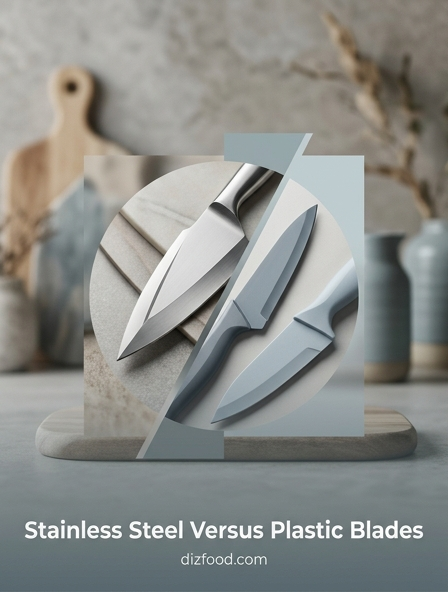
Durability Comparison Between Stainless Steel and Plastic Blades
In the high-pressure environment of a commercial or domestic kitchen, durability is the primary metric for assessing the value of a blade. Stainless steel blades are engineered for high-tensile strength and hardness, typically ranging between 52 and 62 on the Rockwell Scale (HRC). This structural rigidity allows them to withstand the rigorous demands of chopping through dense root vegetables, fibrous meats, and even small bones without warping or catastrophic failure. The molecular density of steel ensures that it remains intact under significant mechanical stress over years of consistent use.
Conversely, plastic blades-often composed of reinforced polycarbonate or acetal polymers-offer a different type of durability. While they lack the absolute hardness of metal, they possess a degree of elasticity that prevents snapping when subjected to lateral torque. However, their lifespan is significantly shorter when exposed to high-friction tasks. In a head-to-head comparison, stainless steel is the clear victor for longevity, whereas plastic is often treated as a semi-disposable tool designed for specific niche applications where metal would be overkill or too aggressive.
| Feature | Stainless Steel | Plastic Polymer |
|---|---|---|
| Hardness (HRC) | 52-62 | Minimal |
| Lifespan | Multi-year | Short-term/Disposable |
| Resistance to Heat | Excellent | Moderate to Low |
Surface Safety and Preventing Scratches with Plastic Edges
The primary advantage of plastic blades in a kitchen context is their inherent safety regarding delicate surfaces. Modern kitchens are filled with materials that are easily marred by traditional metal edges, such as Teflon-coated non-stick pans, ceramic-glass cooktops, and polished marble countertops. Using a stainless steel scraper on a non-stick surface can instantly strip the fluoropolymer coating, rendering the cookware dangerous and ineffective. Plastic edges are specifically designed to provide enough mechanical force to lift debris without gouging the underlying substrate.
These blades function by being softer than the surface they are cleaning. Because the polymer edge yields before the glass or ceramic does, the risk of permanent scratching is virtually eliminated. This makes plastic blades the superior choice for "soft-touch" maintenance tasks. Below are common surfaces where plastic blades are mandatory to maintain structural and aesthetic integrity:
- Non-stick pans (PTFE and Ceramic coatings)
- Induction glass-ceramic stovetops
- Highly polished stainless steel backsplashes
- Softwood cutting boards used for dough preparation
- Acrylic or polycarbonate storage containers
By utilizing plastic edges for these specific scenarios, kitchen staff can ensure that expensive equipment remains in pristine condition, avoiding the micro-fissures where bacteria can often hide and proliferate.
Precision and Sharpness Retention in Metal Versus Polymer
Precision in the kitchen is defined by the ability of a blade to separate fibers with minimal cellular damage. Stainless steel is the gold standard for this requirement due to its ability to be ground to a microscopic "V" or "chisel" edge. The crystalline structure of steel allows for sharpening at acute angles, often between 15 and 20 degrees, which is necessary for tasks like julienne slicing or filleting fish. Furthermore, the inclusion of carbon and chromium in the alloy ensures that the edge remains "keen" through hundreds of cycles before requiring honing.
Plastic blades, by contrast, cannot hold a precision edge. The molecular bonds in polymers are too large and flexible to be honed to a microscopic point. While a plastic blade can be "sharp" enough to cut through soft dough or spread butter, it lacks the biting force to penetrate tomato skins or the tough exterior of a squash. Sharpness retention in plastic is virtually non-existent; once the edge is blunted by friction, it must be discarded or reground, though the latter rarely restores original functionality. For any task requiring a clean, surgical cut, metal is the only viable option. The choice between the two often comes down to the required "fineness" of the result, with metal providing the thinness necessary for professional presentation and polymer providing the blunt force needed for simple separation tasks.
Best Industrial Applications for Stainless Steel Cutting Tools
Industrial kitchen environments require tools that can operate continuously without failure. Stainless steel is the backbone of high-volume food processing because it can handle the thermal and mechanical loads of automated machinery. In industrial meat processing, for example, high-carbon stainless steel blades are used in large-scale grinders and slicers where they must maintain their integrity despite encountering frozen materials or heavy connective tissues. The thermal stability of steel also allows it to be used in high-heat industrial ovens for scraping residues while the equipment is still hot, a task that would melt most plastic alternatives.
Beyond simple cutting, stainless steel is utilized in industrial applications for its weight and balance. The mass of a steel blade provides the necessary inertia for heavy-duty tasks, reducing the physical strain on operators or motors. The following list highlights the primary industrial use-cases for stainless steel tooling:
- High-speed rotary slicers for commercial produce prep
- Heavy-duty bone saws in butchery operations
- Industrial dough dividers and rounders
- Large-scale commercial immersion blender blades
- High-torque scrapers for flat-top commercial griddles
In these settings, the cost of downtime for blade replacement is high, making the long-term reliability of stainless steel more economically viable than any polymer substitute.
When to Choose Plastic Scraper Blades for Delicate Tasks
There are specific moments in kitchen maintenance and food prep where the strength of steel becomes a liability. Plastic scraper blades are the tool of choice for delicate tasks that require precision without the threat of incision or surface damage. One of the most common applications is in the pastry arts. When working with delicate puff pastry or high-hydration sourdough, a metal blade can often "tear" or stick to the gluten structure. A plastic bench scraper, however, provides a smoother release and enough flexibility to follow the curve of a mixing bowl, ensuring every gram of ingredient is recovered without scratching the bowl's finish.
Another critical use case is the removal of adhesives or burnt-on organic matter from glass surfaces. If a new piece of kitchen equipment arrives with industrial stickers, a plastic blade can safely lift the adhesive without leaving behind the permanent "swirl marks" that metal would cause. Furthermore, in kitchens that prioritize safety training for junior staff, plastic blades serve as excellent introductory tools for scraping tasks, significantly reducing the risk of deep lacerations. Selecting plastic is not a sign of inferior quality, but rather a calculated decision to prioritize surface protection and user safety in environments where high-impact cutting is not the primary objective.
Corrosion Resistance and Material Longevity Analysis
The longevity of a blade is not just a function of its hardness, but also its chemical resistance to the kitchen environment. Kitchens are inherently corrosive; they involve constant exposure to water, salt, organic acids (like citrus and vinegar), and caustic cleaning chemicals. Stainless steel gains its "stainless" property from a chromium oxide layer that prevents rust. However, even high-quality steel can suffer from pitting or "crevice corrosion" if left in contact with acidic foods for prolonged periods. The longevity of a metal blade is therefore dependent on proper maintenance, including immediate drying and periodic oiling.
Plastic blades offer a different profile of chemical resistance. They are entirely immune to oxidation (rusting) and are generally unaffected by the weak acids found in food. This makes them ideal for tasks involving long-term exposure to brine or acidic marinades where steel might eventually degrade. However, polymers are susceptible to "environmental stress cracking" and can become brittle if exposed to harsh UV light or certain industrial degreasers over time. While steel survives through physical toughness, plastic survives through chemical inertness. The choice depends on whether the primary threat to the tool is mechanical wear or chemical degradation.
| Factor | Stainless Steel (304/440) | Plastic (Polypropylene/Acetal) |
|---|---|---|
| Rust Resistance | High (but not absolute) | Total |
| Acid Sensitivity | Can pit over time | Inert |
| Heat Deformation | Negligible at kitchen temps | High risk over 250°F |
Hygiene and Sanitization Standards for Food Grade Blades
Hygiene is non-negotiable in food preparation, and the choice of blade material significantly impacts the ease of sanitization. Stainless steel is the preferred material for meeting NSF (National Sanitation Foundation) standards because it is non-porous and can withstand extreme heat. This allows metal blades to be sanitized in high-temperature commercial dishwashers or via autoclaving without any risk of structural melting. The smooth surface of polished steel prevents the accumulation of "biofilms," which are colonies of bacteria that can cling to microscopic imperfections. Because steel does not scratch easily, there are fewer places for pathogens like E. coli or Salmonella to hide.
Plastic blades present a more complex hygiene profile. While the material itself is non-porous, it is much softer than steel and develops micro-scratches almost immediately upon use. These tiny grooves can harbor food particles and bacteria, making manual cleaning less effective over time. To maintain hygiene standards, plastic blades must be replaced frequently or treated with specialized antimicrobial coatings. Additionally, users must ensure that the plastic is "Food Grade" and BPA-free to prevent the leaching of chemicals into the food supply. For high-risk environments like raw meat processing, the heat-sterilizable nature of stainless steel remains the industry benchmark for food safety and public health compliance.
Cost Effectiveness and Lifecycle Value of Blade Materials
Analyzing the cost of kitchen blades requires looking beyond the initial purchase price to the "Total Cost of Ownership" (TCO). Stainless steel blades represent a higher upfront investment. A professional-grade chef's knife or industrial scraper can cost ten to fifty times more than its plastic counterpart. However, when maintained properly, a steel blade can last decades. The lifecycle value is found in its ability to be resharpened; a single investment can serve a kitchen through thousands of service hours, making the "cost per use" incredibly low over several years.
Plastic blades follow a "low-margin, high-volume" economic model. They are inexpensive to purchase in bulk, which is advantageous for high-turnover environments or for tasks where blades are likely to be lost or damaged. However, because they cannot be effectively sharpened and degrade under thermal stress, they require frequent replacement. Over a five-year period, a kitchen might spend more on a constant supply of disposable plastic scrapers than they would on a single, high-quality stainless steel tool. The cost-effectiveness of plastic is highest in specific scenarios: when the risk of damaging an expensive surface is high, or when the tool is used for messy substances like adhesives that would require labor-intensive cleaning on a metal blade. For general cutting, the long-term ROI overwhelmingly favors stainless steel.
Impact Resistance and Structural Integrity Under Pressure
When a blade encounters an unexpected obstacle-such as a bone or a frozen fragment-its structural integrity is put to the test. Stainless steel is prized for its high modulus of elasticity, meaning it can absorb a significant amount of energy before permanently deforming. However, extremely hard steel (high HRC) can be brittle; if dropped on a stone floor or struck against a hard object, the edge may "chip." This necessitates a balance in metallurgy between hardness for cutting and toughness for impact resistance. Modern stainless blades often use a "tempered" core to provide a mix of these two properties.
Plastic blades handle impact through flexibility. Instead of chipping or snapping, a plastic blade will typically "flex" or "roll" its edge. While this prevents the blade from shattering into dangerous shards, it results in an immediate loss of function. In high-pressure industrial scrapers, plastic can fail by "shearing" off at the handle if the resistance is too great. This acts as a safety mechanical fuse, preventing damage to the machine itself by failing before the motor or the surface does. Understanding these failure modes is essential for kitchen safety:
- Steel failure: Chipping or snapping (creates sharp shards).
- Plastic failure: Warping, melting, or shearing (creates dull fragments).
- Steel under pressure: Holds shape until the breaking point.
- Plastic under pressure: Deforms gradually, providing tactile feedback to the user.
Final Verdict Selecting the Right Blade for Your Project
Choosing between stainless steel and plastic blades is not a matter of quality, but of application. The final verdict depends entirely on the substrate you are working with and the desired outcome. For any task involving the precision cutting of organic tissues-such as slicing, dicing, or deboning-stainless steel is the undisputed choice. Its ability to hold a microscopic edge and its superior hygiene through heat sterilization make it the only professional option for primary food preparation. Its durability ensures that it remains a permanent fixture in the kitchen's inventory.
Plastic blades should be viewed as specialized safety tools. Their value lies in what they *don't* do: they don't scratch glass, they don't strip non-stick coatings, and they don't conduct heat as quickly as metal. They are the ideal choice for cleaning modern cookware and handling delicate pastry work where a gentle touch is required. In a well-equipped kitchen, these materials should coexist. Use steel for the "heavy lifting" of prep work and industrial cutting, and keep a set of high-quality polymer scrapers for maintenance and delicate finishing. By matching the material hardness to the task at hand, you maximize the lifespan of your tools and the quality of your culinary output.



Comments