
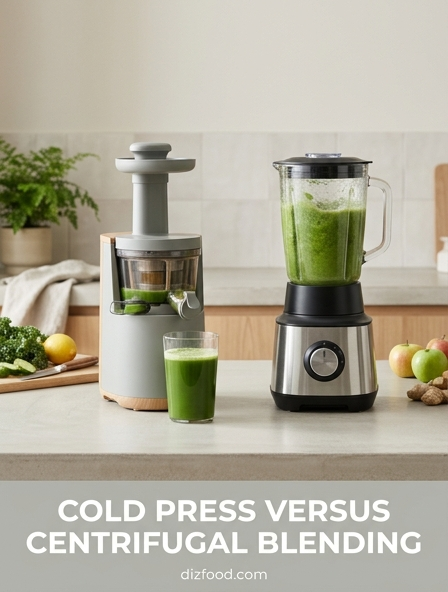
Choosing the right juicer can feel like a science experiment, but it ultimately boils down to how much vitality you want to preserve in your glass. While centrifugal juicers are the high-speed sprinters of the kitchen-using fast-spinning blades that generate heat and friction-cold press (or masticating) juicers take a slower, more deliberate approach. By gently crushing and squeezing produce at low speeds, cold press technology minimizes oxidation and protects the delicate enzymes and phytonutrients that are often compromised by high-heat extraction. If you are looking to maximize your nutritional ROI and want a juice that maintains its integrity for days rather than minutes, understanding the mechanical trade-offs between these two methods is essential for your wellness routine.
| Feature | Cold Press (Masticating) | Centrifugal Extraction |
|---|---|---|
| Mechanism | Slow-turning auger (40-80 RPM) | High-speed spinning blade (3,000-16,000 RPM) |
| Nutrient Retention | Maximum; minimal heat & low oxidation | Lower; heat friction can denature enzymes |
| Juice Yield | High (efficient extraction; bone-dry pulp) | Moderate (wetter pulp; less efficient) |
| Shelf Life | Up to 72 hours (stable nutrients) | Best consumed within 20-30 minutes |
| Best For | Leafy greens, wheatgrass, and soft fruits | Hard vegetables (carrots, apples) and speed |
| Noise & Heat | Quiet operation; no heat transfer | Loud (blender-like); significant heat buildup |
Understanding Cold Press Nutrient Retention
Cold press juicing, also known as masticating juicing, operates on the principle of slow extraction to preserve the inherent nutritional profile of fruits and vegetables. Unlike high-speed methods that rely on sharp blades, cold press juicers utilize a rotating auger to crush and squeeze produce against a mesh screen. This mechanical process mimics human chewing, ensuring that the cellular structure of the plant is broken down gently without the introduction of excessive force or high temperatures.
The primary advantage of this method lies in its ability to keep the juice "alive." By avoiding the violent shredding typical of traditional juicers, the delicate phytonutrients and micronutrients remain intact. This is particularly important for home chefs and health enthusiasts who view juicing as a form of liquid supplementation. The slow extraction process ensures that the liquid remains at room temperature, which is the ideal state for maintaining the biological activity of the ingredients.
- Minimal friction prevents the early breakdown of plant cells.
- Slow RPM (revolutions per minute) limits the amount of air incorporated into the liquid.
- Dense nutrients such as chlorophyll and anthocyanins are extracted more efficiently.
- The mechanical pressing action draws out minerals trapped deep within the fibrous skins.
Ultimately, the retention of nutrients in cold press juicing is significantly higher than in traditional blending or centrifugal methods. Research indicates that certain heat-sensitive vitamins, such as Vitamin C and various B vitamins, are preserved at much higher concentrations when the extraction process avoids high-speed mechanical friction.
The Impact of Centrifugal Heat on Juice Quality
Centrifugal juicers are popular for their speed and convenience, utilizing a flat cutting blade that spins at extremely high velocities-often between 3,000 and 16,000 RPM. While this allows for the rapid transformation of whole apples or carrots into juice, it introduces a significant amount of heat due to the friction between the metal blade and the produce. This rise in temperature, even if slight, can trigger the degradation of sensitive organic compounds.
When produce is subjected to this heat, the molecular stability of the juice is compromised. Many enzymes that facilitate digestion and metabolic function are thermolabile, meaning they begin to denature when exposed to temperatures above a certain threshold. The high-speed rotation also acts like a fan, drawing in large volumes of air that further contribute to the rapid decline of juice quality.
- Frictional heat causes immediate thermal degradation of sensitive antioxidants.
- High-speed blades shred produce, increasing the surface area exposed to oxygen.
- Rapid rotation creates a frothy, aerated texture that indicates early spoilage.
- The separation of solids and liquids occurs almost immediately after extraction.
For those prioritizing the medicinal or therapeutic qualities of juice, the heat generated by centrifugal models represents a significant drawback. The resulting liquid often appears lighter in color and develops a layer of foam on top, both of which are visual indicators that the juice has already begun to lose its potency before it even reaches the glass.
Masticating vs Centrifugal Oxidation Levels
Oxidation is the chemical process that occurs when juice is exposed to oxygen, leading to the browning of the liquid and the loss of nutritional value. In the context of kitchen appliances, the level of oxidation is directly correlated to the extraction speed. Masticating juicers operate at a slow, steady pace, which significantly reduces the amount of air mixed into the juice. In contrast, centrifugal juicers act as high-speed aerators, forcing oxygen into every drop of liquid as it is flung against the filter walls.
This difference in oxidation levels is not merely aesthetic; it impacts the flavor, smell, and health benefits of the final product. High oxidation levels lead to a metallic taste and a watery consistency, while low oxidation preserves the rich, vibrant flavors of the original produce. The table below highlights the key differences observed during the oxidation process between these two popular methods.
| Feature | Masticating (Cold Press) | Centrifugal (High Speed) |
|---|---|---|
| Oxygen Exposure | Minimal; slow pressing action. | High; rapid spinning draws in air. |
| Color Retention | Vibrant and deep hues. | Dull; prone to rapid browning. |
| Foam Content | Very low to none. | Significant foam and froth. |
| Flavor Profile | Rich and concentrated. | Diluted and often metallic. |
By minimizing oxidation, masticating juicers ensure that the juice remains stable for a longer period. This allows users to prepare larger batches of juice at once without fearing that the nutrients will vanish within minutes of extraction.
Maximizing Vitamin Density with Slow Juicing
The density of vitamins in a glass of juice is the primary metric for its success as a health beverage. Slow juicing excels in this area by ensuring that the maximum amount of liquid is extracted from the fibrous pulp. Because the auger presses the produce so tightly against the screen, it forces out the "interstitial fluid" found between the plant cells, which contains the highest concentration of vitamins and minerals.
Vitamins like Vitamin A (beta-carotene) and Vitamin K are particularly well-preserved through slow juicing. These fat-soluble vitamins are often bound to the fiber of the plant; the crushing action of a cold press juicer is more effective at unbinding these nutrients than the slicing action of a high-speed blade. Furthermore, the lack of heat prevents the breakdown of water-soluble vitamins like Vitamin C, which is notoriously sensitive to environmental changes.
- Greater extraction of phytonutrients from the skins and seeds.
- Better preservation of folate and other B-complex vitamins.
- Increased bio-availability of nutrients due to gentle processing.
- Higher concentration of electrolytes in the final juice.
When you consume juice from a slow extractor, you are essentially drinking a concentrated form of the plant's life force. The density of the liquid is noticeably thicker, and the lack of watery separation ensures that every sip provides a consistent dose of the intended vitamins. For individuals managing chronic conditions through nutrition, this density is a critical factor in their daily regimen.
Juice Yield Comparison for Leafy Greens
One of the most significant differences between cold press and centrifugal juicing is seen when processing leafy greens. Herbs, kale, spinach, and wheatgrass are notoriously difficult to juice because they are thin and light. A centrifugal juicer often struggles with these items, as the high-speed blades tend to fling the leaves into the pulp bin before any significant amount of juice can be extracted. This results in a very low yield and a significant waste of expensive organic produce.
Cold press juicers, however, are designed to handle these materials with ease. The auger grabs the leaves and crushes them slowly, effectively wringing the juice out of the thin fibers. This leads to a much drier pulp and a significantly higher volume of juice. For users who prioritize green juices, the cost-benefit analysis heavily favors the cold press method due to the reduced waste of ingredients over time.
| Produce Type | Cold Press Yield | Centrifugal Yield |
|---|---|---|
| Kale/Spinach | Very High (70-80%) | Low (20-30%) |
| Wheatgrass | Excellent | Not Recommended |
| Cucumbers | High | High |
| Apples/Pears | Moderate | High |
As shown, while centrifugal juicers are efficient for hard fruits like apples or watery vegetables like cucumbers, they fail to perform adequately with leafy greens. For a health-conscious kitchen, the ability to extract every drop of liquid from a bunch of kale is essential for both nutritional density and economic efficiency.
How Blending Speed Affects Enzyme Preservation
Enzymes are protein molecules that act as catalysts for thousands of biochemical reactions in the human body. In the context of raw juicing, these enzymes assist in the digestion and absorption of the juice itself. However, enzymes are highly delicate and can be easily destroyed by mechanical stress and heat. The speed at which a juicer or blender operates is a primary factor in whether these enzymes remain functional or become denatured and useless.
Low-speed masticating juicers typically operate at 40 to 80 RPM. This gentle pace preserves the structural integrity of the enzymes. On the other hand, high-speed blenders and centrifugal juicers can exceed 20,000 RPM. At these speeds, the "shearing" force-the physical tearing of molecules-is so intense that it can break the bonds that hold enzymes together. Once an enzyme's shape is altered, it can no longer perform its specific biological function.
- Slow speeds prevent "thermal shock" to raw enzymes.
- Gentle pressing maintains the "living" quality of the juice.
- Cold-pressed juice supports better digestive health due to active enzymes.
- High-speed shearing leads to immediate protein denaturation.
By choosing a slower extraction method, you ensure that the juice remains a bio-active substance. This is particularly important for people using juice for digestive therapy or to boost their metabolic rate. The preservation of these living catalysts is what differentiates a fresh, functional beverage from a simple flavored drink found on a grocery store shelf.
Shelf Life Differences in Extraction Methods
The shelf life of fresh juice is determined by the rate of oxidation and microbial growth, both of which are influenced by the extraction method. Because cold press juicers introduce very little air into the liquid, the resulting juice is much more stable. When stored in an airtight glass container, cold-pressed juice can maintain its nutritional integrity and flavor for up to 72 hours. This makes it ideal for individuals who prefer to "batch juice" twice a week rather than cleaning their machine every day.
Centrifugal juice, conversely, has a very short shelf life. Due to the high levels of aeration and the heat generated during extraction, the oxidation process begins immediately. Within 20 to 30 minutes, the juice will often begin to separate, change color, and lose its fresh taste. For this reason, centrifugal juice must be consumed immediately to gain any significant nutritional benefit.
- Cold press juice remains stable for 48 to 72 hours in refrigeration.
- Centrifugal juice should be consumed within 30 minutes of extraction.
- The lack of foam in cold-pressed juice prevents rapid bacterial growth.
- Air-tight bottling is more effective for juices with low initial oxygen content.
The extended shelf life of cold-pressed juice offers a level of convenience that high-speed juicers cannot match. For a busy lifestyle, the ability to store juice for several days without a significant drop in quality is a major advantage that justifies the slower initial extraction time.
Texture and Consistency Analysis of Juicing Styles
The "mouthfeel" of juice is a subjective but important aspect of the juicing experience. Cold press juicers produce a juice that is noticeably thicker, smoother, and more "full-bodied." This is because the pressing action allows some of the very fine, soluble fibers to pass through the mesh, resulting in a liquid that feels substantial. The juice is typically uniform in color and does not separate into layers of water and solids, even after sitting for a few hours.
In contrast, centrifugal juicing produces a thinner, more watery liquid that is often topped with a thick layer of foam. This foam is the result of air being whipped into the juice at high speeds and can be unpleasant for some drinkers. Furthermore, centrifugal juice is prone to rapid "stratification," where the heavier solids settle at the bottom and the lighter liquid rises to the top. This requires constant stirring to maintain a consistent flavor profile throughout the glass.
- Cold press: Silky texture with integrated micro-fiber.
- Centrifugal: Watery consistency with a frothy head.
- Cold press: No separation; the liquid remains homogenous.
- Centrifugal: Quick separation requires immediate consumption.
For those who enjoy a rich, nectar-like consistency, the cold press method is superior. It provides a more satisfying drinking experience that feels closer to eating the whole fruit or vegetable, whereas centrifugal juice can feel more like flavored water. This difference in texture also makes cold-pressed juice a better base for cocktails, mocktails, and culinary sauces.
Maintenance and Cleaning for Different Juicers
The utility of a kitchen appliance is often judged by how easy it is to maintain and clean. There is a common misconception that cold press juicers are harder to clean because they are more complex. While it is true that they have more specialized parts-such as the auger, the juicing screen, and the silicone scrapers-they are often easier to rinse because they don't have the sharp, dangerous blades found in centrifugal models.
Centrifugal juicers have a large, circular mesh basket with hundreds of tiny teeth that shred the produce. This basket is notoriously difficult to clean, as the fibers become deeply embedded in the mesh. Without immediate scrubbing with a stiff brush, the pulp can dry and clog the holes, rendering the machine ineffective. Additionally, the large plastic housings of centrifugal juicers take up more space in the sink and dishwasher.
- Cold press parts usually require a simple rinse if done immediately.
- Centrifugal baskets require vigorous scrubbing to remove embedded fibers.
- Masticating juicers often come with specialized brushes for the auger.
- Centrifugal juicers have larger chutes, reducing prep time but increasing cleaning bulk.
While the cold press juicer requires more time for "pre-cutting" produce to fit into the smaller chute, the actual cleanup time is often comparable or even shorter than that of a centrifugal model. For the daily juicer, the ease of maintenance is a vital factor in ensuring the habit remains sustainable over the long term.
Long Term Health Benefits of Cold Pressing
Investing in a cold press juicer is often viewed as a long-term investment in one's health. The superior nutrient retention and enzyme preservation translate to a more potent therapeutic tool. Regular consumption of cold-pressed juice can lead to improved digestion, higher energy levels, and a stronger immune system. Because the juice contains concentrated amounts of antioxidants, it is highly effective at reducing systemic inflammation and oxidative stress within the body.
The high yield and ability to juice leafy greens mean that users are more likely to consume a wider variety of vegetables that they might otherwise avoid. Over time, the cumulative effect of consuming these high-quality micro-nutrients can have a profound impact on skin health, cognitive function, and metabolic balance. Furthermore, the ability to batch-prep juice makes it easier to stick to a healthy routine even during busy work weeks.
- Consistent intake of "living" enzymes aids in gut repair.
- High antioxidant levels help combat age-related cellular damage.
- Efficient mineral absorption supports bone and dental health.
- Reduced waste makes high-quality organic juicing more affordable over time.
When comparing the two methods over a period of years, the cold press approach provides a higher "return on investment" regarding health outcomes. While the initial cost of the machine may be higher, the quality of the juice produced ensures that every ounce of produce is used to its fullest potential, providing the body with the cleanest, most nutrient-dense fuel possible.


Comments