
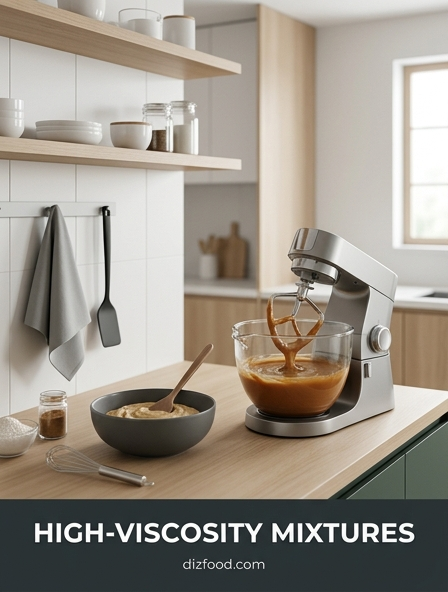
Understanding High Viscosity Ingredients
High viscosity refers to the internal friction of a substance, describing its inherent resistance to flow and gradual deformation. In a culinary context, this manifests as ingredients like thick honey, date pastes, heavy creams, and nut butters. Unlike water-based liquids that move freely, high-viscosity materials cling to surfaces and resist the mechanical motion of mixing tools. Understanding the rheology of these ingredients is essential for selecting the correct kitchen equipment, as they require significantly more energy to shear and move within a container.
Common high-viscosity ingredients found in professional and home kitchens include:
- Nut and seed butters (peanut, almond, tahini)
- Thick vegetable purees (hummus, concentrated pumpkin)
- Heavy doughs (bread dough, chilled cookie mix)
- Natural sweeteners (molasses, agave, honey)
- Frozen fruit bases (acai bowls, fruit sorbets)
Processing these requires a delicate balance between mechanical force and temperature control. Without enough moisture to act as a lubricant, the mixture can become stagnant, leading to inefficient blending or potential equipment failure. Success relies on managing the substance's natural resistance through superior mechanical advantage and appropriate technique.
The Role of High Torque Motors
High torque motors are the structural backbone of heavy-duty kitchen appliances, specifically engineered to overcome the physical resistance offered by dense and sticky mixtures. While many consumers focus on horsepower or high rotations per minute (RPM), torque is the actual measure of rotational force. When a blade encounters a thick mass, such as refrigerated fudge or thick hummus, the drag can cause standard motors to stall. High torque ensures that the blades maintain consistent rotation despite the immense physical pressure exerted by the ingredients.
| Feature | Significance in Viscous Blending |
|---|---|
| Starting Torque | Initiates movement in static, heavy masses without stalling. |
| Continuous Power | Maintains consistent speed under heavy load. |
| Thermal Management | Protects the motor from burnout during long processing cycles. |
The relationship between torque and viscosity is critical; as the density of the mixture increases, the demand for torque rises proportionally. Professional-grade machines often utilize sophisticated cooling systems to dissipate the heat generated by this work, allowing for the successful processing of challenging recipes that would otherwise destroy standard kitchen appliances.
Blade Engineering for Dense Mixtures
Blade design for high-viscosity mixtures differs significantly from standard liquid-processing blades. In a dense environment, the goal is not just to cut, but to create a consistent flow and prevent the formation of air pockets. High-viscosity blades are often thicker and manufactured from hardened stainless steel to prevent bending under pressure. Their geometry is specifically calculated to pull the heavy mass downward into the cutting path, rather than simply spinning it around the perimeter of the container.
The engineering process focuses on several key factors:
- Wingtip Design: Specialized angles that create a powerful downward vortex.
- Surface Area: Increased blade surface to contact more of the dense mixture simultaneously.
- Beveled Edges: Precision-ground edges that can slice through fibrous skins and seeds.
- Bearing Assemblies: Heavy-duty seals that prevent thick liquids from leaking into the motor base.
By optimizing the pitch and angle of the blades, manufacturers ensure that the machine can handle the "impact" phase of blending. This engineering allows for a smoother transition from whole solids to a homogenized, high-viscosity paste without requiring excessive amounts of added liquid or oil.
Mastering the Tamper for Even Flow
The tamper is perhaps the most essential tool when dealing with high-viscosity blends in a high-speed blender. Its primary function is to eliminate "bridging," a phenomenon where an air pocket forms around the blade, causing the mixture to stop moving even while the motor is running. By manually pushing the ingredients back into the blades, the user ensures that every part of the mixture is processed evenly. This is particularly vital for recipes with very low moisture content, such as raw nut butters or thick fruit sorbets.
Effective tamper usage involves several specific techniques:
- Circular Motion: Stirring the corners of the container to push ingredients toward the center.
- Vertical Pushes: Driving frozen or dry ingredients directly into the blade path.
- Timing: Using the tamper continuously during the first 30 seconds of a thick blend.
- Safety: Ensuring the tamper collar prevents the tool from ever touching the moving blades.
Using a tamper correctly reduces the strain on the motor by keeping the load consistent. It also speeds up the blending process, which is crucial for maintaining the temperature and nutritional integrity of the ingredients being processed.
Managing Heat Friction in Thick Blends
When processing high-viscosity mixtures, the friction generated by the blades moving through the dense mass can create significant heat. In many cases, this is an unintended side effect that can alter the flavor, color, or nutritional value of the food. For example, when making raw nut butters, excessive heat can cause the oils to oxidize or give the butter a "cooked" flavor. Conversely, in some applications like making thick soups or fondues, this friction-induced heat is used intentionally to cook or melt the ingredients.
To manage friction heat effectively, consider these strategies:
- Short Pulses: Use the pulse function to break down large pieces without continuous heat buildup.
- Pre-chilling: Chill the container or the ingredients before blending to offset the friction.
- Speed Control: Lowering the RPM can sometimes reduce the heat generation rate.
- Batch Size: Processing smaller batches can allow heat to dissipate more quickly.
Understanding the "thermal ceiling" of your ingredients is vital. If a mixture begins to smoke or smell toasted, it is a sign that the molecular friction has exceeded the desired threshold, requiring an immediate pause in processing to allow the container and motor to cool.
Techniques for Perfect Nut Butters
Creating nut butters from scratch is the ultimate test of a kitchen's high-viscosity capabilities. The process involves breaking down the cellular structure of nuts to release their natural oils, turning a solid into a creamy, flowing paste. This requires patience and a specific sequence of actions to ensure the motor does not overheat while the mixture transitions through various stages of thickness. The most challenging phase is the "dough" stage, where the mixture is at its most viscous and resistant.
Key steps for achieving a professional finish include:
- Roasting: Lightly roasting nuts helps release oils more easily during blending.
- Incremental Speed: Start on the lowest setting to crush, then ramp up to high for emulsification.
- Continuous Tampering: Essential for keeping the thick paste in contact with the blades.
- Cooldown Periods: If the blender becomes hot to the touch, stop and wait 5 minutes.
A successful nut butter should have a glossy sheen, indicating that the oils have been fully emulsified with the solids. Achieving this without adding external oils is a hallmark of mastering high-viscosity kitchen techniques and high-performance equipment utilization.
Achieving Smoothness in Heavy Batches
Smoothness in heavy, viscous batches is defined by the absence of grit and the complete homogenization of all ingredients. In dense media, the particles are held in place by the thickness of the surrounding liquid, making it harder for them to reach the blades for further reduction. Achieving a silken texture in something as thick as a white bean puree or a cashew cream requires sustained high-speed shearing. The goal is to reduce the particle size of the solids until they are below the threshold of human tongue perception.
| Ingredient Type | Requirement for Smoothness |
|---|---|
| Fibrous Vegetables | High-speed shearing to break down cellulose. |
| Soaked Grains/Nuts | Longer processing time to ensure full emulsification. |
| Sticky Fruits | Frequent tampering to prevent uneven "chunks." |
To ensure perfect results, it is often helpful to process the thickest parts of the recipe first before adding any final stabilizers or thickeners. This ensures that the base is as smooth as possible before the viscosity reaches its maximum level, which would otherwise hinder the movement of remaining small particles.
Power Settings for Maximum Efficiency
Using the correct power settings is vital for the longevity of your equipment and the quality of the blend. A common mistake when dealing with high-viscosity mixtures is running the motor at a speed that is too low. While it seems counterintuitive, most high-performance blenders rely on high speeds to activate their internal cooling fans. Running a thick mixture on a low speed can cause the motor to struggle and overheat quickly because the fan is not spinning fast enough to provide adequate airflow.
The ideal power workflow for thick mixtures is as follows:
- Start at the lowest speed setting to begin the initial breakdown of solids.
- Quickly ramp up to the highest speed within the first 5 to 10 seconds.
- Maintain high speed while using the tamper to keep the mixture circulating.
- Drop back to a lower speed only for the final few seconds if folding in ingredients.
By operating at maximum speed, you utilize the motor's full cooling capacity and the blades' maximum shearing force. This efficiency reduces the total time the ingredients are under stress, resulting in a better final texture and a healthier motor.
Preventing Motor Overload and Cavitation
Cavitation occurs when a vacuum or air pocket forms around the blades, preventing them from contacting the mixture. In high-viscosity blending, this is usually indicated by a sudden change in the motor's pitch-a high-pitched "whirring" sound. If left unaddressed, cavitation leads to localized heating and inconsistent results. More importantly, it can lead to motor overload if the user tries to compensate by increasing speed without fixing the air pocket, potentially triggering the machine's thermal protection shut-off.
To prevent these issues, observe the following signs:
- Audible Pitch Change: A sign that the blades are spinning in air, not food.
- Visual Stagnation: The top of the mixture is not moving or swirling.
- Burning Smell: An immediate indicator of motor strain or friction.
- Reduced Output: The blades are spinning but the texture is not changing.
The solution is always to stop the machine, use the tamper to press the ingredients down and burst the air pocket, or add a very small amount of liquid to facilitate flow. Modern blenders often have automatic shut-off sensors to prevent permanent damage, but manual prevention is always the best practice.
Texture Control for Gourmet Results
In gourmet cooking, texture is as important as flavor. High-viscosity mixtures offer a unique opportunity to create various mouthfeels, from the airy lightness of a thick mousse to the dense, rich "chew" of a professional-grade gelato. Texture control is achieved by manipulating the air incorporation and the duration of the blend. Short, high-power bursts can maintain a "chunky" or "rustic" texture, while sustained blending creates a high-gloss, ultra-smooth finish that coats the palate.
Visual and tactile cues for texture control include:
- The Ribbon Stage: When the mixture falls from a spoon in a thick, continuous "ribbon" that holds its shape.
- The Gloss Factor: A shiny surface indicates that fats have been fully emulsified into the solids.
- Vortex Stability: A consistent, four-sided fold at the top of the blender indicates a perfect homogenized flow.
Mastering these nuances allows a chef to customize the experience of a dish. Whether it is a perfectly thick hollandaise or a dense, velvety ganache, the ability to manipulate high-viscosity mixtures with precision is the hallmark of advanced culinary skill. By controlling the mechanical variables, you ensure consistent, professional results every time.




Comments