
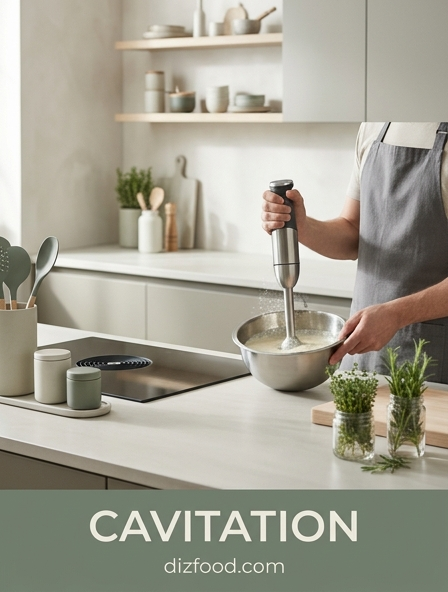
Understanding Blender Cavitation Mechanics
In high-speed blending, cavitation occurs when the blades spin so rapidly that they create a low-pressure zone, resulting in a localized air pocket. This pocket isolates the blades from the ingredients, causing the motor to whine at a high pitch while the food remains stationary. Understanding this fluid dynamic is crucial for culinary precision. When the liquid cannot fill the void left by the spinning blade fast enough, vapor bubbles form and collapse, which can potentially damage the blade surface over time and stall the blending process.
Managing this phenomenon requires a balance of speed, ingredient density, and mechanical intervention. Cavitation is not merely a nuisance; it represents a failure of the vortex, the circular flow that pulls ingredients downward into the cutting path. By recognizing the sound of a "hollow" spin, a cook can identify cavitation before the motor overheats. Factors such as viscosity and centrifugal force determine whether the mixture will cycle smoothly or fail to engage with the spinning assembly. Mastering these mechanics allows for more efficient processing of tough, fibrous, or frozen materials.
Optimal Ingredient Layering Techniques
Correct layering is the primary defense against premature cavitation and motor strain. The goal is to create a heavy mass that naturally presses down onto the blades, ensuring they always have material to process. Proper layering utilizes gravity to maintain constant contact between the blades and the food, ensuring that the air gap responsible for cavitation never has the opportunity to form at the base of the pitcher.
- Liquids: Add water, juice, or milk first to lubricate the blades and initiate the vortex.
- Powders: Add proteins, spices, or flours next so they dissolve quickly without clumping.
- Soft Solids: Incorporate yogurts, nut butters, or fresh fruits to build the base texture.
- Hard Solids: Place ice or frozen chunks at the very top to act as a weight.
This arrangement ensures that the blades immediately engage with liquid, creating a small vortex that gradually pulls the heavier items down. If ice is placed at the bottom, the blades may spin fruitlessly beneath the frozen layer, creating a bridge that prevents any further processing of the ingredients above.
Perfecting Liquid to Solid Ratios
Maintaining a specific ratio of liquid to solid is essential for a continuous cycle. Too much solid material increases internal friction, leading to the "bridge" effect where ingredients hang above the blades. Conversely, too much liquid may prevent the proper emulsification of fats. The following table provides a general guideline for common kitchen preparations to avoid cavitation:
| Preparation | Liquid Ratio | Solid Ratio | Target Consistency |
|---|---|---|---|
| Fruit Smoothie | 40% | 60% | Fluid yet thick |
| Vegetable Purée | 30% | 70% | Velvety and dense |
| Nut Butter | 5% | 95% | Heavy, sticky paste |
| Frozen Dessert | 15% | 85% | Soft-serve texture |
When working with high-viscosity items like nut butters, the risk of cavitation is highest. In these scenarios, the lack of moisture means the "vortex" is almost non-existent. For standard blends, ensuring at least twenty-five percent liquid volume usually provides enough lubrication to keep the ingredients circulating without the blades spinning in a vacuum.
Variable Speed Control Strategies
Many users mistakenly believe that starting a blender at maximum speed is the most efficient path to a smooth result. However, immediate high-speed rotation is a frequent cause of cavitation. The sudden acceleration flings the liquid away from the center of the container, creating an air pocket before the solids have a chance to settle into the blades. The most effective strategy involves starting at the lowest possible setting to slowly break down the large chunks and establish flow.
Once a consistent "slurry" is formed, the speed should be increased gradually in a controlled ramp-up. This allows the vortex to stabilize and expand as the mixture becomes more homogeneous. If you hear the motor pitch rise sharply, it indicates the blades have lost contact with the food. In such cases, one should immediately decrease the speed to allow the mixture to settle back onto the blades before attempting to accelerate again. This rhythmic approach preserves the motor and ensures a more uniform particle size throughout the entire batch.
Mastering Tamper Usage for Thick Blends
The tamper is a specialized tool designed to solve the problem of cavitation without stopping the motor. It is engineered to reach just above the blades, allowing the user to physically push stubborn ingredients into the spinning path. When thick mixtures like hummus or acai bowls stall, the tamper should be used to press down on the four corners of the container. This action breaks the air bridge and forces the ingredients into the vacuum created by the blades.
Effective tempering requires a firm, rhythmic motion rather than a constant, static press. By driving the food downward, you essentially manually restart the vortex. It is important to remember that the tamper is most effective when the blender is running at its highest speed; the high velocity creates the necessary suction to catch the food as it is pushed down. Without this tool, thick, low-moisture recipes would be nearly impossible to achieve in a high-speed blender, as the natural flow of ingredients is insufficient to overcome the resistance of the dense material.
Impact of Temperature on Emulsification
Temperature plays a significant role in how ingredients behave during the blending process. High heat reduces the viscosity of most liquids, which can actually help prevent cavitation by allowing the mixture to flow more easily back toward the blades. However, extreme heat also increases the risk of steam buildup. When blending hot soups, the rapid expansion of air can create a "false cavitation" where the pressure pushes the lid off or creates an air lock that halts circulation.
Conversely, very cold ingredients increase viscosity. Frozen fruits and ice can create a "frost bridge" that hangs above the blades. As the blades spin, they generate localized friction heat. This can slightly melt the layer in immediate contact with the metal, creating a slick surface that prevents the rest of the frozen mass from falling into the cutting zone. Achieving a perfect emulsion often requires managing these thermal variables, ensuring that the mixture remains fluid enough to circulate while remaining cold enough to maintain the structural integrity of fats and proteins.
Blade Performance and Motor Efficiency
The efficiency of the blending process is a direct reflection of the synergy between motor torque and blade geometry. Blades do not necessarily need to be razor-sharp; in high-speed blenders, they often function through sheer impact force. However, any nicks or dulling can change the aerodynamics of the spin, making the unit more prone to cavitation. A high-wattage motor is designed to maintain consistent RPMs even when facing significant resistance from thick mixtures.
When a motor is underpowered, it may slow down when it hits a dense patch, failing to maintain the centrifugal force needed to keep the ingredients moving. This leads to overheating and potential thermal shutdown. Efficient blending relies on the motor's ability to create a powerful enough vacuum to pull the ingredients down after they have been flung upward. If the blade design is inefficient, it will simply push the ingredients aside rather than drawing them into the center. Maintaining the health of the motor by avoiding prolonged stalls is vital for long-term kitchen performance.
Strategies for Silky Smooth Textures
To achieve a professional, silky texture, one must master the transition from a rough chop to a fine emulsion. Cavitation is the enemy of smoothness, as it prevents the consistent processing of every particle. To ensure total refinement of the ingredients, follow this specific operational sequence:
- Pulse the ingredients three to five times to break down large frozen or fibrous chunks.
- Begin the continuous blend on the lowest speed to establish a steady circular flow.
- Slowly increase the speed to maximum, using a tamper if the mixture is highly viscous.
- Maintain high speed for at least 45 seconds to allow for complete micronization.
- Finish by reducing the speed to low for ten seconds to allow large air bubbles to escape.
This sequence ensures that all fibers, seeds, and skins are pulverized into microscopic sizes. The final step of slowing down is often overlooked but is essential for removing the froth created by high-speed aeration, resulting in a much denser and more luxurious mouthfeel.
Preventing Air Pockets in Dense Mixtures
Air pockets are the physical manifestation of cavitation, often appearing as a hollow space around the blade assembly. Preventing them requires proactive management of the mixture's density and internal structure. One effective technique is "thumping"-lifting the blender container slightly and tapping it on the base to settle the contents. This can dislodge trapped air that the blades cannot reach due to the thickness of the blend.
Additionally, incorporating a "pulse" method can be highly effective. By stopping and starting the motor, you allow the ingredients to fall back down and reorganize, filling the gaps that were created during continuous high-speed rotation. Another factor is ingredient hydration; dry powders or leafy greens can trap pockets of air if they are not properly integrated into the liquid base. Ensuring that there is enough "weight" in the upper layers of the blender helps to crush these air pockets through gravitational pressure. If a pocket persists, adding a very small amount of additional liquid can often break the surface tension and restore flow.
Advanced Troubleshooting for Uniform Consistency
Troubleshooting consistency issues requires an acute sense of hearing and observation. A sudden change in the sound of the motor-from a deep growl to a high-pitched whine-is the primary indicator that the blades are spinning in an air pocket. If the mixture stops moving but the blades are clearly turning, you must intervene immediately to prevent the motor from burning out. Look for the "vortex hole"; a healthy blend should have a funnel-like indentation in the center.
If the top of the mixture is flat and stationary, cavitation has occurred. To resolve this, consider the following indicators:
- Bridging: Frozen items are stuck against the sides; use a tamper to dislodge.
- Rattling: Un-blended ice is bouncing at the top; reduce speed to allow it to settle.
- Overheating: A faint electrical smell means the motor is straining; stop and add liquid.
Adding a single tablespoon of liquid at a time through the lid cap can often change the viscosity just enough to collapse the air pocket and re-engage the blades with the solid mass.


Comments