
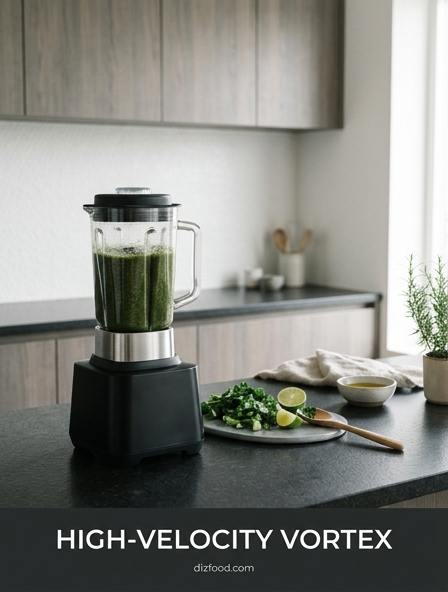
Understanding the High Velocity Vortex
The high-velocity vortex is the fundamental physical phenomenon that distinguishes professional-grade blending from standard food processing. At its core, this kinetic funnel is created when the rotational speed of the blades creates a low-pressure zone at the base of the container. This pressure differential pulls ingredients downward into the "kill zone," where they are subjected to immediate mechanical breakdown. The efficiency of this vortex determines how well the contents are circulated; a weak vortex results in stagnant pockets of unblended material, whereas a robust high-velocity funnel ensures that every particle is processed multiple times per second.
To identify a perfect kitchen vortex, look for the following characteristics:
- A deep, stable "V" shape reaching down to the blade assembly.
- Constant movement of the top layer of ingredients toward the center.
- The absence of air pockets or "cavitating" bubbles around the blade.
- A visible reduction in particle size within the first ten seconds of operation.
Understanding this movement allows chefs to manipulate textures by adjusting the rotational force to match the viscosity of the specific ingredients being processed.
Optimizing Pitcher Geometry for Seamless Flow
The shape of the container is just as critical as the motor's power in maintaining a high-velocity vortex. Pitcher geometry is engineered to break the natural circular motion of liquids, forcing them back into the blades rather than allowing them to spin aimlessly against the walls. Modern designs utilize specific interior contours and specialized corners to disrupt the flow, creating a turbulent environment that maximizes ingredient contact with the cutting surfaces. Without these design interventions, thick mixtures would simply stick to the sides, resulting in uneven textures and motor strain.
| Feature | Mechanical Function |
|---|---|
| Square Walls | Forces liquid into corners to trigger a recursive fold. |
| Internal Baffles | Interrupts laminar flow to prevent air pockets. |
| Tapered Base | Concentrates the force of the vortex on small volumes. |
By optimizing these geometric variables, manufacturers ensure that even the most stubborn solids are continuously recirculated into the high-shear environment, leading to a perfectly homogenous result every time.
Precision Blade Engineering and Shear Force
Precision blade engineering focuses on the concept of shear force rather than simple cutting. In a high-velocity kitchen environment, the blades often lack a traditional sharp edge, relying instead on the immense speed to pulverize cell walls at a molecular level. These blades are typically forged from hardened stainless steel, featuring specific wingtip angles that create an upward lift, maintaining the vortex's integrity. The interaction between the blade's leading edge and the velocity of the liquid creates a zone of intense mechanical stress.
This stress is what facilitates the breakdown of tough fibers and seeds that lower-powered devices cannot touch. As the blade spins, it creates a trailing edge of low pressure that can lead to cavitation-the formation and collapse of vapor bubbles. While often avoided in industrial pumps, controlled cavitation in a kitchen context assists in the rapid disintegration of solids. The balance between blade pitch, surface area, and rotational speed determines the ultimate smoothness of the culinary preparation, ensuring that the shear force is distributed evenly throughout the entire volume of the container.
Mastering Variable Speed for Texture Control
Control over rotational velocity is essential for achieving specific culinary outcomes, from chunky salsas to ultra-fine purées. Variable speed control allows the user to start at a low frequency to incorporate large solids and gradually ramp up to peak RPMs to refine the texture. This gradual acceleration is vital for preventing the motor from stalling and ensuring the vortex forms correctly without trapping excessive air at the start of the cycle. Mastering these speed transitions is a hallmark of professional technique.
To achieve the best results with variable speed settings, follow these operational steps:
- Start on the lowest setting to break down large chunks.
- Slowly increase the dial to medium to establish the central vortex.
- Shift to high speed for the final thirty seconds to achieve aeration.
- Pulse briefly at the end to settle any large air bubbles.
By manipulating the speed, the chef can manage the kinetic energy within the pitcher, preventing the "spinning" effect where the blades move too fast for the heavy ingredients to drop down, a common issue in high-speed processing.
The Science of Centrifugal Emulsification
Centrifugal emulsification occurs when the high-velocity vortex forces two immiscible liquids, such as oil and water, into a stable suspension. The sheer force generated by the blades breaks the oil into microscopic droplets, which are then dispersed so thoroughly that they cannot easily recombine. In a high-speed kitchen environment, this process happens in seconds, creating dressings and sauces with a creamy mouthfeel without the need for excessive stabilizers. The vortex acts as the primary engine for this transformation, ensuring that every molecule is subjected to the same level of dispersion.
The stability of the resulting emulsion is directly proportional to the speed of the blades and the duration of the cycle. Higher speeds produce smaller droplets, which results in a thicker, more permanent bond. This scientific approach to mixing allows for the creation of dairy-free creams and perfectly bound vinaigrettes that remain stable for days. The intense heat occasionally generated during this process can also help in partially denaturing proteins, further assisting the binding process and creating a unique structural integrity in the finished liquid.
Strategic Ingredient Layering for Maximum Intake
The order in which ingredients are added to the container significantly impacts the efficiency of the high-velocity vortex. Proper layering utilizes gravity to push ingredients toward the blades, ensuring that the motor doesn't work harder than necessary. When the vortex is initiated, the bottom layers are converted into a liquid base, which then acts as a medium to pull down the heavier, solid items placed on top. This strategic approach prevents the blades from spinning in an air pocket and ensures a continuous flow from the moment the switch is flipped.
Use the following hierarchy when loading the pitcher:
- Liquids: Water, juice, or milk form the essential base.
- Soft Solids: Powders, yogurts, and soft fruits.
- Fibrous Greens: Spinach, kale, or herbs.
- Hard Solids: Frozen fruits, ice, and nuts.
By placing the heaviest and hardest items at the top, you ensure they provide the downward pressure needed to keep the ingredients in constant contact with the blade assembly, maximizing the intake and reducing processing time.
Thermal Management in High Speed Processing
A significant byproduct of high-velocity blending is the generation of friction heat. When blades spin at upwards of 20,000 RPM, the kinetic energy transferred to the ingredients can raise the temperature of the liquid by several degrees per minute. This can be a benefit when making hot soups directly in the pitcher, but it is a challenge when trying to maintain the vibrant color and fresh taste of cold gazpachos or green smoothies. Thermal management is therefore a critical skill for any high-speed blender operator.
To counteract unwanted heat, professionals often use frozen components or shorten the blend cycle to the absolute minimum required for the desired texture. High-end motors are also equipped with cooling fans and advanced airflow systems to prevent the base from overheating during long runs. Understanding the relationship between blending time and temperature allows for precise control over the final serving state of the dish. Excessive heat can also dull the flavors of delicate herbs, making speed and efficiency the primary goals in maintaining the integrity of the raw ingredients during the high-velocity cycle.
Achieving Microscopic Breakdown of Fibrous Solids
The true power of a high-velocity vortex lies in its ability to achieve a microscopic breakdown of tough, fibrous solids. Ingredients like kale, ginger, and berry seeds contain complex cellulose structures that are difficult for the human digestive system to process and often leave a gritty texture in food. High-speed processing ruptures these cell walls, releasing the nutrients trapped inside and turning what would be a "chunky" drink into a completely smooth liquid. This is achieved through the combination of high RPMs and the recursive nature of the vortex flow.
As the fibers pass through the blade's path, they are repeatedly sheared into smaller and smaller fragments until they are no longer perceptible to the palate. This level of refinement is essential for creating professional-grade coulis, nut milks, and silken purees. The process also increases the bio-availability of the nutrients, as the mechanical pre-digestion allows the body to absorb the vitamins and minerals more easily. Total cell wall rupture is the gold standard for high-velocity kitchen equipment, transforming the texture of raw solids into a luxurious, uniform consistency.
Refining the Aerodynamic Blend Cycle
Aerodynamics plays a surprisingly large role in the behavior of the vortex within the blending container. The interaction between the spinning liquid and the air trapped inside the pitcher can lead to oxidation, which affects both the color and nutritional value of the food. Refining the blend cycle involves managing this air-to-liquid ratio. Some advanced systems now offer vacuum blending, which removes the air before the vortex begins, resulting in a much denser, more colorful, and nutrient-rich liquid. In standard systems, the user must manage this by not over-blending at high speeds.
The lid design also contributes to the aerodynamics; a well-sealed lid with a vented cap allows for the release of steam when processing hot liquids while maintaining the internal pressure needed to keep the vortex stable. If the lid is removed during a high-speed cycle, the vortex can collapse, causing the contents to splash. By respecting the aerodynamic requirements of the machine, the cook can ensure that the food remains vibrant and that the texture is not overly aerated, which can lead to a "foamy" mouthfeel that is often undesirable in high-end culinary applications.
Pro Techniques for Consistent Liquid Silkiness
Achieving consistent liquid silkiness requires a combination of the right equipment and refined technique. While the high-velocity vortex does most of the heavy lifting, the final steps of the process determine the ultimate quality of the output. Professionals often employ a "polishing" phase at the end of the blend, where the speed is reduced slightly to allow the largest remaining particles to settle into the blades one last time. This ensures that the final product is free of even the smallest grains or fibers.
To ensure consistent silkiness in every batch, consider these professional tips:
- Always use a high-powered motor capable of maintaining RPMs under load.
- Incorporate a natural emulsifier like lecithin or xanthan gum for long-term stability.
- Pass the final liquid through a fine-mesh chinois if absolute perfection is required.
- Cool the container between uses to prevent residual heat from affecting the next batch.
By following these protocols, you can harness the full power of the vortex to create textures that are indistinguishable from those found in the world's most demanding professional kitchens.






Comments