

The Mechanics of Cellular Disruption
In the culinary environment, cellular disruption refers to the mechanical process of breaching the rigid cell walls of plant tissues. These walls, primarily composed of cellulose, hemicellulose, and pectin, serve as a protective barrier for the nutrient-dense cytoplasm within. When using high-shear implements like blenders or food processors, the goal is to apply sufficient kinetic energy to overcome the structural integrity of these polysaccharides. This process transforms solid produce into a liquid or semi-liquid state by liberating intracellular fluids.
- Mechanical Shearing: The direct contact between a sharp edge and the cell wall.
- Turbulent Cavitation: Pressure changes in the liquid that create microscopic bubbles, which collapse and shock the cell structures.
- Impact Fragmentation: High-velocity collisions between particles that further pulverize remaining cellular debris.
Effective disruption is not merely about liquefaction; it is about the precision of the breakdown. By controlling the intensity of these forces, a chef can dictate the final texture of a puree, ensuring that the fibrous "skeleton" of the plant is reduced to a microscopic scale that the human tongue perceives as smooth rather than gritty.
Maximizing Nutrient Bioavailability Through Blending
Nutrient bioavailability is significantly enhanced when cellular structures are thoroughly pulverized. Many essential phytonutrients, such as carotenoids in carrots or lycopene in tomatoes, are trapped within the fibrous matrix of the plant cell. Raw consumption often results in poor absorption because human digestion cannot fully break down cellulose. Mechanical blending pre-digests these materials, increasing the surface area for digestive enzymes to act upon once consumed.
- Liberation of Vacuole Contents: Releasing stored minerals and vitamins into the suspension.
- Reduction of Particle Size: Smaller particles allow for faster chemical reaction rates during digestion.
- Emulsification of Fat-Soluble Nutrients: High-speed blending can help incorporate healthy fats with plant matter, aiding the absorption of vitamins A, D, E, and K.
However, the process is a balance between access and preservation. While breaking the cells makes nutrients more accessible, it also exposes sensitive compounds to oxygen. Therefore, the duration of the cellular breakdown must be optimized to ensure that the nutritional gains from increased surface area are not negated by the degradative effects of prolonged oxidation or heat friction.
Achieving the Perfect Micro-Emulsion
A micro-emulsion in the kitchen is achieved when the particle size of the dispersed phase is reduced to a sub-micron level, creating a mixture that is translucent and incredibly stable. Unlike standard emulsions, which may eventually separate, a micro-emulsion utilizes high shear force to ensure that oil droplets are so small they remain suspended through Brownian motion. This requires a precise balance of mechanical energy and the presence of surfactants or emulsifiers naturally found in ingredients.
| Factor | Impact on Emulsion | Required Action |
|---|---|---|
| Droplet Size | Smaller droplets increase stability and creaminess. | Increase blade RPM. |
| Surface Tension | High tension leads to rapid separation. | Add lecithin or mustard. |
| Viscosity | Thicker continuous phases slow droplet movement. | Control temperature and starch. |
The transition from a macro-emulsion to a micro-emulsion changes the way flavor molecules interact with the palate. Smaller droplets provide a more uniform distribution of fat-soluble aromas, resulting in a more intense and lingering flavor profile that coats the tongue evenly.
Impact of Blade Speed on Fiber Breakdown
The velocity of a blender blade, measured in rotations per minute (RPM), is the primary determinant of how effectively insoluble fibers are processed. Low speeds are sufficient for soft fruits, but high-fiber vegetables like kale or celery require tip speeds exceeding 20,000 RPM to achieve total cellular liquidation. At these speeds, the blade does not just cut; it creates a vortex that subjects every particle to repeated high-impact collisions, shearing the tough cellulose strands into fragments smaller than 100 microns.
- Low Speed (3,000-7,000 RPM): Ideal for chunky textures and delicate mixing.
- Medium Speed (7,000-15,000 RPM): Suitable for standard purees and emulsifying vinaigrettes.
- High Speed (15,000+ RPM): Necessary for pulverizing seeds, skins, and dense fibrous networks.
When fiber is broken down to this degree, the resulting liquid gains a "creamy" mouthfeel despite containing no dairy. This is due to the release of intracellular starches and pectins which act as natural thickeners. Consistent blade speed ensures that the fiber breakdown is homogenous, preventing the "sedimentation" effect where solids settle at the bottom of a container over time.
Managing Heat and Oxidation in High-Speed Blending
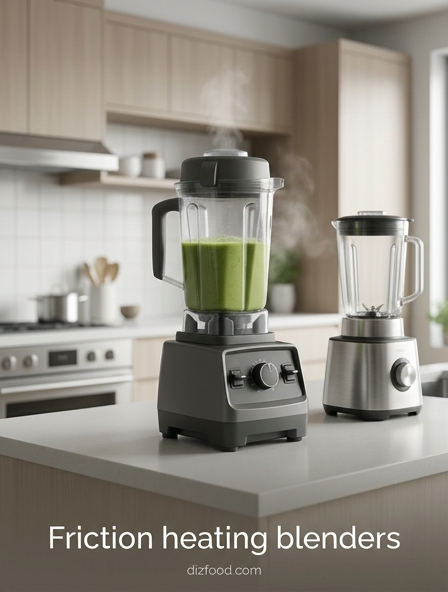
High-speed blending generates significant kinetic energy, much of which is converted into thermal energy through friction. If a blender runs for an extended period, the temperature of the contents can rise rapidly, potentially denaturing enzymes and altering the flavor profile of raw ingredients. Furthermore, the vortex created by the blades pulls air into the mixture, leading to rapid oxidation of sensitive pigments like chlorophyll and polyphenols, which can turn a bright green sauce into a dull brown one.
- Temperature Control: Use chilled ingredients or ice to offset frictional heat.
- Vacuum Blending: Utilizing specialized equipment to remove air before processing to prevent oxidation.
- Pulse Timing: Short bursts of power instead of continuous running to allow heat dissipation.
Understanding the thermal threshold of your ingredients is vital. For instance, aromatic herbs like basil are highly sensitive to both heat and oxygen. To maintain their vibrant color and fresh volatile oils, the blending process must be as rapid as possible, often involving a "shock" cooling step immediately following the cellular disruption to lock in the desired chemical state.
The Role of Shear Force in Texture
Shear force occurs when layers of fluid move at different velocities relative to each other, creating a "tearing" action at the molecular level. In a kitchen context, this is most evident in the use of immersion blenders or high-performance stationary units. As the blade spins, it creates a high-pressure zone at the tips and a low-pressure zone behind it. This gradient forces the ingredients to stretch and tear, effectively thinning out sauces and creating a highly refined texture that cannot be achieved through simple mashing.
- Laminar Flow: Smooth, parallel layers of fluid movement, useful for gentle folding.
- Turbulent Flow: Chaotic fluid movement that maximizes ingredient collision.
- Shear Thinning: A property where a substance becomes less viscous under stress, allowing for easier processing of thick gels.
The application of shear force is particularly important when working with hydrocolloids. Many thickeners require a specific amount of shear to hydrate properly. Without sufficient force, these agents may clump or fail to reach their full thickening potential. Mastering shear allows a chef to manipulate the rheology of a dish, achieving a perfect balance between fluidity and body.
Unlocking Bound Flavors from Plant Cells
Much of the flavor in plant-based cooking is locked within the vacuoles and cell walls. These aromatic compounds, often volatile organic compounds (VOCs), are only released when the cell is ruptured. This is why a crushed clove of garlic is more pungent than a sliced one. High-speed cellular breakdown maximizes the release of these bound flavors, creating a more complex and intense sensory experience. The process also allows for the interaction of enzymes and substrates that were previously kept in separate cellular compartments.
- Enzymatic Reactions: The "allium" flavor in onions is created when cell walls break and enzymes mix.
- Essential Oil Release: Pulverizing citrus peels or herbs releases concentrated oils into the surrounding medium.
- Increased Surface Area: Enhances the extraction of flavors during subsequent cooking or infusion steps.
By controlling the degree of cellular breakdown, a chef can tune the intensity of the flavor. Total homogenization results in a bold, singular flavor profile, while a coarser breakdown allows for "pockets" of flavor that provide a more varied tasting experience. This mechanical liberation is the first step in building the deep flavor foundations required for high-end gastronomy.
Optimizing Viscosity for Velvety Mouthfeel
Viscosity is the measure of a fluid's resistance to flow, and in the kitchen, it is the defining characteristic of "mouthfeel." When cells are broken down, the release of long-chain polysaccharides like starch and pectin increases the internal friction of the liquid, making it thicker. Achieving a "velvety" texture requires a specific particle size distribution; if the particles are too large, the sauce feels grainy, but if they are perfectly uniform and small, the liquid feels rich and heavy on the tongue without being cloying.
| Texture Goal | Particle Size Range | Technique |
|---|---|---|
| Velvety/Smooth | 10-40 microns | High-speed blending + fine mesh straining. |
| Pulpy/Rustic | 100-500 microns | Low-speed processing or food mill. |
| Syrupy/Clear | <5 microns | Centrifugation or ultra-filtration. |
The relationship between cellular breakdown and viscosity is non-linear. Initially, breaking more cells increases thickness as more solids enter the suspension. However, extreme shear can eventually break down the polymer chains themselves, actually decreasing viscosity. Precision in blending time is therefore essential to hit the "sweet spot" of texture.
The Chemistry of Starch and Pectin Release
Starch and pectin are the primary structural and energy-storage molecules in plants. Pectin acts as the "glue" between cell walls, while starch is stored in granules within the cell. Mechanical disruption plays a dual role here: it physically releases these molecules from the cellular matrix and, through the heat generated by friction, can initiate the gelatinization of starch or the activation of pectin. This is particularly useful when creating thick soups or fruit purees where no external thickeners are desired.
- Pectin Solubilization: High shear helps dissolve pectin into the liquid phase, creating a natural gel.
- Starch Granule Rupture: Breaking open starch granules allows them to absorb water and swell more efficiently.
- Homogenization: Ensuring these polymers are evenly distributed to prevent "weeping" or syneresis.
In high-pectin fruits like apples or quinces, the mechanical breakdown can be so effective that the resulting puree sets into a firm paste upon cooling. Understanding the concentration of these molecules within different ingredients allows the chef to predict how the viscosity will change post-processing, ensuring a consistent final product.
Essential Equipment for Precision Particle Reduction
To achieve professional-grade cellular breakdown, the equipment must be capable of generating high torque and maintaining high RPM under load. Standard household blenders often lack the cooling systems or motor strength required for the sustained shear needed to pulverize tough fibers or create stable micro-emulsions. Precision particle reduction requires tools designed with fluid dynamics in mind, featuring specific blade geometries and container shapes that eliminate "dead zones" where ingredients might escape the blades.
- High-Performance Stationary Blenders: Feature motors typically rated at 2.0 horsepower or higher.
- Immersion Circulators and Blenders: Allow for shearing directly in the cooking vessel, minimizing aeration.
- Rotor-Stator Homogenizers: Laboratory-grade tools that use a stationary sleeve to force liquid through tiny gaps, achieving sub-micron particle sizes.
The material of the blades also matters; hardened stainless steel or carbon-coated edges maintain their sharpness longer, ensuring that the mechanism of disruption remains "cutting" rather than "crushing." Investing in the right equipment allows for a level of textural refinement that defines modern culinary excellence, turning simple raw ingredients into sophisticated, smooth compositions.




Comments