
Understanding Flour Protein Content
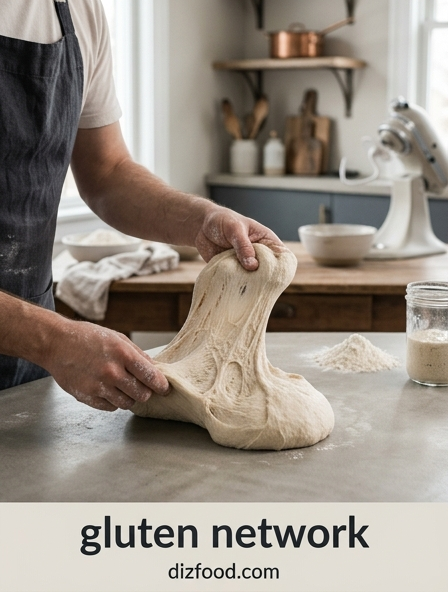
The foundation of any gluten network lies in the specific protein composition of the flour used. Wheat flour contains two primary proteins: glutenin and gliadin. When hydrated, these proteins link together to form a complex, elastic matrix known as gluten. Glutenin provides strength and elasticity, allowing the dough to bounce back, while gliadin offers extensibility, enabling the dough to stretch without tearing. The ratio and total amount of these proteins vary significantly across different flour types, directly impacting the final crumb structure and volume of baked goods.
| Flour Type | Protein Content (%) | Best Use Case |
|---|---|---|
| Cake Flour | 6% - 8% | Tender, delicate crumbs |
| All-Purpose | 9% - 11% | Versatile daily baking |
| Bread Flour | 12% - 14% | High-volume, chewy breads |
| High-Gluten | 14% + | Bagels and pretzels |
Selecting the correct protein level is the first step in managing the gluten network. High-protein flours require more water and intensive handling to fully develop their potential, whereas low-protein flours must be handled gently to prevent the formation of a tough, rubbery texture in delicate pastries.
The Science of Autolyse
Autolyse is a technique popularized by Raymond Calvel that involves mixing only the flour and water before adding yeast, salt, or levain. This resting period typically lasts between twenty minutes and two hours. During this phase, two critical enzymatic processes occur. First, the protease enzymes begin to break down some of the protein bonds, which slightly relaxes the dough and increases extensibility. Second, the amylase enzymes convert starches into simple sugars, providing food for the yeast later in the process.
By allowing the flour to fully hydrate without the interference of salt or the immediate fermentation of yeast, the gluten chains begin to organize themselves spontaneously. This passive development significantly reduces the required mechanical mixing time, which helps preserve the carotenoid pigments in the flour, resulting in better flavor and a creamier crumb color. Bakers often utilize autolyse to achieve a more open crumb structure in sourdough and artisanal baguettes, as it allows the dough to expand more easily during the initial stages of baking.
Optimizing Hydration for Gluten Strength
Water acts as the catalyst for gluten formation. Without sufficient hydration, glutenin and gliadin molecules remain dormant and unable to bond. However, the relationship between water and gluten is a balancing act. In low-hydration doughs, the proteins are tightly packed, resulting in a dense, stiff structure that is easy to shape but resists expansion. Conversely, high-hydration doughs create a more fluid environment where proteins can move freely, facilitating the creation of long, extensible gluten strands.
Optimal hydration is determined by the flour's absorption capacity, which is influenced by protein content and bran particles. High-protein and whole-grain flours generally require more water. If the hydration is too high for the specific flour, the gluten network becomes overly diluted, leading to a dough that lacks the structural integrity to hold fermentation gases. This results in a flat, pancake-like loaf. To optimize strength, water should be added incrementally, allowing the gluten to absorb the moisture and build tension before more liquid is introduced, a process often referred to as "bassinage."
Mixing Techniques for Structural Integrity
Mechanical energy is required to transform a shaggy mass of flour and water into a cohesive, organized gluten network. Mixing aligns the randomly oriented protein chains into a structured lattice. The choice of technique depends on the desired final texture and the hydration level of the dough. While traditional kneading is effective for lower hydration, wetter doughs require different approaches to build strength without adding excessive flour.
- Slap and Fold: Ideal for high-hydration doughs, this method uses gravity and impact to stretch the gluten and incorporate air.
- Pincers Method: Used primarily in the initial stages to integrate ingredients thoroughly without tearing the developing bonds.
- Spiral Mixing: A mechanical method that provides consistent tension and oxygenation, common in commercial bakeries.
- Rubaud Method: A hand-mixing technique that mimics a mechanical mixer, lifting the dough to build strength and aeration simultaneously.
The goal of mixing is not just to combine ingredients but to create a series of disulfide bonds between glutenin molecules. These bonds act as the "hooks" that give the dough its structural integrity and allow it to trap carbon dioxide during fermentation.
Temperature Control and Protein Development
Temperature is a critical variable that dictates the rate of enzymatic activity and the physical properties of the gluten network. Warmer temperatures generally accelerate the bonding process and increase dough extensibility. However, if the dough becomes too warm-typically above 80°F (27°C)-the gluten can become overly relaxed and sticky, making it difficult to handle and prone to collapsing. Cold temperatures, on the other hand, slow down molecular movement, resulting in a tighter, more elastic dough that requires longer fermentation times.
Bakers often track the Desired Finished Dough Temperature (DFDT) to ensure consistency. This calculation takes into account the room temperature, flour temperature, and the friction factor of the mixing process. By controlling the temperature of the water used, the baker can steer the gluten development toward the desired outcome. Proper temperature management ensures that the gluten network is strong enough to support the gas produced by the yeast while remaining flexible enough to expand during the oven spring, preventing cracks or a dense crumb.
The Critical Role of Salt
Salt is far more than a seasoning in the context of bread chemistry; it is a vital structural conditioner. From a molecular perspective, salt carries an ionic charge that interacts with the gluten proteins. Sodium and chloride ions help to neutralize the charges on the protein strands, allowing them to slide past each other more easily and then lock into place, which significantly tightens the gluten network. This results in a dough that is less sticky and much more resilient.
Without salt, the dough would be overly extensible and difficult to shape, often tearing under its own weight. Furthermore, salt regulates the rate of yeast fermentation. By slowing down the yeast, salt prevents the gluten network from being overstretched too quickly, which could lead to structural failure. Most professional recipes call for salt at a concentration of 1.8% to 2.2% of the total flour weight. Adding salt too early can sometimes inhibit hydration during autolyse, which is why it is often introduced after the initial rest period to maximize both hydration and structural reinforcement.
Strategic Folding During Bulk Fermentation
In modern artisanal baking, the majority of gluten strength is often developed during the bulk fermentation stage rather than through intensive initial mixing. This is achieved through strategic folding. Folding the dough serves two purposes: it redistributes heat and yeast, and it physically stretches the gluten to build tension. Unlike aggressive kneading, folding is gentle, preserving the delicate gas bubbles already forming within the matrix.
- Stretch and Fold: Pulling one side of the dough upward and folding it over the center to align fibers.
- Coil Fold: Lifting the dough from the middle and allowing the ends to tuck under themselves, using the dough's weight to create tension.
- Lamination: Stretching the dough into a thin sheet on a damp surface before folding it back together, used for maximum strength.
The frequency and number of folds are determined by the dough's behavior. A slack, weak dough may require four or five sets of folds, while a strong, low-hydration dough may only need one or two. This iterative process allows the gluten to "relax and tighten" repeatedly, creating a robust network capable of supporting a high rise.
Achieving the Perfect Windowpane Test
The windowpane test is the definitive qualitative measurement used to assess the maturity of a gluten network. To perform this test, a small piece of dough is gently stretched between the fingers. If the gluten is well-developed, the dough will stretch into a thin, translucent membrane-resembling a windowpane-without tearing. If the dough snaps or develops holes before it becomes translucent, the gluten network is either underdeveloped or has been compromised.
Achieving a successful windowpane indicates that the disulfide bonds are numerous and well-aligned, providing the necessary elasticity and strength. This level of development is essential for enriched doughs, like brioche, which must support heavy fats and sugars, or for high-volume loaves like sandwich bread. In some artisanal sourdoughs, a full windowpane is not always the goal at the start, as the gluten will continue to develop through time and folding. However, the test remains the most reliable way to gauge whether the dough has the physical capacity to retain the gasses produced during the final proof and baking stages.
Managing Fermentation for Peak Elasticity
Fermentation is the process that breathes life into the gluten network, but it also poses a risk to its stability. As yeast consumes sugars, it releases carbon dioxide gas and ethanol. The CO2 inflates the gluten "balloons," creating the crumb structure. Simultaneously, the production of organic acids, such as lactic and acetic acid, lowers the pH of the dough. A slight increase in acidity actually strengthens the gluten, making it more elastic and better at gas retention.
However, if fermentation proceeds for too long, the environment becomes overly acidic. Excessive acidity triggers the over-activation of protease enzymes, which begin to digest the gluten proteins themselves. This leads to "over-proofing," where the gluten network becomes so weak that it can no longer hold the gas, causing the dough to collapse. Managing fermentation requires a keen eye on volume increase and dough feel. The goal is to reach the "peak elasticity" where the network is fully inflated but still possesses enough residual strength to expand one last time when it hits the intense heat of the oven.
Avoiding Overmixing and Mechanical Breakdown
While mixing is essential for gluten development, it is possible to provide too much mechanical energy, leading to a phenomenon known as overmixing. Overmixing occurs when the disulfide bonds that give gluten its strength are physically sheared apart faster than they can reform. Once these bonds are permanently broken, the dough loses its ability to hold tension and becomes a sticky, viscous mass that resembles a thick batter rather than a structured dough.
Signs of overmixing include a dough that suddenly becomes shiny, extremely sticky, and loses its "memory" or ability to pull away from the sides of the mixing bowl. In high-speed commercial mixers, this can happen in a matter of minutes. In home settings, it is rarer but still possible with high-protein flours and powerful stand mixers. Once a dough has reached the point of mechanical breakdown, the gluten network is destroyed beyond repair; no amount of resting or folding can restore its structural integrity. Understanding the limits of your flour and monitoring the dough's resistance during mixing is the only way to prevent this irreversible structural failure.

Comments