
Settling the age-old debate between dishwasher loading and manual drying is about more than just clearing the counter; it is about optimizing your kitchen's hygiene, energy footprint, and personal time. While hand-drying with a cloth provides the immediate satisfaction of putting dishes away, it frequently introduces cross-contamination risks from bacteria lingering in damp fabric fibers. Modern dishwashers, conversely, leverage high-heat cycles and evaporation technology to ensure a sanitary, streak-free finish that manual labor simply cannot replicate. For the modern homeowner seeking the ultimate kitchen workflow, the verdict is clear: delegating the drying process to your machine maximizes sanitation and frees you from the sink, leaving manual drying strictly for those delicate heirlooms that require a gentle touch.
| Feature | Dishwasher Loading | Manual (Towel) Drying |
|---|---|---|
| Hygiene Level | High: Heat cycles kill 99.9% of germs. | Lower: Towels often harbor bacteria. |
| Time Efficiency | Passive: Done while you sleep or work. | Active: Requires 15-30 mins of labor. |
| Finish Quality | Spotless: Best with rinse aids. | Variable: Often leaves lint or streaks. |
| Resource Use | High energy for heat; low water use. | Zero energy; high water (if hand-washing). |
| Item Safety | Secure: Items remain stationary. | Risky: High chance of drops/chips. |
| The Verdict | Winner for daily efficiency and health. | Best for wood, cast iron, and crystal. |
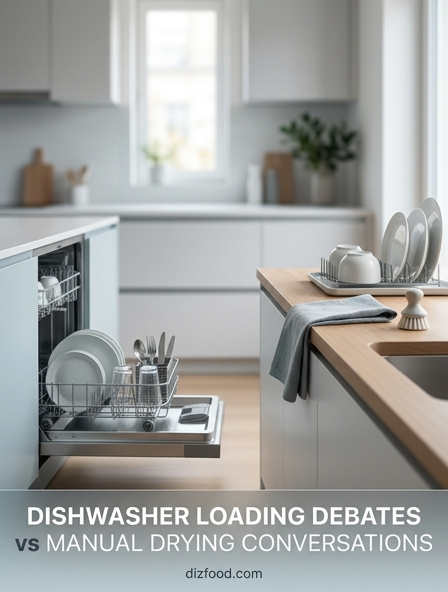
Dishwasher Loading Efficiency versus Manual Drying Techniques
The debate between mechanical efficiency and manual precision begins with spatial geometry. Dishwasher loading efficiency relies on the optimization of spray arm paths and the strategic angling of vessels to prevent water pooling. When a dishwasher is loaded correctly, it utilizes the machine's internal volume to its fullest potential, ensuring that every surface is exposed to high-pressure jets. This "Tetris-like" approach requires an understanding of how water circulates from the center outward, necessitating that larger items like platters and pots stay on the periphery to avoid shielding smaller items.
Conversely, manual drying techniques prioritize the immediate removal of moisture to prevent spotting and streaks. While a dishwasher uses residual heat or fans, hand drying allows for a tailored approach to different materials. For example, delicate crystal and cast iron require specific handling that a generic heat cycle cannot provide. The efficiency of manual drying is often measured by the speed of turnover; once a dish is dried by hand, it is immediately ready for storage, bypassing the one-to-three-hour wait time associated with machine cycles.
| Factor | Dishwasher Loading | Manual Drying |
|---|---|---|
| Primary Focus | Spatial Optimization | Surface Clarity |
| Drying Agent | Evaporation/Condensation | Absorbent Textiles |
| Speed | Slow (1-3 hours) | Immediate |
The Science of Sanitization Machine Washing vs Hand Drying
Sanitization in the kitchen is governed by the relationship between temperature, time, and chemical concentration. Modern dishwashers excel in this area by maintaining water temperatures between 140°F and 155°F during the final rinse. This thermal threshold is critical for the denaturing of proteins and the destruction of common foodborne pathogens like E. coli and Salmonella. Hand washing rarely reaches these temperatures, as the human skin can typically only tolerate water up to 110°F, which is insufficient for total sanitization without the heavy use of chemical agents.
The drying phase is equally vital for hygiene. Machine drying occurs in a controlled, enclosed environment, minimizing the risk of airborne contamination. Manual drying, however, relies heavily on the cleanliness of the kitchen towel. A damp towel can quickly become a breeding ground for bacteria if not laundered frequently. To maintain high hygiene standards during manual processes, the following must be considered:
- The frequency of towel rotation to prevent cross-contamination.
- The use of air-drying racks which allow for 360-degree ventilation.
- The material of the drying cloth, with microfiber and linen being superior to cotton for lint reduction.
- The ambient humidity of the kitchen environment, which dictates the rate of natural evaporation.
Psychological Roots of Domestic Dishwasher Loading Arguments
Arguments over how to load a dishwasher are rarely about the dishes themselves; they are often manifestations of deeper psychological needs for control, order, and efficiency. To the "Optimizer," a poorly loaded dishwasher represents a waste of resources and a lack of foresight. To the "Improviser," the rigid rules of the Optimizer feel like unnecessary micromanagement. This domestic friction often stems from different cognitive styles and the way individuals process spatial information.
Psychologists note that the kitchen is a high-stakes environment where "correct" behavior is often tied to one's upbringing. A person who grew up in a household where manual drying was a communal activity may view the dishwasher as a cold, isolating machine that disrupts domestic rhythm. Conversely, those who value automation may see manual drying as an inefficient use of time. These conflicts are fueled by several recurring behavioral archetypes:
- The Perfectionist: Insists on tines being used exactly as designed.
- The Overloader: Believes if it fits, it washes, often resulting in "nesting" where water cannot reach surfaces.
- The Pre-Rinser: Cannot trust the machine and performs manual labor beforehand, often annoying the "Efficiency Expert."
- The Defensive Loader: Re-arranges the dishes after someone else has already finished loading them.
Energy Consumption Comparison Dishwashers vs Manual Drying Methods
The common misconception that hand washing and manual drying save energy is frequently debunked by modern environmental studies. An Energy Star-certified dishwasher uses as little as 3 gallons of water per cycle, whereas a running tap can discharge 2 gallons of water per minute. When considering the energy required to heat the water, the dishwasher's internal heating element is significantly more efficient at maintaining specific temperatures than a standard home water heater transporting water through pipes to a sink.
Manual drying itself consumes no direct electricity, but the hidden energy costs involve the production and laundering of kitchen towels. If a household uses several towels a day to keep up with hand drying, the energy consumed by the washing machine and dryer to clean those towels must be factored into the total environmental footprint. In contrast, the "heated dry" function of a dishwasher is the most energy-intensive part of its cycle. Many users opt for "air dry" settings to bridge the gap between machine convenience and manual energy savings.
- Dishwashers use approximately 1.5 kWh per load on average.
- Heating a sink full of water (20 gallons) can use double the energy of a dishwasher cycle.
- Mechanical drying via the machine can increase energy use by 15-25%.
- Manual drying requires secondary energy expenditure for towel maintenance.
Maximizing Kitchen Workflow Dishwasher Organization vs Hand Towels
Efficiency in the kitchen is determined by the "work triangle" and how seamlessly one can transition from meal preparation to cleanup. Dishwasher organization is a proactive workflow strategy; by loading items in a specific order (back to front, bottom to top), the user minimizes the time spent with the door open and reduces physical strain. This systematic approach ensures that when the cycle ends, unloading is faster because similar items are grouped together, allowing for "bulk" put-away into cabinets.
Manual drying, while perceived as slower, offers a different workflow advantage: the "clear counter" policy. Hand drying prevents the accumulation of dishes on a rack, which can be an eyesore and a barrier to food prep in smaller kitchens. Using high-quality hand towels allows for immediate clearance of the workspace. However, this requires a disciplined "wash-dry-put away" loop. To maximize this workflow, many professional kitchens employ a hybrid method: large, bulky items are hand-dried immediately to reclaim space, while standard plates and cutlery are relegated to the dishwasher to be processed out of sight.
Why Dishwasher Loading Styles Cause Constant Household Friction
The "Dishwasher Wars" are a staple of modern cohabitation because the appliance serves as a shared canvas for individual logic. Friction arises when one person's mental model of "efficiency" clashes with another's "convenience." For the person who loads the machine with surgical precision, seeing a haphazardly placed bowl that blocks the detergent dispenser is not just a minor error; it is a systemic failure. This creates a cycle of "dish-fixing," where one partner sneakily rearranges the other's work, leading to feelings of resentment and undermined competence.
Communication styles play a massive role in these disputes. Often, the "correct" way to load is never explicitly discussed, leading to assumptions and eventual blowups. The tension is exacerbated by the "hidden" nature of the task; because the results of a bad load are only visible hours later (when dishes come out dirty), the feedback loop is delayed, making it harder to learn from mistakes. Resolving this friction usually requires a compromise on "load standards" or a strict division of labor where only one person is responsible for the machine's configuration to ensure consistency.
Hygiene Standards of High Heat Cycles vs Manual Air Drying
When evaluating hygiene, the high heat cycle of a dishwasher is objectively superior at eliminating microbial life. Most modern units feature an "Sani-Rinse" option that meets NSF/ANSI Standard 184, ensuring a 99.999% reduction in bacteria. This is achieved through a sustained rinse at 150°F. Manual air drying, while passive, relies on the evaporation of water in an open-air environment. If the air in the kitchen is stagnant or if the drying rack is placed near a high-traffic area (like a trash can or prep station), the risk of re-contamination is present.
Manual drying with a towel is the most variable in terms of hygiene. A fresh, sterile towel is effective, but a towel used for multiple items can spread moisture and microbes from one plate to the next. For those who prefer manual methods, air drying is generally recommended over towel drying to minimize physical contact. However, air drying requires a well-ventilated rack that prevents "puddling" at the base. Without proper drainage, the bottom of the rack becomes a reservoir for biofilm and mold, which can transfer back to the clean dishes during the drying process.
The Environmental Cost of Manual Dish Drying vs Modern Dishwashers
The environmental debate between manual and machine methods has shifted heavily in favor of machines over the last decade. Modern dishwashers are designed to recycle water through multiple filtration stages, meaning the same few gallons are cleaned and reused throughout the wash cycle. In contrast, manual washing often involves a continuous stream of water. Even the act of drying has an environmental cost; hand towels require hot water, detergent, and dryer energy to stay clean. A single load of laundry for kitchen linens can consume more energy than several dishwasher cycles.
Furthermore, the chemical impact of detergents differs. Dishwasher detergents are highly concentrated and designed to work with specific water volumes, reducing waste. Manual dish soaps often lead to over-sudsing and excessive water use for rinsing. When comparing the two, the carbon footprint of a dishwasher is largely tied to its manufacturing and the electricity used for heating water. However, over the lifespan of the appliance, the water saved-estimated at over 5,000 gallons per year for an average family-far outweighs the environmental cost of its production compared to the resource-heavy requirements of manual cleaning.
Modern Kitchen Management Dishwasher Tetris vs Countertop Drying
Kitchen management in the 21st century often revolves around the battle for countertop real estate. "Dishwasher Tetris" is the art of maximizing internal machine space to keep the counters entirely clear. This approach appeals to those who favor a minimalist aesthetic and want to hide the "evidence" of cooking immediately. By mastering the angles and levels of the dishwasher racks, a user can fit an entire dinner party's worth of dishes into a single square yard of floor space, leaving the kitchen looking pristine while the machine does the work.
Countertop drying, on the other hand, is a more visible and industrial approach to kitchen management. It is often necessary for items that are not "dishwasher safe," such as high-end chef knives, wooden cutting boards, and non-stick pans. The challenge of countertop drying is managing the visual clutter and the humidity it adds to the room. Modern solutions like over-the-sink drying racks or absorbent stone mats attempt to mitigate these issues, but they still require a sacrifice of workspace. Ultimately, the choice depends on the kitchen's size and the types of tools used by the cook; a high-tech kitchen may rely on Tetris, while a traditional "from-scratch" kitchen often requires a dedicated drying zone.
Best Practices for Dishwasher Loading and Manual Drying Efficiency
To achieve the best results regardless of the method chosen, certain technical standards should be followed. For dishwasher loading, the most important rule is to ensure that the spray arms can rotate freely and that no large items are blocking the detergent dispenser. For manual drying, the focus should be on the quality of the tools and the order of operations. Implementing a "clean as you go" philosophy can bridge the gap between these two methods, ensuring that the kitchen never reaches a state of overwhelming clutter.
- Face all dishes toward the center spray arm to ensure direct water contact.
- Place plastics on the top rack to prevent melting from the bottom heating element.
- When hand drying, use a "dab and buff" technique rather than a "wipe" to reduce lint.
- Store hand towels in a dry, ventilated area between uses to prevent bacterial growth.
- Periodically clean the dishwasher filter to maintain mechanical efficiency and prevent odors.
- Use a rinse aid in the dishwasher to break surface tension, which aids in the "flash drying" process.
By combining the mechanical power of the dishwasher for bulk items with the delicate touch of manual drying for specialty tools, a household can maintain a high standard of both hygiene and efficiency.






Comments