
If you've ever stood in your kitchen wondering how to achieve that perfect, paper-thin round of masa, you've likely faced the classic dilemma: the heavy-duty cast iron tortilla press versus the versatile rolling pin. While a cast iron press offers the authentic, effortless leverage needed for uniform corn tortillas in seconds, a rolling pin provides the tactile control essential for stretching gluten-heavy flour dough to your desired thickness. Choosing the right tool isn't just about tradition; it's about matching your equipment to your specific dough type and physical comfort to ensure your homemade tacos are as impressive as they are delicious.
| Feature | Cast Iron Tortilla Press | Traditional Rolling Pin |
|---|---|---|
| Best For | Corn tortillas (Masa Harina) | Flour tortillas & Chapatis |
| Effort Level | Low; utilizes heavy leverage | High; requires manual pressure |
| Consistency | Perfectly uniform thickness | Variable; depends on skill |
| Speed | Fast; ideal for batch cooking | Slower; one at a time |
| Versatility | Limited to flatbreads/tostones | High; used for all baking |
| Maintenance | Needs seasoning to prevent rust | Simple wash and dry |
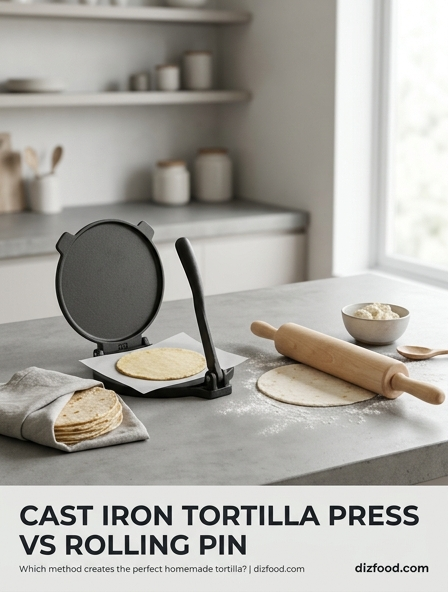
Cast Iron Tortilla Press vs Rolling Pin Key Differences
When entering the world of homemade Mexican cuisine, the choice between a cast iron tortilla press and a traditional rolling pin is one of the first technical hurdles a cook faces. These two tools operate on entirely different mechanical principles. A cast iron press utilizes a heavy lid and a lever handle to apply vertical, uniform pressure across the surface of the dough. This method is designed to flatten the dough instantly into a perfect circle without stretching the fibers. In contrast, a rolling pin relies on lateral force and manual manipulation, requiring the cook to push, pull, and rotate the dough to achieve the desired shape and thickness.
- Mechanical Action: The press uses leverage and weight; the rolling pin uses friction and human strength.
- Material Composition: Presses are typically heavy-duty cast iron or aluminum, while rolling pins are often wood, marble, or stainless steel.
- Target Dough Type: Presses are optimized for gluten-free corn masa, whereas rolling pins are essential for elastic wheat-based flour tortillas.
- Skill Requirement: The press is beginner-friendly and produces consistent results quickly; the rolling pin requires a developed technique to maintain circular symmetry.
Ultimately, the key difference lies in how they handle dough elasticity. Because corn masa lacks gluten, it does not "snap back" when pressed. Flour dough, however, contains gluten that resists the static pressure of a press, often shrinking back immediately after the lever is released. This fundamental biological difference in the dough dictates which tool will reign supreme in your kitchen.
Achieving Perfect Thickness with a Cast Iron Press
The hallmark of a high-quality tortilla is its thinness, which allows it to puff on the comal while remaining pliable enough to fold without breaking. A cast iron press is the gold standard for achieving this consistency because of its sheer mass. The weight of the top plate, often weighing between 8 to 15 pounds, does most of the work. When you engage the lever, the force is distributed evenly from the center outward, ensuring that the edges are just as thin as the middle. This is notoriously difficult to achieve with a rolling pin, where human error often leaves a thicker "hump" in the center of the tortilla.
To achieve the best results with a press, the use of a liner is mandatory. Most seasoned cooks use two sheets of plastic (cut from a heavy-duty freezer bag) or parchment paper. This prevents the moist masa from sticking to the iron plates. Because the cast iron is non-flexible, it creates a flat, plane-parallel surface that ensures every tortilla in a batch of twenty is identical in gauge. For those who find their tortillas are still too thick, a common trick is to press the dough once, rotate the plastic liner 180 degrees, and press a second time. This compensates for any slight mechanical play in the hinge of the press, resulting in a paper-thin, professional-grade corn tortilla every time.
Why Rolling Pins Excel for Flour Tortillas
While the press is the king of corn, it often fails when faced with wheat flour dough. Flour tortillas rely on gluten development for their soft, chewy texture. Gluten creates an elastic web that provides structural integrity, but this elasticity makes the dough stubborn. When you put a ball of flour dough in a cast iron press, the vertical pressure flattens it, but the moment the pressure is released, the gluten fibers retract like a rubber band. This results in a tortilla that is too thick and small, often leading to a dense, bread-like texture rather than a light, translucent wrap.
- Gluten Manipulation: Rolling pins stretch the gluten strands gradually, allowing them to relax into a new, thinner shape.
- Custom Sizing: Rolling pins allow for much larger diameters (10 to 12 inches) which are standard for burritos, whereas most presses are limited to 6 or 8 inches.
- Tapered Control: Using a thin, tapered rolling pin (often called a "palote") allows the cook to apply more pressure to the edges, creating a feather-light border.
Using a rolling pin also allows the cook to feel the tension in the dough. If the dough is resisting, the cook knows to let it rest for another ten minutes to allow the gluten to relax. This tactile feedback is entirely lost when using a heavy mechanical press. For those seeking the authentic large, soft flour tortillas found in Northern Mexico, the rolling pin is an irreplaceable tool.
Speed and Efficiency in the Tortilla Making Process
In a busy kitchen, the time it takes to move from a dough ball to a finished product is a major consideration. The cast iron press is significantly faster for high-volume production. Once the masa is prepared and portioned into balls, the pressing process takes roughly five seconds per tortilla. There is no need for dusting the surface with flour or carefully monitoring the shape, as the press dictates the geometry. This allows one person to press tortillas while another manages the griddle, creating a seamless assembly line that can produce dozens of tortillas in minutes.
| Action | Cast Iron Press | Rolling Pin |
|---|---|---|
| Setup Time | Minimal (just liners) | Needs floured surface |
| Time per Unit | 5-10 Seconds | 30-60 Seconds |
| Physical Effort | Low (Leverage-based) | Moderate (Arm/Shoulder) |
| Consistency | Extremely High | Variable (Skill-based) |
The rolling pin, while versatile, is a slower instrument. Each tortilla requires individual attention-rolling, rotating, and checking for thickness. For a family dinner where 20 or 30 tortillas are needed, the cumulative time spent rolling can be substantial. However, for a small batch of specialty flour tortillas, the extra time is often viewed as a worthwhile trade-off for the superior texture and size control that the rolling pin provides.
Uniformity and Texture Pressing vs Rolling
Uniformity is not just about aesthetics; it is about cooking physics. A tortilla that is thicker on one side than the other will cook unevenly on the comal. The thick parts will remain raw and doughy, while the thin parts may burn or become brittle. The cast iron press excels at creating a perfectly flat disc with a uniform "crush." This uniformity ensures that when the heat hits the dough, the moisture inside turns to steam simultaneously, causing the tortilla to puff up into a balloon. This "puff" is the sign of a perfect tortilla, as it separates the two layers and creates a light, airy internal texture.
Rolling pins create a different texture profile. Because the rolling action involves shearing forces, it can slightly change the alignment of the particles in the dough. In flour tortillas, this helps create the micro-layers that lead to a flaky, soft bite. However, with corn masa, rolling can sometimes be counterproductive. The masa is more fragile and lacks the "stretch" of flour dough, meaning a rolling pin can often cause the edges to fray or crack (known as "ragged edges"). A press keeps the masa contained and compressed, resulting in smooth, sealed edges that hold moisture better during the cooking process. If you value a professional, uniform look for your tacos, the press is visually superior.
Pros and Cons of Heavy Cast Iron Presses
Investing in a cast iron press brings a professional feel to the kitchen, but it is a tool with specific maintenance requirements and physical characteristics. Its primary advantage is its durability; a well-made cast iron press can last for generations, becoming a kitchen heirloom. The heavy weight ensures that even the most stubborn masa is flattened with minimal effort from the user.
- Pro: Effortless Pressure. The heavy lid does the work so your wrists don't have to.
- Pro: Longevity. Cast iron is nearly indestructible and won't warp over time like wood or plastic.
- Con: Weight. At 10+ pounds, it can be cumbersome to retrieve from high cabinets or deep storage.
- Con: Maintenance. Like a cast iron skillet, the hinge and plates should be kept dry to prevent rust, though they don't require the same level of seasoning since they don't touch the food directly.
- Con: Single-Purpose. Unlike a rolling pin, a press is a "unitasker" that takes up significant footprint for one specific job.
Despite the cons, many home cooks find that the "pro" of perfect results outweighs the "con" of storage space. If the hinge is made of inferior metal, it can be a point of failure, but a solid iron construction solves this issue. For the dedicated taco enthusiast, the reliability of a heavy press is worth every inch of counter space it occupies.
Mastering the Traditional Rolling Pin Technique
Using a rolling pin for tortillas is an art form that requires patience and a specific sequence of movements. Unlike rolling out a pie crust, where you want to avoid overworking the dough, rolling a tortilla requires enough pressure to thin out the gluten-heavy dough without tearing it. The goal is a circle, which is notoriously difficult for beginners who often end up with shapes resembling maps of various countries.
- The Center Start: Always start the pin in the center of the dough ball and roll outward, stopping just before the edge to avoid thinning the rim too much.
- The 45-Degree Turn: After every one or two passes of the pin, lift the dough and rotate it 45 degrees. This ensures the circle grows evenly in all directions.
- Light Dusting: Use just enough flour to prevent sticking. Too much flour will toughen the tortilla and create a dusty, scorched flavor on the griddle.
- Flip and Repeat: Periodically flip the dough over to ensure the underside isn't bunching up or sticking to the work surface.
Mastering this technique allows the cook to produce "Sonoran style" tortillas, which are incredibly thin-almost translucent-and can be much larger than what a standard press allows. This skill is highly valued because it allows for versatility; the same rolling pin used for tortillas can be used for biscuits, pizza dough, and pastries, making it a more versatile tool for a minimalist kitchen.
Which Tool is Best for Corn Tortillas
When it comes to corn tortillas, the debate is essentially settled: the cast iron press is the undisputed winner. The reason lies in the chemistry of masa harina. Corn dough is made from nixtamalized corn, which has a clay-like consistency. It lacks the elastic proteins found in wheat. If you try to roll out corn masa with a rolling pin, the dough tends to stick to the pin, crumble at the edges, and crack under the lateral stretching motion. The dough prefers to be compressed rather than stretched.
A press applies force from a 90-degree angle, which perfectly suits the crumbly nature of corn masa. It binds the particles together into a cohesive disc. Furthermore, because corn tortillas are traditionally eaten in a smaller format (usually 5 to 6 inches), they fit perfectly within the diameter of a standard press. Attempting to roll corn tortillas by hand is not only time-consuming but often results in a rustic, uneven texture that lacks the delicate mouthfeel of a pressed tortilla. For anyone serious about making authentic corn tacos, a cast iron press is not just an option; it is a necessity. It ensures the masa remains hydrated and the structure stays intact from the press to the pan.
Storage and Durability Comparison for Home Cooks
In a modern kitchen, storage space is often at a premium. This is where the rolling pin has a distinct advantage. A rolling pin is slender and can be tucked into a utensil drawer or stood up in a crock. It is lightweight and easy to grab for a quick meal. A cast iron press, however, is a bulky, heavy piece of equipment. It usually requires its own dedicated spot in a lower cabinet because of its weight. Its footprint is significant, and its irregular shape (including the protruding handle) makes it difficult to stack other items on top of it.
In terms of durability, the cast iron press is a tank. It is not susceptible to the cracking or warping that can affect wooden rolling pins if they are exposed to moisture or extreme temperature changes. While a wooden rolling pin can last years, it can develop nicks or stains. The cast iron press, provided it is kept dry to avoid rust, is virtually indestructible. For a cook who prioritizes tool longevity and performs heavy-duty tasks, the iron press is the superior investment. However, for the casual cook who only makes tortillas once or twice a year, the rolling pin's ease of storage and multi-functional nature make it a more practical choice for the average household cupboard.
The Final Verdict Choosing Your Tortilla Tool
The decision between a cast iron tortilla press and a rolling pin ultimately depends on your culinary preferences and how often you plan to cook. There is no one-size-fits-all answer, as both tools serve distinct purposes within the niche of flatbreads. If your primary goal is to make authentic, street-style corn tortillas with masa harina, you should choose the cast iron press. It offers a level of speed, uniformity, and ease of use that a rolling pin simply cannot match for gluten-free dough. The investment in a press will pay for itself in the quality of your tacos and the time saved during prep.
On the other hand, if you are a fan of large, soft, flour tortillas or if you want a tool that can handle multiple tasks in the kitchen, the rolling pin is the way to go. It is the only effective way to deal with the elasticity of wheat gluten and offers the flexibility to make different sizes of wraps. For many enthusiasts, the ideal solution is to own both: a heavy 8-inch cast iron press for corn-based meals and a simple wooden rolling pin for flour-based recipes. By understanding the strengths and limitations of each tool, you can ensure that your homemade tortillas-whether corn or flour-always have the perfect texture and thickness for your next feast.

Comments