
Mastering Cast Iron Weight for Precision
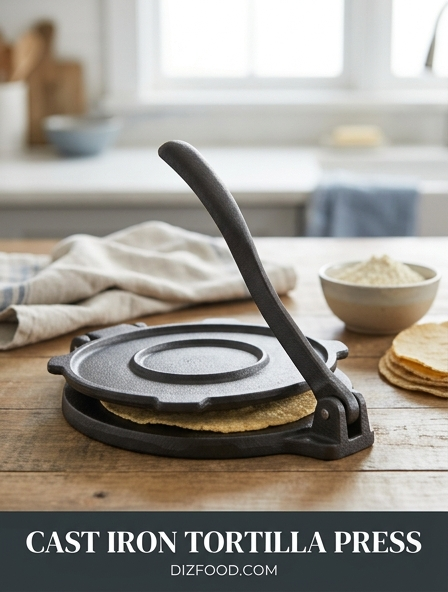
The primary advantage of a cast iron tortilla press lies in its inherent heft. Unlike aluminum or wooden alternatives, the density of cast iron provides the necessary gravitational force to flatten masa with minimal exertion from the cook. This weight ensures that the plates remain parallel during the initial contact, which is crucial for achieving a perfectly round shape. To master this weight, one must learn to let the top plate drop naturally rather than forcing it down immediately with the handle.
Effective weight management involves the following principles:
- Center the dough ball slightly toward the hinge to counteract the natural forward push of the lever.
- Use the handle only for the final tightening phase, not for the entire pressing motion.
- Ensure the press is on a level surface to prevent the heavy top plate from shifting laterally.
- Avoid over-pressing, as the weight of the iron can easily over-extend the dough if too much manual force is added.
By relying on the tool's mass, you achieve a professional level of precision that preserves the delicate structure of the corn or flour dough without tearing the fibers.
Optimal Dough Preparation for Speed
Efficiency in a kitchen environment depends heavily on the state of the dough before it ever touches the cast iron. For corn tortillas, the masa must reach a specific elasticity-often compared to the feel of damp play-dough. If the dough is too dry, it will crack at the edges under the weight of the press; if it is too wet, it will adhere to the liners despite the best release techniques. Proper resting is the secret to a rapid workflow.
- Hydrate the masa harina and let it rest for at least 20 minutes to allow full absorption.
- Check for "tackiness" by pressing a small test ball between your palms.
- Pre-portion the entire batch of dough before beginning the pressing process.
- Keep the dough balls under a damp cloth to maintain moisture levels during the session.
When the dough is prepared optimally, the press functions as a high-speed conduit rather than a bottleneck. You can transition from ball to flat disc in seconds, maintaining a rhythm that keeps pace with a hot comal or griddle.
Essential Lining Techniques for Consistency
A common mistake when using a heavy cast iron press is attempting to place dough directly onto the metal surface. Even a perfectly seasoned press will cause raw masa to stick, resulting in a ruined tortilla and a difficult cleanup. Lining the plates is non-negotiable for professional results. While parchment paper is an option, many traditional cooks prefer heavy-duty plastic liners cut from freezer bags because of their durability and superior release properties.
Consider these lining strategies for the best output:
- Cut two circles or squares of plastic slightly larger than the diameter of the press plates.
- Avoid thin plastic wraps, as they tend to wrinkle and leave unsightly creases in the tortilla.
- Keep the liners clean of dough residue between presses to ensure the next tortilla releases cleanly.
- Replace the liners if they become warped or stretched from the heat of the nearby stove.
Consistency is achieved when the liner remains flat and taut. This allows the weight of the iron to distribute evenly across the surface, producing a smooth, professional finish every time.
The Double Press Method for Uniformity
Even the most high-quality cast iron presses can have slight variations in pressure distribution due to the mechanical nature of the hinge. To achieve professional-grade uniformity, many chefs employ the "Double Press" method. This technique compensates for the fact that the side closest to the hinge often receives slightly more pressure than the side near the handle. By rotating the tortilla, you ensure that any mechanical bias is neutralized.
- Place the dough ball in the center and press down firmly using the lever.
- Lift the top plate and the upper liner to check the initial thickness.
- Rotate the tortilla, still between the liners, 180 degrees.
- Close the press and apply a second, lighter burst of pressure with the handle.
This simple rotation transforms an oval or unevenly thick disc into a perfect circle with a standardized thickness. It is the hallmark of a meticulous cook who understands the physics of their equipment. The result is a tortilla that cooks evenly, with no raw or overdone spots on the edges.
Calibrating Pressure for Even Thickness
The thickness of a tortilla dictates its final texture, from the soft flexibility required for tacos to the sturdy structure needed for tostadas. Calibrating how much manual pressure to apply to the cast iron handle is a skill developed through repetition. Because cast iron does not flex, the feedback you feel through the handle is direct and immediate. Understanding the relationship between lever force and final diameter is key to a successful cook.
| Target Style | Pressure Level | Visual Indicator |
|---|---|---|
| Standard Taco | Moderate | Translucent edges, approx 6 inches |
| Burrito/Large | Heavy | Edge of the press plates reached |
| Thick Gordita | Light | Significant thickness, approx 4 inches |
When applying pressure, avoid "bouncing" the handle. A smooth, sustained squeeze provides the most even results. If you find the tortillas are consistently thinner on one side, check the hinge pin for debris or wear, as this can throw off the calibration of the entire unit.
Rapid Workflow for Large Batches
When cooking for a crowd, the cast iron press becomes the centerpiece of an assembly line. To maintain a rapid workflow, you must minimize the movement between the pressing station and the cooking surface. The weight of the cast iron allows you to work quickly, but only if your mise en place is organized. A rhythmic approach ensures that the tortillas are pressed just as the previous one is flipped on the heat.
To maximize your output during large batches, follow these workflow tips:
- Position the press immediately to the left or right of your stove or comal.
- Use a cooling rack or a fabric-lined basket to store finished tortillas immediately.
- Have a second person handle the flipping if possible, while you focus on the press.
- Maintain a stack of pre-cut liners to replace any that become sticky or damaged.
By treating the process as a continuous loop, you can produce dozens of tortillas in minutes. The cast iron's thermal mass also helps keep the dough slightly warm if placed near the heat, which can aid in the final stretch of the masa.
Maintaining Cast Iron for Peak Performance
A cast iron tortilla press is an heirloom-quality tool, but it requires specific care to prevent oxidation and ensure the hinge remains fluid. Because it rarely comes into direct contact with food thanks to liners, maintenance is simpler than that of a skillet, yet it is often neglected. Rust is the primary enemy, especially in humid kitchen environments where steam from the stove is prevalent.
- Wipe the press down with a dry cloth after every use to remove any stray moisture.
- Periodically apply a very thin layer of food-grade oil to the plates and the hinge.
- Check the hinge bolt or pin for tightness; a loose hinge will cause uneven pressing.
- Store the press in a dry cupboard, preferably with a piece of paper towel between the plates.
If rust does develop, scrub it away with fine steel wool and re-season the metal just as you would a cast iron pan. A well-maintained press will provide a lifetime of service, with the hinge becoming smoother and the plates more seasoned over decades of use.
Scaling Dough Balls for Identical Results
The secret to a stack of tortillas that look like they came from a professional tortilleria is consistency in the initial dough weight. Guessing the size of the dough ball leads to tortillas of varying diameters and thicknesses, which complicates the cooking process. Using a digital kitchen scale allows you to calibrate your output exactly to the size of your press.
| Dough Ball Weight | Resulting Diameter | Best Use Case |
|---|---|---|
| 30 grams | 4 - 5 inches | Street Tacos / Sliders |
| 45 grams | 6 inches | Standard Table Tortilla |
| 60 grams | 7 - 8 inches | Large Quesadillas |
Once you have determined your preferred weight, pre-roll all the balls before you start pressing. This ensures that the pressure applied by the cast iron remains constant across the entire batch. Consistent scaling also means consistent cooking times, allowing you to develop a "muscle memory" for when to flip the tortilla on the griddle based on the steam release.
The Role of Masa Hydration in Pressing
Hydration is the most critical variable when using a heavy press. Because cast iron applies significant force, the moisture content of the masa determines whether the dough will expand smoothly or shatter at the perimeter. "Masa fatigue" occurs when the dough has been handled too much or left out too long, losing the water molecules that act as a lubricant during the pressing phase.
Observe these signs of hydration levels during the pressing process:
- Correct: The edges are smooth and the tortilla peels easily from the plastic liner.
- Too Dry: The edges appear "shaggy" or cracked; the tortilla may break when lifted.
- Too Wet: The dough spreads too thin and clings stubbornly to the liners, leaving residue.
If you notice cracking, return the dough balls to a bowl and knead in water one tablespoon at a time. The heavy weight of the iron will actually highlight hydration flaws more clearly than hand-patting, making it an excellent diagnostic tool for your dough quality.
Troubleshooting Common Pressing Irregularities
Even with a high-quality cast iron press, irregularities can occur. Most issues stem from either the positioning of the dough or the mechanics of the lever. If your tortillas are consistently coming out as ovals rather than circles, it is likely that the dough ball is being placed too far toward the handle. The lever action pushes the dough forward as it descends, so starting slightly off-center toward the hinge usually corrects this.
- Uneven Thickness: Rotate the tortilla 180 degrees and press a second time.
- Sticking: Ensure you are using liners and check if the dough is over-hydrated.
- Tearing: This usually happens if the top plate is lifted too quickly, creating a vacuum.
- Off-center Pressing: Ensure the press is on a flat, non-slip surface to prevent shifting.
By identifying these common pitfalls, you can adjust your technique to take full advantage of the cast iron's capabilities. Mastering the press is a balance of mechanical understanding and tactile sensitivity to the dough's resistance.

Comments