
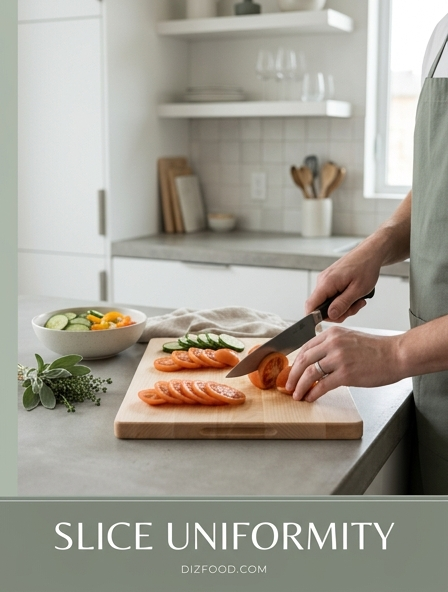
The Science of Even Heat Distribution
In the realm of culinary physics, slice uniformity is the cornerstone of predictable thermal transfer. When ingredients are cut into disparate shapes and sizes, the surface-area-to-volume ratio varies significantly across the batch. This variation causes smaller or thinner pieces to reach their target internal temperature much faster than their larger counterparts. Consequently, the chef is faced with a dilemma: remove the food when the small pieces are perfect, leaving the large pieces raw, or wait for the large pieces to cook, thereby incinerating the smaller ones.
Uniform slicing ensures that every cell within the ingredient is subjected to the same amount of kinetic energy over the same duration. This is particularly vital in high-heat environments like stir-frying or searing, where seconds determine the difference between caramelization and carbonization. By standardizing the dimensions of your produce, you create a controlled environment where heat penetrates the center of each slice at a synchronized rate. This scientific approach eliminates the guesswork associated with "hot spots" or uneven pans, providing a foundation for reliable, repeatable culinary results in any professional or home kitchen setting.
Elevating Plate Presentation Through Precision
The visual narrative of a dish begins long before the first bite is taken. Precision slicing transforms a humble arrangement of vegetables into a sophisticated architectural feat. When a chef masters the art of uniformity, they gain the ability to create patterns, gradients, and symmetries that signal a high level of craftsmanship. For example, a meticulously sliced Ratatouille or a Carpaccio relies entirely on the geometric repetition of its components to convey elegance. Randomness in thickness or shape can make a premium dish appear unrefined or amateurish.
- Symmetry: Aligned edges create a sense of order and intentionality.
- Rhythm: Repeating identical shapes guides the eye across the plate.
- Professionalism: Uniformity suggests a disciplined kitchen environment.
Beyond simple aesthetics, precision slicing allows for better layering and stacking. When slices are identical, they can be easily shingled or spiraled, adding verticality and depth to the presentation. This structural integrity ensures that the dish remains stable during transport from the kitchen to the table, preserving the visual impact intended by the creator. Ultimately, precision in cutting is the bridge between a simple meal and an elevated gastronomic experience.
Consistency in Every Bite
The hallmark of a well-executed dish is a consistent flavor and texture profile that persists from the first forkful to the last. Slice uniformity plays a critical role in this sensory experience by ensuring that every bite contains the intended ratio of ingredients. If a salad contains chunks of cucumber that vary from paper-thin to an inch thick, the diner's palate is subjected to an erratic sequence of textures that can be jarring. Uniformity allows the chef to control the "mouthfeel," ensuring that the crunch, softness, or elasticity of the food is deliberate and balanced.
Moreover, uniform slices facilitate even seasoning and sauce distribution. A thin slice has more surface area relative to its weight to catch vinaigrettes or spices compared to a thick, dense cube. When all pieces are the same size, they absorb flavors at the same rate, preventing some bites from being over-salted while others remain bland. This equilibrium is essential for complex dishes where multiple components must harmonize. By maintaining strict standards for slice uniformity, a cook guarantees that the flavor journey is smooth, predictable, and satisfying for the consumer, reinforcing the quality of the recipe.
Mastering Knife Skills for Uniformity
Achieving perfect uniformity is a physical discipline that requires both the right technique and significant practice. The journey begins with the "claw grip," a fundamental hand position that protects the fingertips while acting as a guide for the blade. By using the knuckles to stabilize the ingredient, a cook can move the knife in precise increments, resulting in slices of identical thickness. The motion of the knife-whether a fluid rocking motion or a clean push-cut-must be rhythmic and consistent. Inconsistency in the speed or angle of the stroke often leads to tapered slices that are thick on one end and thin on the other.
- Anchor the Product: Ensure the ingredient has a flat base to prevent rolling.
- Consistent Spacing: Move your guiding hand back in measured, equal steps.
- Blade Alignment: Keep the knife perpendicular to the cutting board at all times.
- Focus on Rhythm: Maintain a steady pace to keep the physical pressure even.
Developing these skills takes time, but the payoff is a significantly more efficient prep period. Once the muscle memory is established, uniformity becomes second nature, allowing the chef to focus on the more creative aspects of the culinary arts without sacrificing the technical precision required for professional results.
The Impact on Cooking Times
In a fast-paced professional kitchen, timing is everything. Slice uniformity is the primary tool used by chefs to standardize cooking times across large batches of food. When ingredients are prepared with inconsistent dimensions, the total time required to finish a dish becomes unpredictable. This leads to bottlenecks in the "mise en place" and can result in delayed service. For instance, if a tray of roasted potatoes contains both wedges and thin slices, the chef must manually sort or constantly check the oven, wasting valuable energy and attention.
| Slice Thickness | Standard Cook Time | Resulting Texture |
|---|---|---|
| 1/8 Inch | 2-3 Minutes | Crispy / Tender |
| 1/4 Inch | 5-7 Minutes | Al Dente |
| 1/2 Inch | 12-15 Minutes | Soft / Fully Cooked |
By enforcing strict uniformity, recipes become scalable and predictable. A chef knows exactly how long a specific cut will take to reach perfection, allowing for better synchronization between different stations. This level of control is what allows a kitchen to serve hundreds of identical plates simultaneously, ensuring that the quality remains high regardless of the volume of orders being processed.
Professional Standards in Modern Kitchens
In the hierarchy of a professional kitchen, the ability to produce uniform cuts is often the first test of a cook's competence. Modern culinary standards demand a high degree of technical accuracy, as uniformity is tied directly to food waste management and cost control. When slices are irregular, the "off-cuts" are often discarded, leading to higher food costs and lower efficiency. Professional kitchens utilize standardized terminology such as julienne, brunoise, and batonnet to define exact dimensions, ensuring that every member of the team is working toward the same visual and functional goal.
These standards are not merely about tradition; they are about communication. When a head chef calls for a "fine dice," there is an expectation of millimeter-level precision. This uniformity ensures that the final dish matches the established "gold standard" of the restaurant, regardless of who is working the line that day. Furthermore, modern diners, influenced by culinary media, have higher expectations for the technical execution of their meals. Meeting these professional standards for uniformity demonstrates a respect for the ingredients and a commitment to the craft, which are essential for any establishment aiming for excellence or Michelin-level recognition.
Essential Tools for Perfect Slicing
While skill is paramount, the quality of a chef's tools significantly impacts their ability to maintain slice uniformity. A dull blade is the enemy of precision; it requires more force, which often causes the knife to slip or crush the fibers of the ingredient rather than slicing through them cleanly. A high-carbon steel chef's knife, kept at a razor-sharp edge, allows for effortless gliding through produce, ensuring the blade stays on the intended path. Additionally, specialized knives like the "nakiri" are designed specifically for vegetable prep, featuring a flat profile that facilitates full contact with the cutting board.
- Chef's Knife: The versatile workhorse for most uniform slicing tasks.
- Honing Rod: Essential for maintaining the blade's alignment between sharpenings.
- Slicing Knife: A long, thin blade perfect for uniform cuts of meat or fish.
- Bench Scraper: Used to clear the board quickly, maintaining a clean workspace for accuracy.
Beyond knives, accessories like ruler-embedded cutting boards or guide rails can assist beginners in calibrating their eyes for thickness. However, the most essential "tool" remains the sharpening stone. Without a sharp edge, even the most expensive knife will fail to produce the clean, uniform lines required for high-end culinary work. Investing in quality tools and their maintenance is a prerequisite for any cook serious about precision.
Visual Appeal and Culinary Excellence
Culinary excellence is often defined by the intersection of flavor and artistry. Visual appeal plays a disproportionate role in the perception of taste; studies have shown that diners perceive neatly arranged, uniformly sliced food as being more flavorful and higher in quality. This psychological effect, often called "the halo effect," means that the precision of your knife work can actually enhance the diner's enjoyment of the meal. A dish that looks haphazardly prepared suggests a lack of care in the seasoning and cooking process, even if the flavors are technically sound.
In fine dining, uniformity is used to create a sense of wonder. When a guest sees a hundreds of tiny, perfectly identical cubes of apple in a dessert, they recognize the labor and skill involved. This appreciation for the process elevates the meal into a form of performance art. Uniformity also allows for the creative use of negative space on the plate. Clean, straight lines and identical circles provide a contrast to organic swirls of sauce or purees, creating a balanced composition that satisfies the human brain's innate desire for order and beauty. Thus, uniformity is a key ingredient in the recipe for true culinary excellence.
Texture Balance in Gourmet Dishes
Gourmet cooking often relies on the delicate interplay between different textures-crunchy, creamy, chewy, and crisp. Slice uniformity is the tool that allows a chef to calibrate these textures with extreme precision. For instance, in a dish like a scalloped potato gratin, the thickness of the potato slices determines whether the final result is a cohesive, melt-in-the-mouth experience or a disjointed pile of hard and soft layers. If the slices are uniform, the starch releases evenly, creating a luxurious, velvety sauce that binds the dish together perfectly.
In raw preparations like crudo or carpaccio, thickness is even more critical. A slice of raw scallop that is too thick can feel rubbery, while one that is too thin might disappear on the tongue without providing any substance. By achieving a uniform, specific thickness, the chef ensures that the resistance the teeth meet is consistent, allowing the diner to focus on the subtle flavor nuances of the protein. This mastery over texture balance is what separates basic cooking from gourmet gastronomy. Uniformity ensures that the intended structural integrity of each component is maintained, providing a sophisticated tactile experience that complements the dish's flavor profile.
Achieving Perfection with Mandolines and Blades
When the volume of prep is high or the required thickness is paper-thin, even the most skilled chef may turn to a mandoline. This tool is designed specifically for absolute slice uniformity, utilizing a fixed blade and an adjustable platform to produce slices that are identical to the millimeter. The mandoline excels at tasks that are nearly impossible to do by hand consistently, such as creating translucent radish rounds for a garnish or ultra-thin potato chips. However, the use of such precision blades requires a high degree of respect and safety consciousness.
- Adjustable Settings: Allows for micro-adjustments in thickness for different recipes.
- Interchangeable Blades: Enables julienne or waffle cuts with the same level of uniformity.
- Safety Guards: Essential for protecting the hands when working at high speeds.
While the mandoline provides a mechanical advantage, the chef must still ensure the ingredient is prepped correctly before it touches the blade. Slicing with a mandoline requires a steady, even pressure to prevent "wedging," where one side of the slice becomes thicker than the other. When used correctly, these blades are the ultimate shortcut to perfection, ensuring that every single piece of produce contributes to the overall excellence of the final culinary creation.

Comments