
Starting your cooking process with a vigorous rolling boil is the secret to achieving perfectly textured grains and pasta every time. When water reaches this high-energy state, the constant movement of turbulent bubbles acts as a natural agitator, preventing individual pieces from clumping together as they release surface starches. This rapid circulation ensures even heat distribution, allowing the food to cook uniformly while maintaining a firm, al dente bite rather than becoming a gummy mess. Mastering this technique helps you manage heat levels effectively, especially when navigating the delicate balance between a messy boil over vs controlled simmer.
Understanding the Science of a Rolling Boil
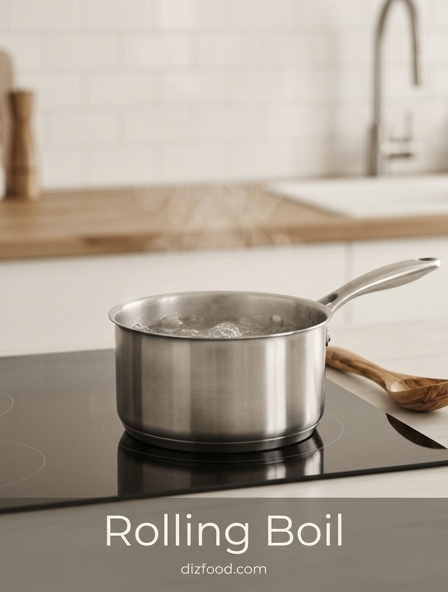
A rolling boil is defined by vigorous, large bubbles that continue to break the surface even when the liquid is stirred. At sea level, this occurs when water reaches its boiling point of 212°F (100°C). At this stage, the vapor pressure of the liquid equals the atmospheric pressure exerted upon it, causing a rapid phase transition from liquid to gas. This state is not merely about temperature; it is characterized by high kinetic energy and intense convection currents that circulate throughout the pot.
Unlike a gentle simmer, where small bubbles rise sporadically, a rolling boil involves the entire volume of water in a constant state of motion. This process is essential for specific culinary techniques because it ensures that the temperature remains stabilized at the maximum possible point for the environment. The thermal energy provided by the heat source is no longer increasing the temperature of the water but is instead being consumed by the latent heat of vaporization, facilitating a consistent and powerful environment for cooking dense or starchy foods.
Preventing Starch Clumping Through Active Turbulence
When starches like pasta or dumplings are introduced to hot water, they immediately begin to release surface molecules that can become incredibly sticky. Without sufficient intervention, these items will fuse together into unappealing masses. The rolling boil provides a mechanical solution to this chemical problem through active turbulence. The rapid movement of water acts as a physical separator, constantly pushing individual pieces of food away from one another.
- Mechanical Agitation: Constant bubble formation prevents pieces from settling and bonding at the bottom of the pot.
- Surface Rinsing: The vigorous flow of water helps wash away excess surface starch before it can solidify into a glue-like coating.
- Spatial Distribution: High-energy currents ensure that ingredients remain suspended and distributed evenly across the vessel.
By utilizing the natural force of the boiling water, cooks can minimize the need for manual stirring. This is particularly important during the first few minutes of cooking when the risk of clumping is at its highest due to initial starch gelatinization.
Ensuring Even Heat Distribution for Uniform Results
In a stagnant or lightly simmering pot, "cold spots" can occur where the temperature is slightly lower than at the heat source's direct point of contact. This leads to unevenly cooked food, where some portions may be overdone while others remain raw in the center. A rolling boil eliminates this discrepancy through the principle of rapid convection. As the water at the bottom of the pot heats up, it becomes less dense and rises, while cooler water sinks to take its place, creating a continuous loop of thermal energy.
This cycle ensures that every cubic centimeter of water is maintained at an identical temperature. For large items like potatoes or thick-cut pasta, this uniformity is vital. It guarantees that the exterior and interior of the food are subjected to the same caloric intensity simultaneously. Without this aggressive circulation, the heat transfer would rely solely on conduction through the liquid, which is significantly less efficient and prone to fluctuations that compromise the final quality of the dish.
Maintaining Temperature Recovery When Adding Ingredients
The moment room-temperature or chilled ingredients are dropped into boiling water, the overall temperature of the pot drops significantly. This is known as the "thermal shock" to the system. A rolling boil, supported by a high-volume pot, possesses a greater amount of stored thermal energy, allowing for a faster temperature recovery. If the water is only simmering, the addition of food can drop the temperature below the threshold required for proper cooking, leading to a long delay before the water returns to a boil.
Maintaining a high heat setting during this transition is critical for efficiency. Professional kitchens often use large ratios of water to food to minimize the duration of this recovery period. A quick return to the boiling point ensures that the cooking process remains on schedule and prevents the food from sitting in lukewarm water, which can negatively impact the structural integrity of the ingredient. Consistent heat throughout the entire cooking duration is the hallmark of a controlled and successful kitchen environment.
The Role of Water Movement in Texture Development
The texture of boiled foods is heavily influenced by the physical environment of the cooking liquid. In a rolling boil, the constant bombardment of water molecules against the surface of the food helps to define its outer layer. This is particularly evident in the preparation of certain grains and legumes where a specific "bite" is desired. The movement prevents the accumulation of a thick, gummy layer of exterior starch, resulting in a cleaner mouthfeel and more distinct individual particles.
- Exterior Sealing: High heat quickly sets the proteins and starches on the surface, creating a protective barrier.
- Internal Pressure: Rapid heat transfer creates internal steam within the food, contributing to a fluffy or tender interior.
- Friction: The movement of the water gently abrades the surface of ingredients, which can be useful for creating specific textures in potatoes intended for roasting.
By controlling the intensity of the boil, a chef can manipulate how much or how little the surface of the food is agitated, directly affecting the final culinary outcome.
Why a Simmer Leads to Mushy Pasta and Grains
Cooking pasta or grains at a low simmer rather than a rolling boil often results in a sub-optimal, mushy texture. When the water temperature is too low and the movement is minimal, the starch granules in the food absorb water more slowly and unevenly. Instead of the surface being quickly "set" by high heat, the starch begins to dissolve into the water, creating a sticky environment that encourages the food to soak up excess moisture, leading to bloating and structural collapse.
| Feature | Simmering Water | Rolling Boil |
|---|---|---|
| Starch Impact | Dissolves slowly, creates gummy film | Sets quickly, stays firm |
| Water Absorption | Excessive and uneven | Controlled and uniform |
| Agitation Level | Low (potential for sticking) | High (natural separation) |
| Final Texture | Soft, mushy, or fragile | Firm, distinct, and elastic |
Without the vigorous movement of a boil, the food spends too much time in a transitional state where it is neither raw nor properly cooked, allowing the water to penetrate too deeply into the grain's matrix.
Achieving the Perfect Al Dente Consistency
The term "al dente," meaning "to the tooth," refers to food that is cooked to be firm to the bite. Achieving this state requires precise control over the cooking environment. A rolling boil is the most effective tool for this because it allows for a very narrow window of time between being undercooked and overcooked. Because the heat transfer is so efficient and consistent, the cook can rely on standardized timing to reach the perfect level of doneness where the center remains slightly resistant.
High heat ensures that the outer layers of the pasta do not become overhydrated while the center is still cooking. This gradient is essential for the al dente texture. If the water were cooler, the exterior would become saturated and soft long before the heat reached the core. Therefore, maintaining a violent, rolling boil is the only way to ensure that the transition from raw to perfectly cooked happens rapidly enough to preserve the desired elastic tension within the starch structure of the noodle or grain.
Optimizing Hydration and Starch Gelatinization
Starch gelatinization is the process where starch granules absorb water and swell when heated. For this to occur optimally, both heat and moisture must be present in specific proportions. A rolling boil optimizes this process by providing a surplus of kinetic energy which helps the water molecules penetrate the tightly packed starch chains. This leads to a more complete and uniform gelatinization throughout the food item, which is necessary for digestibility and flavor development.
- Granule Swelling: High temperatures allow granules to reach their maximum volume without bursting prematurely.
- Molecular Alignment: Rapid heat helps align amylose and amylopectin chains, contributing to better structural integrity.
- Efficiency: The increased energy in a boil reduces the total time the food must spend submerged, preventing nutrient leaching.
When hydration occurs at the boiling point, the resulting texture is typically superior because the starch network remains intact, providing a satisfying chew rather than a crumbly or pasty consistency associated with lower-temperature hydration methods.
The Relationship Between Heat Intensity and Cooking Time
Cooking time is a function of heat transfer rate. In a rolling boil, the rate of heat transfer from the water to the food is maximized because of the high temperature and the constant movement of the liquid. This efficiency is what makes the rolling boil a standard in professional recipes. It provides a predictable baseline; ten minutes in a rolling boil will yield the same result every time, whereas ten minutes in a variable simmer could result in vastly different levels of doneness.
The intensity of the heat also influences the "carry-over" cooking that occurs after the food is drained. Because a rolling boil heats the food so effectively, the internal temperature of the ingredient is high enough to continue the cooking process for a brief moment after removal from the water. Understanding this relationship allows cooks to time their dishes perfectly, pulling ingredients from the heat just seconds before they reach their peak to account for the residual energy stored within the food's mass.
Mastering Water Surface Tension for Better Results
Surface tension plays a surprising role in the kitchen, especially when boiling starchy foods. As starch and proteins leach into the water, they act as surfactants, strengthening the surface tension of the water and trapping steam in bubbles. This is what causes "boiling over," where a thick foam rises and spills over the sides of the pot. Mastering the rolling boil requires managing this tension to ensure the process remains controlled and safe for the cook.
- Oil Addition: A drop of oil can break the surface tension, preventing foam from stabilizing and rising.
- Temperature Regulation: While a boil should be rolling, slightly adjusting the burner can prevent the foam from reaching the brim.
- Vessel Choice: Using a taller pot provides more "headspace" for the foam to rise and collapse without overflowing.
By understanding how the bubbles interact with the surface, cooks can maintain the high-energy environment needed for quality results without the mess and danger of a pot boiling over onto the stove surface.

Comments