
Ever wondered if that box of confectioners sugar and the bag of icing sugar in your pantry are actually the same thing? While these terms are often used interchangeably in kitchens across the globe, understanding their subtle nuances is the secret to achieving a flawless, melt-in-your-mouth finish on your desserts. Essentially, both products consist of granulated sugar ground into a fine, snowy powder, typically categorized by how many times it has been milled (such as 10X). The defining characteristic of these sugars is the addition of a small amount of anti-caking agent, usually cornstarch, which prevents clumping and ensures a silky consistency. Whether you are whipping up a professional-grade royal icing or a simple buttercream frosting, knowing how these finely milled sweeteners function will help you eliminate grittiness and achieve perfectly smooth sweets every time.
| Feature | Confectioners Sugar | Icing Sugar |
|---|---|---|
| Primary Region | Commonly used in the United States. | Commonly used in UK, Canada, and Australia. |
| Ingredients | Finely ground sucrose + 3% starch. | Finely ground sucrose + 2-5% starch. |
| Texture | Extremely fine, "dust-like" particles. | Powdery; can vary slightly by brand/region. |
| Anti-Caking Agent | Typically Cornstarch (Maize starch). | Cornstarch or Tri-calcium phosphate. |
| Best For | Buttercream, fudge, and whipped cream. | Royal icing, glazes, and decorative dusting. |
| Interchangeability | 1:1 replacement in almost all recipes. | 1:1 replacement in almost all recipes. |
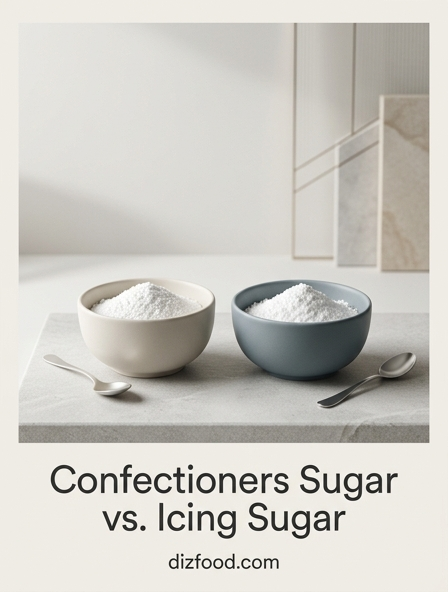
Confectioners Sugar vs Icing Sugar: Are They Actually Different
In the culinary world, names for ingredients often vary by geography, leading to confusion among home bakers. When comparing confectioners sugar and icing sugar, the short answer is that they are functionally identical. Both terms refer to granulated white sugar that has been mechanically milled into an incredibly fine, soft, and voluminous powder. This process transforms the crystalline structure of standard table sugar into a dust-like consistency that dissolves almost instantly when it comes into contact with liquid or fat.
While the terms are used interchangeably in most English-speaking kitchens, the distinction usually lies in where the recipe was written rather than what is inside the bag. In the United States, "confectioners sugar" is the standard industry and retail term, though it is also frequently called "powdered sugar." In the United Kingdom, Australia, and Canada, "icing sugar" is the predominant label found on grocery store shelves. Regardless of the label, both products undergo the same rigorous grinding process to ensure a uniform particle size that is essential for smooth textures in professional baking.
Despite their similarities, it is important to note that both varieties contain a small amount of an anti-caking agent. Because finely ground sugar is highly hygroscopic-meaning it readily absorbs moisture from the air-it would quickly turn into a solid, unusable block without an additive. Whether you buy a box labeled as icing sugar or a bag labeled as confectioners sugar, you are purchasing a refined sweetener specifically engineered to provide a silky finish to desserts, glazes, and frostings.
Understanding the Key Ingredients in Powdered Sugar Varieties
While most people assume that powdered sugar is simply 100% sugar, the ingredient list reveals a slightly more complex composition. The primary ingredient is, of course, sucrose, derived from either sugar cane or sugar beets. However, to maintain the flowable, powdery texture that bakers rely on, manufacturers must include an anti-caking agent. Without this addition, the high surface area of the microscopic sugar particles would cause them to bond together at the slightest hint of humidity.
- Sucrose: This makes up approximately 95% to 97% of the product. The quality of the base sugar determines the purity and whiteness of the final powder.
- Cornstarch: In the United States, cornstarch is the most common additive, usually making up 3% to 5% of the total weight. It acts as a physical barrier between sugar particles.
- Tapioca Starch or Potato Starch: In some regions or in organic varieties, alternative starches are used. These are preferred by some chefs as they can have a less noticeable "chalky" aftertaste than cornstarch.
- Tricalcium Phosphate: Occasionally used as a flow agent in industrial settings to ensure the sugar does not clump during large-scale manufacturing and packaging.
The presence of these starches is what distinguishes confectioners sugar from pure granulated sugar beyond just the particle size. The starch plays a functional role in recipes as well, acting as a minor thickening agent. This is particularly noticeable when making a simple glaze; the starch helps the icing set with a matte finish and prevents it from weeping or becoming overly translucent when applied to warm baked goods.
Regional Naming Differences for Finely Ground Sugar Explained
The global language of baking is rich with regionalisms, and sugar nomenclature is one of the most prominent examples. If you are following a recipe from a British cookbook, you will almost certainly see a call for "icing sugar." This name reflects the product's primary use in the UK: creating the stiff, white royal icing used to coat traditional fruitcakes and wedding cakes. Across the Atlantic, American bakers refer to the same substance as "confectioners sugar," highlighting its broader utility in the world of candy making and general confections.
In Canada, the terminology often reflects a blend of influences. While "icing sugar" is common, many French-speaking regions use the term "sucre à glacer," which literally translates to "sugar for icing." Meanwhile, in Australia and New Zealand, the term "icing sugar" is standard, but you may also encounter "icing sugar mixture," which specifically denotes the version containing cornstarch, versus "pure icing sugar," which is 100% sucrose and lacks the anti-caking agent. This distinction is crucial in those regions for certain gluten-free applications or specific candy recipes.
Regardless of whether a recipe calls for powdered, icing, or confectioners sugar, the physical product remains a highly refined, pulverized sweetener. The divergence in naming is largely a result of historical marketing and the development of regional culinary traditions. Understanding these linguistic variations allows home cooks to confidently navigate international recipes without worrying that they are missing a specialized ingredient. In nearly every case, a bag of 10X powdered sugar from a US supermarket is exactly what a British baker means when they reach for their box of icing sugar.
Can You Substitute Icing Sugar for Confectioners Sugar
The question of substitution is a frequent one for those exploring international cuisines, but when it comes to icing sugar and confectioners sugar, the answer is a definitive yes. Because they are essentially the same product under different names, they can be substituted at a 1:1 ratio by weight or volume. Whether you are whipping up a batch of American buttercream or preparing a delicate French macaron batter, the performance of the sugar will be identical regardless of the label on the packaging.
There is, however, one minor nuance to consider: the type of anti-caking agent used. Most commercial brands use cornstarch, but some specialty or international brands might use potato starch or tapioca starch. In the vast majority of recipes, this difference is imperceptible. However, if you are making a delicate cooked frosting or a specific type of candy where clarity is paramount, different starches might react slightly differently to heat. For standard non-cooked applications like dusting a cake or mixing a glaze, these differences are irrelevant.
One situation where you should be cautious is if a recipe specifically calls for "pure icing sugar" (often found in Australian recipes). Pure icing sugar does not contain cornstarch. If you substitute standard American confectioners sugar (which does contain cornstarch) for pure icing sugar, the starch may slightly alter the texture or cause the mixture to thicken more than intended. Conversely, using pure icing sugar where confectioners sugar is expected might result in a product that clumps more easily or fails to set properly in humid conditions.
The Essential Role of Cornstarch in Confectioners Sugar
Cornstarch is the unsung hero of the confectioners sugar world. When sugar is ground into such fine particles, its surface area increases exponentially. Sugar is naturally hygroscopic, meaning it attracts and holds water molecules from the surrounding environment. Without an intervention, the microscopic grains of sugar would absorb ambient humidity and fuse together, transforming a light, airy powder into a hard, crystalline mass within days of production. Cornstarch prevents this by acting as a physical buffer and a moisture desiccant.
Typically, cornstarch makes up about 3% to 5% of the total volume of confectioners sugar. It coats the individual sugar particles, providing a "slip" that allows the powder to pour easily and remain fluffy. Beyond its role as a preservative and anti-clumping agent, cornstarch also contributes to the functional properties of the sugar in baking. In frostings and glazes, the starch helps provide body and stability. It gives buttercream a slight crust as it dries, which is essential for decorative piping that needs to hold its shape over time.
In cooked applications, the small amount of cornstarch can also act as a thickener. For example, when used in shortbread cookies, the starch interferes with gluten development, resulting in a more tender, "melt-in-your-mouth" texture than if granulated sugar were used. However, some professional pastry chefs find that the cornstarch can leave a slightly chalky sensation on the tongue or a dull finish on certain glazes. In these high-end applications, chefs may choose to grind their own sugar fresh or seek out brands that use alternative starches like tapioca, which dissolves more cleanly.
Comparing Texture and Fineness: 10X vs 6X Sugar
In the commercial baking industry, confectioners sugar is often categorized by its level of fineness, denoted by a "number-X" system. This classification refers to how many times the sugar has been processed through the milling system to achieve a specific particle size. The higher the number, the finer the powder. Understanding these grades is helpful for selecting the right sugar for specific culinary tasks, as the texture can impact the final mouthfeel of a dessert.
| Sugar Grade | Texture Description | Primary Uses |
|---|---|---|
| 10X Sugar | Ultra-fine, silk-like powder. | Professional frostings, glazes, and delicate meringues. |
| 6X Sugar | Slightly coarser than 10X. | Standard household baking and decorative dusting. |
| 4X Sugar | Noticeably grainier. | Industrial coatings for donuts and fruits. |
The 10X variety is the most common grade found in grocery stores across North America. It is the preferred choice for buttercream frosting because the particles are so small they dissolve instantly into the fat, ensuring there is no "gritty" sensation when eating. 6X sugar, while still very fine, may retain a tiny amount of crystalline structure that can be felt in very smooth fillings. For the average home baker, the difference between 6X and 10X is subtle, but for professional patisserie, the 10X grade is the gold standard for achieving a flawless, mirror-like finish on glazes and a creamy consistency in fillings.
Best Culinary Uses for Icing and Confectioners Sugar
The versatility of confectioners sugar makes it a staple in any baker's pantry. Its ability to dissolve without the need for heat is its most significant advantage over granulated sugar. This makes it the essential ingredient for uncooked preparations where a smooth texture is mandatory. From the simplest decorative touch to complex structural frostings, the applications for this finely milled sweetener are vast and varied across many different dessert traditions.
- Buttercream Frosting: The primary ingredient in American and decorative frostings, providing sweetness and structural integrity.
- Glazes and Icing: Combined with water, milk, or citrus juice to create a pourable coating for donuts, bundt cakes, and cookies.
- Dusting and Garnish: Sifted over brownies, tarts, or crepes for a professional-looking finish that adds a hit of sweetness.
- Whipped Cream: Added to heavy cream to provide sweetness and a small amount of stability thanks to the cornstarch content.
- Shortbread and Meltaway Cookies: Used in doughs to create a delicate, tender crumb that breaks down easily on the palate.
- Royal Icing: Mixed with egg whites or meringue powder to create a hard-setting icing for gingerbread houses and detailed cookie decorating.
Beyond these common uses, confectioners sugar is also utilized in the production of homemade marshmallows and Turkish delight to prevent the candies from sticking together. Its fine texture allows it to coat sticky surfaces evenly without creating a crunch. Additionally, it is often used in the centers of chocolates and truffles to create a smooth, melt-in-the-mouth filling that would be impossible to achieve with the larger grains of standard table sugar.
How to Make Your Own Confectioners Sugar at Home
If you find yourself in the middle of a recipe and realize you have run out of confectioners sugar, you can easily manufacture a substitute using standard pantry staples. The process involves grinding granulated sugar into a fine powder and adding a small amount of starch to mimic the commercial version. While the result may not be quite as perfectly uniform as the "10X" variety produced by industrial mills, it is more than sufficient for most frosting and baking needs.
- Measure the Sugar: Start with one cup of standard granulated white sugar. This will yield slightly more than one cup of powdered sugar once aerated.
- Add Starch: Add one tablespoon of cornstarch (or arrowroot powder for a corn-free version). This is essential to prevent the sugar from clumping and to help it set in recipes.
- Process: Place the mixture into a high-speed blender or a clean spice grinder. A standard food processor can work, but it may not achieve the necessary level of fineness.
- Blend: Pulse or blend on high for 30 to 60 seconds until the sugar looks like a fine, white powder. Be careful not to over-process to the point where the friction heat melts the sugar.
- Sift: Pass the resulting powder through a fine-mesh sieve to remove any remaining large crystals. Repeat the blending process for any grains that didn't pass through.
Homemade confectioners sugar is best used immediately, as it may lack the long-term stability of store-bought versions. However, if you must store it, keep it in an airtight container to prevent it from absorbing moisture. Because home blenders vary in power, always check the texture between your fingers; if it still feels gritty, continue blending until it feels like soft silk.
Why Frosting Requires Powdered Sugar Instead of Granulated
The primary reason frosting recipes call for powdered sugar rather than granulated sugar is the issue of solubility and texture. Granulated sugar is composed of large, hard crystals that require either heat or significant amounts of liquid to dissolve completely. In a typical buttercream frosting, the ratio of fat (butter) to liquid is very high. Because sugar does not dissolve in fat, the large crystals of granulated sugar would remain intact, resulting in a frosting that is unpleasantly gritty and crunchy.
Powdered sugar solves this problem because its particles are so small that they can be evenly suspended throughout the fat. While they don't technically "dissolve" in the butter, the grains are so microscopic that the human tongue cannot distinguish individual crystals, perceiving only a smooth, creamy mass. Furthermore, the cornstarch present in confectioners sugar provides a stabilizing effect. It helps the frosting hold its shape and prevents the oils in the butter from separating, which is particularly important for piped decorations like roses or borders.
There are some frostings, such as Swiss or Italian Meringue Buttercream, that do use granulated sugar. However, these recipes involve a critical step where the sugar is heated with egg whites or turned into a hot syrup to fully dissolve the crystals before being whipped into the butter. For "American" style buttercream, which is a cold-process frosting, powdered sugar is the only way to achieve the desired sweetness without sacrificing the silky mouthfeel that defines a high-quality dessert.
Storing Your Confectioners Sugar to Prevent Clumping and Lumps
Proper storage is the key to maintaining the shelf life and usability of confectioners sugar. Because the sugar is so finely ground, it has a massive surface area that is extremely sensitive to environmental factors. Humidity is the greatest enemy; even a small amount of moisture in the air can penetrate the packaging and cause the sugar to form hard, pebble-like lumps. While these lumps can often be broken down, they make the sugar difficult to measure accurately and even harder to incorporate smoothly into recipes.
To keep your sugar in peak condition, it should be transferred from its original paper box or plastic bag into a rigid, airtight container. Glass jars with rubber seals or high-quality plastic containers with locking lids are ideal. Store the container in a cool, dry, and dark place, such as a pantry or cupboard away from the stove or dishwasher, as heat and steam are major contributors to clumping. If you live in an exceptionally humid climate, you might even consider adding a food-grade desiccant packet to the container to absorb any stray moisture.
If you find that your sugar has already developed lumps, all is not lost. The most effective way to restore it is through sifting. Using a fine-mesh sieve or a mechanical crank sifter is a mandatory step for many professional bakers, regardless of how well the sugar was stored. Sifting not only removes lumps but also aerates the powder, making it easier to whisk into liquids or fold into delicate batters. If the lumps are particularly hard, you can use the back of a spoon to press them through the mesh, effectively re-milling the sugar for your recipe.


Comments