
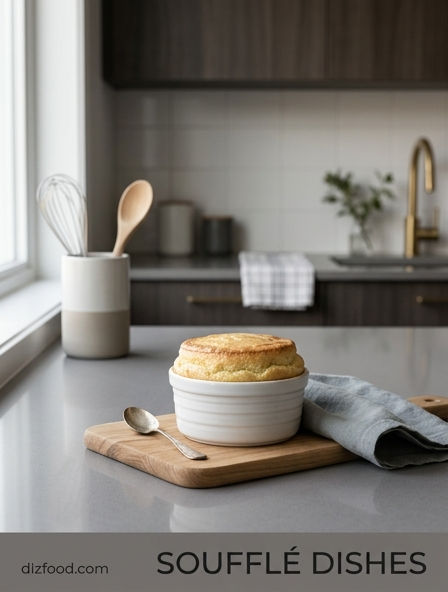
Straight Sides for Vertical Expansion
The architectural hallmark of a traditional soufflé dish is its perfectly vertical sidewalls. Unlike flared bowls or tapered ramekins, the 90-degree angle of a soufflé dish is engineered to facilitate an unobstructed vertical ascent. As the air bubbles trapped within the egg-white matrix expand due to heat, they exert pressure in all directions. Straight sides channel this energy upward, allowing the batter to climb the walls with minimal resistance. If the sides were slanted, the expanding foam would spread outward, losing the structural tension required for a dramatic, towering rise.
Furthermore, these straight walls provide a consistent guide for the delicate emulsion. When the batter is poured into a cylindrical vessel, the surface area remains constant throughout the entire rising process. This consistency ensures that the internal pressure of the steam and heated air is distributed evenly against the container. Professional chefs often emphasize that the height of the soufflé is directly proportional to the integrity of these vertical planes, which act as a launchpad for the aerated mixture as it transitions from a liquid state to a solidified foam.
Heat Distribution in Large Ramekins
The thermal properties of a soufflé dish are critical for a successful bake. Large ramekins made from high-quality ceramic or porcelain are designed to absorb and radiate heat slowly and evenly. This gradual heat transfer is essential because a sudden spike in temperature can cause the exterior of the soufflé to set before the center has had sufficient time to expand. By using materials with high thermal mass, the dish ensures that the batter is heated from the bottom and sides simultaneously.
| Material | Heat Retention | Expansion Support |
|---|---|---|
| Ceramic | High | Excellent |
| Glass | Medium | Fair |
| Metal | Low | Poor |
Because the ceramic walls hold heat so effectively, they continue to cook the edges of the batter even after the oven door is briefly opened. This thermal stability prevents the sudden temperature drops that often lead to the premature collapse of the delicate protein structure. The thickness of the vessel walls acts as a buffer, protecting the sensitive egg proteins from the direct, fluctuating intensity of the oven's heating elements.
Maximizing Air Retention Through Volume
The volume of the soufflé dish must be carefully matched to the amount of batter to maximize air retention. If a dish is too large for the recipe, the batter will sit low in the vessel, and much of the expanding air will escape into the empty space of the oven before the structure can set. Conversely, a dish that is too small will cause the batter to overflow haphazardly. The goal is to fill the dish to a point where the expansion begins just as the batter reaches the rim, utilizing the full volume to trap steam.
When the ratio of batter to volume is optimal, the trapped air bubbles are forced to push against one another, creating a dense but light internal lattice. This density is what provides the soufflé with its characteristic "loft." By choosing a dish with the correct capacity-typically measured in ounces or milliliters-the baker ensures that the thermal expansion of the gases is fully harnessed to lift the weight of the base ingredients, such as chocolate, cheese, or fruit purees, resulting in a light and airy texture.
The Role of Ceramic Porosity
Ceramic is the preferred material for soufflé dishes not only for its heat retention but also for its specific porosity. Most professional soufflé dishes are glazed on the interior to create a smooth surface, yet the underlying ceramic body remains a dense, insulating layer. The interaction between the batter and the ceramic surface is vital for the "climb" of the soufflé. A slightly porous or textured finish, often aided by a coating of sugar or breadcrumbs, allows the batter to find purchase on the walls.
- Thermal Inertia: Prevents rapid cooling during serving.
- Moisture Control: Regulates the humidity at the contact point.
- Structural Support: Offers a stable foundation for the protein matrix.
The porosity of the ceramic also helps in managing the moisture levels at the interface of the dish and the batter. As the soufflé bakes, a small amount of steam is generated at the edges. A quality ceramic vessel manages this moisture, preventing the base from becoming soggy while ensuring the sides do not become excessively dry and brittle. This balance is what allows the soufflé to remain attached to the walls as it rises without becoming permanently stuck.
Surface Tension and Side Wall Grip
The physics of a soufflé rise depends heavily on the friction between the batter and the side walls of the dish. This is why prep work, such as buttering the dish and coating it with sugar or grated cheese, is so important. These coatings provide a microscopic "ladder" for the egg proteins. As the heat causes the batter to expand, the surface tension of the liquid mixture allows it to grip these particles and pull itself upward. Without this grip, the soufflé would likely bulge in the center while the edges remain low.
The straight walls of the dish maximize this surface tension by providing a continuous, vertical path. As the batter rises, the proteins denature and solidify against the lubricated surface. This creates a thin, crusty skin that supports the weight of the interior foam. The relationship between the upward force of the expanding gases and the downward force of gravity is mediated by this side wall grip. A well-prepared dish ensures that the upward force wins, leading to a symmetrical and stable expansion that lasts from the oven to the table.
Ensuring Uniform Heat for Stability
Stability in a soufflé is achieved through uniform heat distribution, a task for which the standard soufflé dish is specifically designed. The circular shape of the dish is not merely aesthetic; it ensures that every point within the batter is roughly the same distance from the heat source (the walls). In a square or rectangular dish, the corners would heat up faster than the sides, leading to uneven expansion and a distorted shape. The round ceramic vessel promotes a centripetal heat flow that cooks the batter evenly from the outside in.
This uniformity is essential for the structural integrity of the egg whites. If one side of the soufflé bakes faster than the other, the protein bonds will set prematurely on one side, causing the soufflé to lean or crack. The heavy base of the soufflé dish also plays a role, providing a steady supply of heat to the bottom of the batter, which is often the heaviest part of the mixture. This bottom-up heating ensures that the entire mass moves as a single unit, maintaining its equilibrium and preventing the dreaded mid-bake collapse.
Diameter Ratios for Optimal Rise
The ratio of a dish's diameter to its height significantly influences the final aesthetic and texture of the soufflé. A wider, shallower dish will produce a soufflé with more surface area on top, which is ideal for savory dishes where a browned, cheesy crust is desired. However, for maximum height, a narrower dish with taller sides is preferred. The smaller diameter concentrates the upward force of the steam, resulting in a more dramatic vertical "pop."
- Small Ramekins (3-4 oz): Best for individual servings and quick heat penetration.
- Standard Dishes (8-10 oz): Ideal for a balance of height and creamy interior.
- Large Dishes (1.5-2 qt): Requires longer bake times and precise temperature control.
When selecting a dish, the baker must consider the "aspect ratio." A dish that is too wide acts more like a gratin dish, where the expansion is spread over a large area, reducing the perceived rise. By contrast, a dish with a high height-to-width ratio forces the batter into a tight column, which is more resistant to external air currents and better at maintaining its structural posture once removed from the heat.
Supporting Egg White Structural Integrity
The primary challenge in soufflé baking is supporting the fragile protein network of the whipped egg whites. As the heat increases, these proteins begin to uncoil and bond with one another, forming a solid wall around the air bubbles. The soufflé dish acts as an external skeleton for this process. By containing the batter within a rigid ceramic boundary, the dish prevents the foam from collapsing under its own weight before the proteins have had a chance to coagulate.
Because the dish is a poor conductor compared to metal, it allows the egg whites to reach their setting temperature (approximately 145°F to 150°F) slowly. This slow transition is vital for structural integrity; it gives the air bubbles time to expand to their maximum volume before the protein "cage" hardens. A dish that heats too quickly would snap the proteins into place while the bubbles are still small, resulting in a dense, rubbery texture rather than the sought-after cloud-like consistency of a masterfully executed soufflé.
Vessel Depth and Airiness Correlation
The depth of a soufflé dish is directly correlated to the airiness of the final product. A deeper vessel allows for a greater volume of batter to be insulated from the direct heat of the oven, creating a temperature gradient from the outer edges to the center. This gradient is what produces the varied textures within a single dish: a firm, cake-like exterior and a soft, almost molten interior. The depth ensures that the core of the soufflé remains protected, allowing the air bubbles there to stay moist and flexible.
In a shallow dish, the heat reaches the center too quickly, often resulting in a uniform, dry texture throughout. For those seeking the classic "soufflé experience," a depth of at least two to three inches is recommended. This vertical space provides enough room for the steam to generate a significant lift. As the steam rises from the bottom of the deep vessel, it passes through the layers of batter above it, further aerating the mixture and contributing to a lighter, more voluminous mouthfeel that defines the dish.
Physics of Uniform Batter Growth
The growth of soufflé batter is a practical application of Charles's Law, which states that the volume of a gas is proportional to its absolute temperature. In the enclosed environment of a soufflé dish, the air trapped during the whisking process expands as the internal temperature rises. The physics of uniform growth requires that this expansion happens symmetrically. The cylindrical geometry of the dish ensures that the pressure exerted by the gas is equalized against the walls, preventing localized blowouts or uneven bursting.
The dish also facilitates the "piston effect." As the batter at the bottom heats up, it pushes the entire mass of batter above it upward. Because the dish has a uniform cross-section from bottom to top, the batter moves as a cohesive unit. This uniform growth is what creates the flat, level top seen in professional soufflés. Without the stabilization provided by the dish's rigid, heat-retaining walls, the internal gases would likely escape through the weakest point of the foam, leading to an asymmetrical rise and a loss of the delicate, aerated structure.

Comments