
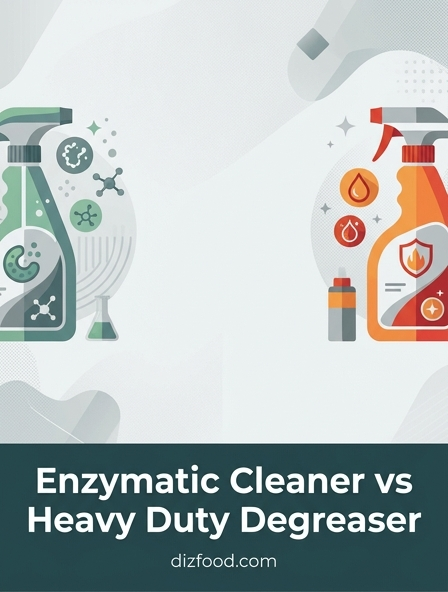
Staring down a crusty stovetop or a grimy range hood often leaves you wondering whether to reach for a "green" biological solution or a high-powered chemical striker. When comparing an enzymatic cleaner versus a heavy-duty degreaser, the winner depends entirely on the molecular makeup of your mess. Enzymatic cleaners utilize specialized proteins to physically "eat" organic soils like proteins and starches, making them the ultimate long-term solution for porous surfaces and hidden odors. In contrast, heavy-duty degreasers use high-alkaline surfactants to instantly emulsify and shatter the bonds of polymerized oils and heat-set carbon. While enzymes offer a safer, eco-friendly approach for daily organic buildup, the chemical degreaser remains the undisputed king of fast-acting, industrial-strength kitchen reclamation.
| Feature | Enzymatic Cleaner | Heavy-Duty Degreaser |
|---|---|---|
| Action Mechanism | Biological "digestion" of organic matter | Chemical emulsification of lipids/oils |
| Best Use Case | Food scraps, starches, and drain maintenance | Burnt-on grease, motor oil, and vent hoods |
| Dwell Time | Long (15-60 mins or leave-on) | Short (1-5 mins for fast reaction) |
| Safety Profile | Non-toxic, biodegradable, pH neutral | Corrosive; requires gloves/ventilation |
| Surface Care | Safe for stone, grout, and fabrics | Can etch aluminum or damage paint |
| Odor Control | Eliminates source of smells (bacteria) | Masks smells with heavy fragrances |
Understanding Enzymatic Cleaners and Degreasers
In the demanding environment of a commercial or high-traffic home kitchen, maintaining hygiene requires a sophisticated understanding of chemical interactions. Two primary categories of cleaning agents dominate the landscape: enzymatic cleaners and heavy-duty degreasers. While both are designed to eliminate grime, their chemical compositions and methods of action are fundamentally different. Enzymatic cleaners are biological formulations that utilize specific proteins to catalyze the breakdown of organic waste. These are often viewed as the "gentle but persistent" option, working over time to consume residues like proteins, starches, and fats.
On the opposite end of the spectrum, heavy-duty degreasers are typically formulated with high-alkaline chemicals, solvents, and powerful surfactants. These are engineered for immediate impact, designed to strip away polymerized oils and carbonized grease that accumulate on high-heat surfaces. Understanding which tool to use depends heavily on the nature of the soil and the substrate being cleaned. To better differentiate their roles, consider the following primary characteristics:
- Composition: Enzymes are biological catalysts; degreasers are chemical solvents or alkalines.
- Reaction Speed: Degreasers work on contact; enzymes require "dwell time" to be effective.
- Target Soils: Enzymes excel at hidden organic matter; degreasers excel at visible, baked-on grease.
- Post-Application: Enzymes often leave a residual cleaning effect; degreasers must be rinsed thoroughly to prevent surface damage.
Choosing between these two is not merely a matter of preference but a strategic decision based on the kitchen's operational needs. Whether dealing with a clogged floor drain or a blackened charbroiler, the selection of the right agent ensures both efficiency and the longevity of kitchen equipment.
How Enzymes Break Down Organic Matter
Enzymatic cleaners operate through a biochemical process known as catalysis. Unlike traditional detergents that simply lift dirt from a surface, enzymes act as microscopic "scissors" that physically chop complex organic molecules into smaller, more manageable pieces. In a kitchen setting, the most common enzymes used are proteases, amylases, and lipases. Each is specialized for a specific type of waste: proteases target protein-based stains like meat juices or egg residues; amylases break down carbohydrates and starches such as pasta or flour; and lipases focus on fats and oils.
The process begins when the enzyme molecule binds to its specific target, known as a substrate. This "lock and key" mechanism ensures that the enzyme is highly effective at its designated task without being overly aggressive toward the surface material itself. Once the enzyme breaks the chemical bonds of the organic matter, the residue becomes water-soluble. This allows the waste to be easily rinsed away or even consumed by beneficial bacteria if the cleaner is a bio-enzymatic blend. This microscopic degradation is particularly useful in porous areas where traditional chemicals cannot reach.
Because this is a biological process, it is not instantaneous. For enzymes to work effectively in a kitchen, they must remain moist and be given adequate time to "digest" the material. This is why enzyme-based floor cleaners or drain treatments are often applied at the end of a shift, allowing them to work overnight. When used correctly, they provide a level of deep cleaning that chemical degreasers, which only affect the surface, cannot replicate.
The Chemical Power of Heavy Duty Degreasers
Heavy-duty degreasers represent the "brute force" of the kitchen cleaning world. These formulations are designed to tackle the most stubborn, polymerized, and carbonized greases that result from high-heat cooking. The chemical power of a degreaser typically stems from three main components: alkaline builders, solvents, and surfactants. Alkaline builders, such as sodium hydroxide or potassium hydroxide, raise the pH of the solution, which helps to saponify fats-essentially turning grease into a soap-like substance that can be dissolved in water.
Solvents within the degreaser play a critical role by penetrating the dense layers of baked-on oil, breaking the molecular cohesion that allows grease to stick to stainless steel or cast iron. Meanwhile, surfactants reduce the surface tension of the water, allowing the cleaning solution to spread evenly and lift the loosened particles away from the substrate. This multi-pronged attack makes heavy-duty degreasers indispensable for cleaning equipment like deep fryers, oven interiors, and exhaust hoods where grease has been "cooked" onto the surface.
Unlike enzymatic cleaners, which are often pH-neutral and biological, heavy-duty degreasers are chemically aggressive. They are engineered for rapid action, providing near-instant results when applied to a warm surface. However, this power comes with the need for careful handling. The high alkalinity that makes them so effective against grease can also make them corrosive to certain metals and hazardous to human skin and respiratory systems. In the fast-paced environment of a commercial kitchen, the immediate efficacy of a degreaser is its greatest asset, allowing for quick turnarounds during cleaning cycles.
Key Differences in Cleaning Mechanisms
The fundamental difference between enzymatic cleaners and heavy-duty degreasers lies in how they interact with the soil. An enzymatic cleaner is a biological worker that consumes waste, whereas a degreaser is a chemical stripper that displaces waste. This distinction leads to significant variations in application methods, safety protocols, and results. While a degreaser might be the first choice for a visible spill on a stovetop, an enzyme cleaner is often the better choice for the microscopic film left behind in grout lines.
The following table outlines the primary differences in their operational mechanisms to help kitchen staff make informed decisions during their cleaning routines:
| Feature | Enzymatic Cleaners | Heavy Duty Degreasers |
|---|---|---|
| Action Type | Biological digestion (breaking bonds) | Chemical emulsification and lifting |
| Speed | Slow (minutes to hours) | Fast (seconds to minutes) |
| pH Level | Typically Neutral (7.0 - 9.0) | High Alkaline (11.0 - 14.0) |
| Dwell Time | Required for maximum efficacy | Minimal; often requires scrubbing |
| Residual Effect | Continues cleaning after application | None; must be rinsed away |
Furthermore, temperature sensitivity varies greatly between the two. Enzymes are delicate; if the water is too hot, the proteins may denature and lose effectiveness. Conversely, many heavy-duty degreasers actually perform better when applied to surfaces that are slightly warm, as the heat helps to soften the grease, allowing the solvents to penetrate more deeply. This makes degreasers the preferred choice for hot equipment like grills, while enzymes are better suited for ambient temperature areas like floors and sinks.
When to Choose an Enzyme Based Solution
Enzyme-based solutions are most effective when the cleaning goal involves the removal of organic biofilms, odors, or deeply embedded waste in porous surfaces. In a kitchen, certain areas are prone to "invisible" buildup that traditional chemicals struggle to address. For instance, floor grout and the undersides of equipment often harbor a mixture of fats and proteins that can lead to foul odors and pest attractions. Because enzymes migrate into small crevices and continue to work as long as moisture is present, they provide a more thorough "deep" clean in these specific scenarios.
Choosing an enzymatic cleaner is particularly advantageous in the following situations:
- Drain Maintenance: Enzymes break down the fats, oils, and grease (FOG) that cause slow drains and clogs without damaging PVC or metal pipes.
- Odors from Organic Decay: They neutralize odors at the source by breaking down the sulfur-producing bacteria found in floor drains and trash receptacles.
- Floor Porosity: Kitchen tiles and grout lines trap grease; enzymes penetrate these pores to lift out embedded soils that mopping leaves behind.
- Eco-Conscious Requirements: When a facility must minimize its chemical footprint or adhere to strict "green" cleaning protocols.
Another critical time to choose enzymes is when dealing with biological "sludge" in soda fountain trays or ice machine drains. These areas often develop a sugar-based biofilm that is resistant to standard sanitizers but easily dismantled by amylase-heavy enzymatic formulas. By incorporating these biological agents into a weekly maintenance schedule, kitchen managers can prevent the buildup of materials that eventually lead to mechanical failures or health code violations.
Best Applications for Industrial Degreasers
Industrial degreasers are designed for the "war zones" of the kitchen-areas where heat and oil combine to create thick, stubborn residues. These products are essential for maintaining equipment that handles high volumes of animal fats or vegetable oils. Because of their high pH and solvent content, they are the only tools capable of breaking the chemical bonds of carbonized grease, which is essentially grease that has been "baked" into a solid, plastic-like state on a surface.
The most effective applications for these powerful chemicals include:
- Exhaust Hoods and Filters: These areas collect airborne grease that thickens over time. A heavy-duty degreaser is required to liquify this buildup for removal.
- Deep Fryer Exteriors: Spilled oil around fryers oxidizes and becomes extremely sticky; degreasers emulsify this layer rapidly.
- Ovens and Rotisseries: The high-heat environment carbonizes food drippings, requiring the high-alkaline power of a degreaser to strip the residue.
- Grills and Griddles: Daily maintenance of cooking surfaces often requires a fast-acting degreaser to ensure no flavor transfer or uneven heating occurs.
It is important to note that industrial degreasers are restorative tools as much as they are maintenance tools. When a piece of equipment has been neglected, an enzymatic cleaner will likely fail to penetrate the outer "crust" of the soil. In these cases, the chemical intensity of a degreaser is necessary to strip the surface back to the bare metal. Once the heavy buildup is removed, a regular cleaning schedule can be maintained, but for the initial "heavy lift," the industrial degreaser remains the industry standard.
Safety Profiles and Environmental Impact
The safety profiles of enzymatic cleaners and heavy-duty degreasers represent two very different levels of risk management. Enzymatic cleaners are generally considered much safer for both the user and the environment. Most are pH-neutral, non-toxic, and non-corrosive, meaning they do not require specialized Personal Protective Equipment (PPE) like respirators or heavy chemical-resistant gloves. Environmentally, enzymes are biodegradable and do not introduce harsh phosphates or volatile organic compounds (VOCs) into the water system, making them the preferred choice for facilities prioritizing sustainability.
In contrast, heavy-duty degreasers demand strict safety protocols. Their high alkalinity can cause severe chemical burns to the skin and permanent damage to the eyes upon contact. Furthermore, the solvents used in many industrial degreasers can release fumes that irritate the respiratory tract, necessitating well-ventilated spaces during application. From an environmental perspective, the runoff from these chemicals must be handled carefully. High-pH discharge can disrupt the balance of local wastewater treatment systems, and some older degreaser formulas contain surfactants that are toxic to aquatic life.
Modern chemical engineering has led to the development of "greener" degreasers that use citrus-based solvents (like d-Limonene) to reduce toxicity, but they still typically carry a higher hazard profile than enzymes. Kitchen managers must ensure that Safety Data Sheets (SDS) are readily available for all degreasers and that staff are trained in "neutralizing" these chemicals during the rinsing process. While enzymes offer a "set it and forget it" safety profile, degreasers require active monitoring and careful disposal to mitigate their environmental footprint.
Surface Compatibility and Material Care
A critical factor in choosing between these two cleaners is the material of the surface being cleaned. Kitchens are comprised of various materials, including stainless steel, aluminum, brass, plastic, and natural stone, each reacting differently to chemical stress. Heavy-duty degreasers, particularly those with high concentrations of sodium hydroxide, can be devastating to "soft" metals. Aluminum, for instance, will oxidize and turn black or become pitted if exposed to high-alkaline degreasers for even a short period. This can ruin expensive baking sheets, mixer components, and some types of ventilation filters.
Enzymatic cleaners offer a much broader range of compatibility. Because they are typically pH-neutral, they are safe to use on almost any surface that can withstand water. This makes them ideal for:
- Natural Stone: Enzymes won't etch marble or granite countertops like acidic or highly alkaline cleaners might.
- Plastic and Rubber: Degreasers can sometimes dry out or crack rubber gaskets and plastic housings; enzymes are generally inert toward these materials.
- Painted Surfaces: High-solvent degreasers can act as paint strippers, whereas enzymes will only target the organic soil on top of the paint.
However, users must be cautious with stainless steel when using degreasers. While stainless is highly resistant to corrosion, leaving a high-alkaline degreaser to dry on the surface can cause "white rust" or streaking that is difficult to polish out. Always verify the manufacturer's recommendations for high-end kitchen appliances. Generally, if the surface is delicate or decorative, an enzymatic cleaner is the safer bet; if the surface is rugged industrial steel and covered in burnt grease, the degreaser is the appropriate, albeit more aggressive, choice.
Efficacy on Grease versus Biological Stains
The "efficacy" of a cleaner is entirely dependent on the type of stain it is fighting. In a kitchen, stains are generally categorized into lipid-based (fats and oils) and biological/protein-based (blood, starches, and sugary syrups). Heavy-duty degreasers are the undisputed kings of lipid-based stains. They are designed to break the hydrophobic nature of oil, allowing it to mix with water and be wiped away. This is why they are so effective on the "yellow film" found on walls near fryers or the thick black sludge on grill grates.
Enzymatic cleaners, however, often outperform degreasers when dealing with complex biological stains and "invisible" biofilms. For example, a degreaser might clean the surface of a floor, but it often pushes some of the organic matter deeper into the grout. Over time, this trapped matter rots, leading to smells and bacteria growth. Enzymes do not just move the stain; they break it down until it no longer exists as an organic compound. This makes them significantly more effective for:
- Dried Milk or Egg Residue: These proteins can become very hard; proteases in enzyme cleaners "digest" them more effectively than surfactants alone.
- Starch Buildup: Flour and pasta water create a sticky film that can be resistant to standard degreasers but is easily handled by amylase.
- Blood and Meat Juices: Enzymes provide a level of biological cleaning that helps prepare a surface for final sanitization.
Ultimately, the most effective kitchen sanitation programs use both. A degreaser is used to remove the bulk of the heavy grease, and an enzymatic cleaner is used as a secondary step or a specialized treatment to ensure that no biological "food" is left behind for bacteria to thrive on.
Selecting the Right Product for Your Needs
Selecting the right product requires a balance of speed, safety, and the specific cleaning challenge at hand. A "one-size-fits-all" approach usually leads to either wasted money or damaged equipment. To choose correctly, first assess the age and state of the soil. If you are performing a nightly wipe-down of a vent hood that sees heavy frying, a degreaser is the only tool that will keep up with the volume of oil. However, if you are noticing a persistent "sour" smell coming from your floor drains despite regular mopping, an enzymatic drain maintainer is the correct solution.
Consider the following decision-making framework for your kitchen:
- Daily Surface Maintenance: For tabletops and light-duty prep areas, a mild enzymatic cleaner or a multi-surface cleaner is usually sufficient and safer for staff.
- Heavy Equipment Cleaning: For fryers, ovens, and hoods, keep a high-quality industrial degreaser on hand, but ensure staff are trained in PPE use.
- Deep Tissue Cleaning: For floors and porous surfaces, use an enzymatic "no-rinse" floor cleaner to allow the enzymes to penetrate grout overnight.
- Environmental and Regulatory Goals: If your kitchen is located in a district with strict grease-trap regulations, using enzymes in your sinks can help reduce the amount of solid waste reaching the trap, potentially lowering pumping costs.
In conclusion, the most efficient kitchens utilize a tiered approach. Use heavy-duty degreasers as your "stripping agents" for the hardest jobs where speed and chemical power are non-negotiable. Use enzymatic cleaners as your "preventative maintenance" tools to handle organic buildup, odors, and deep-seated grime that chemicals simply cannot touch. By matching the cleaning agent to the specific molecular makeup of the soil, you ensure a cleaner, safer, and more durable kitchen environment.




Comments